Service-Based Interfaces in 5G Explained
The Service-Based Interfaces (SBIs) in 5G are the interfaces used by 5G Core (5GC) network functions to expose and consume services in the Service-Based Architecture (SBA). Instead of relying only on fixed point-to-point interfaces, the 5GC is designed so that authorized network functions can discover each other and communicate using common service principles.
In practical terms, service-based interfaces are what allow functions such as AMF, SMF, PCF, UDM, AUSF, NSSF, NRF, NEF, and AF to interact in a more flexible, cloud-friendly, and modular way than earlier EPC designs.
Quick facts
| What they are | Service-Based Interfaces are the API-style interfaces used by 5GC network functions to expose and consume services inside SBA. |
|---|---|
| Common technology | The 5GC SBA realization uses HTTP/2-based service communication with standardized service behavior across 29.5xx specifications. |
| Discovery anchor | NRF supports NF registration, service discovery, and NF profile handling. |
| Main interface families | Namf, Nsmf, Npcf, Nudm, Nausf, Nnssf, Nnrf, and Nnef are the easiest SBI families to learn first. |
| Why engineers care | SBIs explain how the 5G Core becomes modular, cloud-friendly, discoverable, and more dynamic than LTE EPC. |
| Specification baseline | 3GPP TS 23.501, TS 29.500, TS 29.510, and the wider 29.5xx service family. |
Why service-based interfaces matter
Service-based interfaces are one of the biggest reasons the 5G Core feels fundamentally different from LTE EPC. Instead of thinking only in terms of tightly bound core nodes on specialized links, the 5GC also works as a set of service producers and consumers.
That matters operationally because it changes how functions are discovered, scaled, versioned, upgraded, and debugged. It also explains why 5GC discussions so often sound closer to cloud platforms than older telecom core networks.
Where service-based interfaces fit in 5G architecture
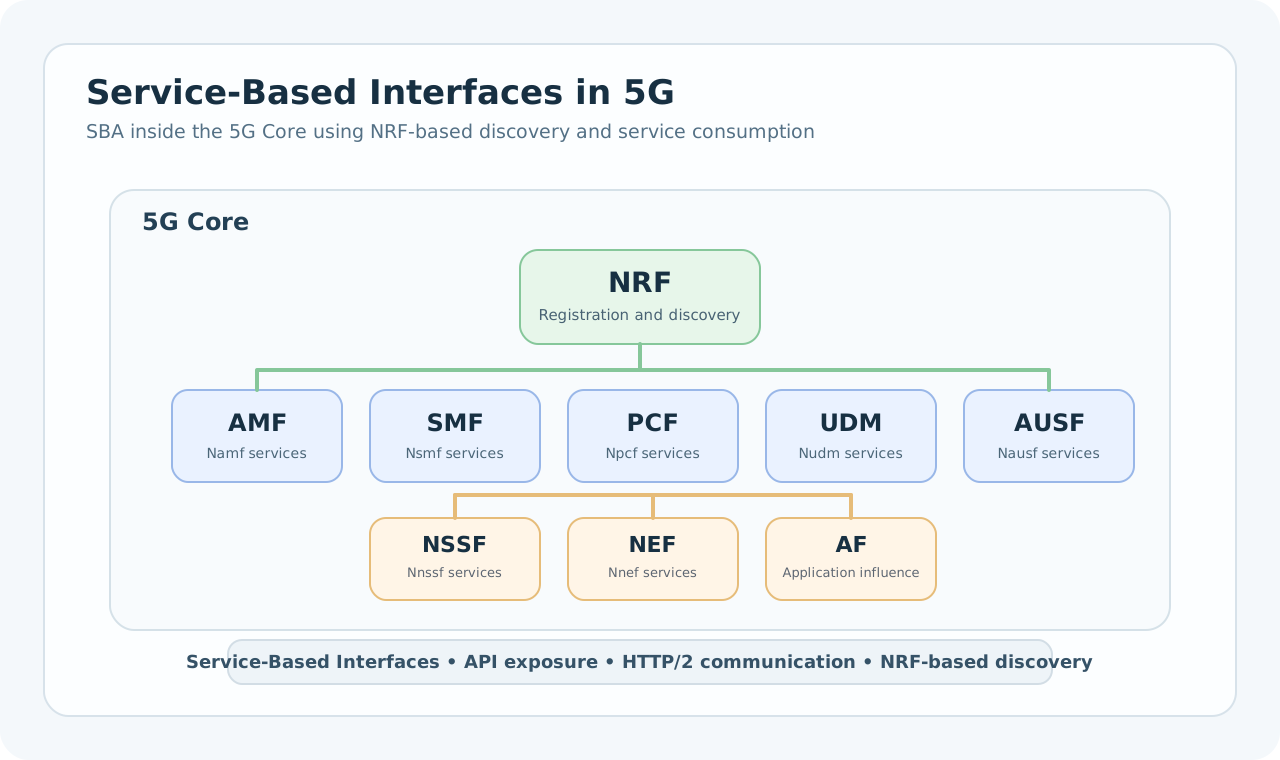
What are service-based interfaces?
A service-based interface is an interface where one network function offers a defined service and another network function consumes it. In 5G SBA, network functions are treated as service producers and service consumers rather than only fixed nodes on rigid interfaces.
The key mental shift is this: instead of thinking only in terms of node A connected to node B over a dedicated point-to-point interface, the 5GC also works in terms of network function A exposing a service and network function B discovering and consuming that service.
Why 5G uses service-based interfaces
- Modularity so functions can evolve more independently.
- Reusability so multiple consumers can use the same service family.
- Flexibility in how functions are deployed, discovered, and scaled.
- Scalability so individual control functions can scale on their own demand curve.
- Cloud-native deployment so the core aligns more naturally with modern infrastructure patterns.
In practical operator terms, this means the 5GC can introduce, expand, or replace functions with less architectural friction than earlier EPC systems.
Technical realization of 5G SBA
The technical realization of the 5GC Service-Based Architecture is specified in TS 29.500. That matters because SBI is not just a high-level diagram concept. It is a standardized stage-3 realization model that defines how services are exposed and consumed across the 5GC.
In other words, SBA is both an architecture principle in the 23-series and a concrete service realization model in the 29.5xx family.
Common technology used on service-based interfaces
In the 5GC SBA model, service-based interfaces are realized using common web-style API principles. HTTP/2-based service communication is part of the standardized technical realization.
This is one of the clearest reasons the 5G Core is often described as more cloud-native than LTE EPC.
NRF and service discovery
The NRF is central to service-based interfaces because it supports network function registration, service discovery, and NF profile handling.
Without the NRF, service-based communication would be much less dynamic. With the NRF, network functions can register their services, discover available service producers, and select suitable peers more flexibly.
Open the NRF deep dive for the service-registry view.
Main service-based interfaces in 5GC
| Service-based interface | Exposed by | Main purpose |
|---|---|---|
| Namf | AMF | Access and mobility related services. |
| Nsmf | SMF | Session-management related services. |
| Npcf | PCF | Policy-control related services. |
| Nudm | UDM | Subscriber and data-management related services. |
| Nausf | AUSF | Authentication related services. |
| Nnssf | NSSF | Slice-selection related services. |
| Nnrf | NRF | NF registration and discovery. |
| Nnef | NEF | Exposure and API mediation services. |
This is the practical shortlist most engineers need first when learning how service-based communication works inside the 5GC.
Important service-based interface families
Namf
Access, mobility, reachability, and AMF-centered control services.
Nsmf
PDU session lifecycle, session-control logic, and SMF service exposure.
Npcf
Policy-control services for QoS, charging-related rules, and policy decisions.
Nudm
Subscriber, profile, and data services used by multiple 5GC functions.
Nausf
Authentication services and security-related access control behavior.
Nnssf
Slice-selection support and slice-aware control behavior.
Nnrf
Registration, discovery, and NF profile handling at the heart of SBA.
Nnef / AF Context
Exposure-facing interaction where external applications influence or consume controlled network capabilities.
Service-based interfaces vs reference-point interfaces
One of the biggest sources of confusion in 5G is the difference between reference-point interfaces such as N1, N2, N3, N4, and N6 and service-based interfaces such as Namf, Nsmf, Npcf, and Nnrf.
| Type | Examples | Main purpose |
|---|---|---|
| Reference-point interfaces | N1, N2, N3, N4, N6 | Architectural paths between functions or domains. |
| Service-based interfaces | Namf, Nsmf, Npcf, Nnrf | API-style service exposure and consumption in SBA. |
A simple rule of thumb helps: N2 tells you that NG-RAN talks to the AMF on the control plane, while Namf tells you how AMF services are exposed and consumed inside the SBA model.
Service-based interfaces vs LTE EPC
| Feature | LTE EPC | 5G Core SBA |
|---|---|---|
| Core communication style | Mostly fixed point-to-point interfaces | Service-based APIs plus reference points |
| Discovery model | More static | Dynamic and NRF-based |
| Modularity | Lower | Higher |
| Cloud-native friendliness | Lower | Higher |
This comparison is one of the cleanest ways to explain why the 5G Core is seen as more modular and cloud-ready than EPC.
Why service-based interfaces matter for cloud-native 5G
- Independent scaling of major network functions.
- More modular deployment patterns across private and public 5G cores.
- Cloud-native service composition and automation.
- Easier evolution of individual core functions.
- API-driven integration and exposure models.
That is why SBI and SBA show up constantly in discussions about private 5G, operator automation, network exposure, and cloud-native core design.
Common troubleshooting angles for service-based interfaces
| Symptom | What to inspect |
|---|---|
| NF discovery fails | Check NRF registration, NF profile correctness, discovery policy, and producer availability. |
| Service calls time out | Check HTTP/2 path health, inter-service latency, retries, and API compatibility. |
| Policy or subscriber lookup looks stale | Check whether the consumer is reaching the correct producer instance and whether profiles or data views are out of sync. |
| Slice-aware behavior is inconsistent | Check slice-aware discovery, NSSF-related service use, and whether the right NF instance is being selected. |
| External exposure behaves oddly | Check NEF-facing mediation, authorization, and whether the exposed service path matches the internal SBA path. |
FAQ
What are service-based interfaces in 5G?
Service-based interfaces are the interfaces used by 5GC network functions to expose and consume services inside the Service-Based Architecture.
What is the difference between SBI and N-interfaces in 5G?
SBI refers to API-style service communication between 5GC functions, while N-interfaces like N1, N2, N3, and N4 are architectural reference points between functions or domains.
Does 5G use HTTP/2 for service-based interfaces?
Yes. The 5GC SBA technical realization uses HTTP/2-based service communication as part of the service-based interface model.
What is the role of NRF in service-based interfaces?
The NRF supports NF registration, service discovery, and NF profile handling, making it central to SBA communication.
Why are service-based interfaces important in 5G?
Because they make the 5G Core more modular, scalable, cloud-friendly, and dynamic than earlier EPC designs.
Key takeaways
- The 5G Core is built on a Service-Based Architecture in which authorized network functions expose and consume services.
- The technical realization of 5GC service-based interfaces is defined in TS 29.500.
- The NRF is central to SBA because it enables NF registration and service discovery.
- Major 5GC functions such as AMF, SMF, PCF, UDM, AUSF, and NSSF participate in the SBI model.
- Understanding service-based interfaces is essential for analyzing SBA, cloud-native 5GC design, NF discovery, policy control, network exposure, and internal 5GC service communication.
References
- 3GPP TS 29.500 - 5G System; Technical realization of Service Based Architecture Primary stage-3 reference for the technical realization of the 5GC Service-Based Architecture and the protocols supported on service-based interfaces.
- 3GPP TS 23.501 - System architecture for the 5G System (5GS) Primary architecture reference for the 5GC SBA model, network functions, and service-based communication principles.
- 3GPP TS 29.510 - 5G System; Network Repository Services Stage-3 reference for NRF services, NF registration, service discovery, and NF profile handling.
- 3GPP TS 29.502 - 5G System; SMF Services Example stage-3 service reference showing how major 5GC functions expose standardized SBA services.