AF in 5G Explained
The AF (Application Function) is a logical function in the 5G Core ecosystem that allows applications and service platforms to influence network behavior, especially around QoS, routing, and policy control.
In practical terms, AF is where application intent enters the network-control side. That intent is not usually enforced directly by AF itself. Instead, AF influences functions such as PCF, which then shape how SMF and UPF treat the session and data path.
Quick facts
| Full name | Application Function. |
|---|---|
| Main role | Represents application or service intent so the network can adapt policy, QoS treatment, or routing behavior. |
| Works with | Most directly with PCF over N5, and in some exposure models through NEF for controlled access to network capabilities. |
| Closest idea | It is the application-awareness branch of the 5GC, not a packet-forwarding or core-access node. |
| Why it matters | AF is what allows services such as gaming, streaming, MEC, and enterprise apps to influence how the network treats their traffic. |
| Common outcomes | QoS adjustments, route influence, edge breakout preference, and service-specific policy handling. |
AF in the 5G architecture
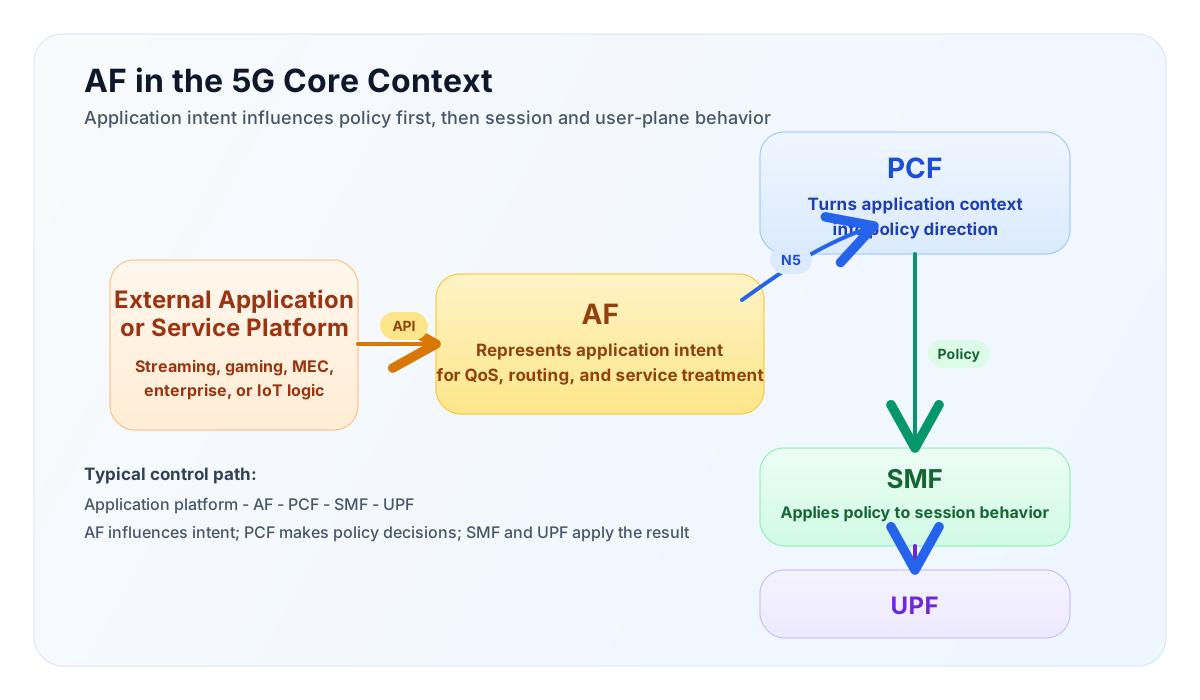
The AF is usually best thought of as logically outside or at the edge of the 5GC rather than as a classic core node like AMF or SMF. Its value is that it lets the network react to what the application actually needs.
What does the AF do?
A simple way to think about AF is this: the AF is the application-awareness function that tells the network what kind of service treatment would best match the application experience.
- Provides application requirements to the network.
- Influences QoS policy decisions.
- Can request or suggest traffic-routing changes.
- Supports service-specific optimization.
- Works with policy or exposure functions rather than enforcing packet treatment itself.
AF and QoS control
One of the main jobs of AF is to express service intent in a way the network can use. That may include asking for lower latency, more stable bandwidth treatment, or service handling that better fits a specific application flow.
- A streaming service may care about sustained throughput.
- A gaming service may care more about latency and jitter.
- An enterprise app may care about predictable route handling or service isolation.
AF does not “grant” QoS by itself. It provides the application context that helps the policy side decide what should happen.
AF and PCF interaction
The most important AF relationship is usually with the PCF. Over the N5 reference point, AF can provide application context that influences policy decisions.
| Side | Main role |
|---|---|
| AF | Represents what the application or service wants from the network. |
| PCF | Turns that context into policy direction that other 5GC functions can apply. |
This is one of the clearest examples of 5G’s more flexible architecture: the network is no longer only subscriber-aware, it can also be more application-aware.
AF and NEF interaction
AF may also interact with the NEF (Network Exposure Function), especially when network capabilities need to be exposed in a controlled and secure way to external or third-party application systems.
- NEF provides controlled exposure of network capabilities.
- AF can use that exposure model for API-driven service influence.
- This becomes especially relevant for third-party and enterprise-integrated application ecosystems.
In other words, AF is part of the application side of the story, while NEF is often part of the controlled exposure path into the 5GC.
AF and SMF / UPF
AF does not usually control the SMF or UPF directly. The normal architecture path is indirect:
- AF provides application context.
- PCF translates that context into policy direction.
- SMF applies the relevant session-side policy behavior.
- UPF becomes one of the places where the actual traffic treatment shows up.
This separation matters because it keeps the architecture modular. AF expresses intent, while session and forwarding functions remain responsible for actual enforcement.
AF and traffic steering
AF can also influence traffic steering. That does not mean it is a routing protocol. It means it can provide the application context that helps the network choose a more suitable path.
- Traffic may be steered toward an edge UPF for lower latency.
- Specific service flows may prefer local breakout.
- Enterprise services may need policy-aware steering toward dedicated service domains.
AF and edge computing (MEC)
AF is particularly important for MEC and other low-latency service models. Edge applications are one of the clearest cases where the network benefits from knowing more about the application’s intent.
- AR and VR benefit from low-latency edge breakout.
- Industrial or enterprise applications may prefer localized service anchoring.
- Interactive services benefit when policy and routing align with edge deployment.
AF and network slicing
AF can also matter in network slicing scenarios. A service may need treatment that aligns better with one slice profile than another, even if the actual slice-selection logic is handled elsewhere in the 5GC.
So while AF is not the slice-selection function, it can still provide service intent that becomes important in slice-aware policy handling.
AF in Service-Based Architecture
AF fits naturally into the service-based 5G model. Instead of treating the network as a closed transport box, the 5GC can consume richer service context through structured interfaces and APIs.
- Supports dynamic service control.
- Fits better with modern cloud and edge platforms.
- Makes application-aware networking more realistic than in older architectures.
AF vs traditional networks
| Aspect | Older mobile-core model | 5G with AF |
|---|---|---|
| Application awareness | More limited and less native to the architecture. | More explicit and service-integrated. |
| QoS influence | Mostly network-side and subscriber-side driven. | Can be informed by application context too. |
| Edge support | Less naturally integrated. | Far better aligned with MEC and low-latency service paths. |
Common AF use cases
- Video streaming optimization.
- Online gaming and interactive services.
- Enterprise and private-network applications.
- IoT services that need service-specific behavior.
- AR, VR, and low-latency edge services.
Common AF issues
- QoS requests that do not align with actual policy outcomes.
- Policy conflicts between application intent and subscriber or operator policy.
- NEF-side exposure failures in external integration models.
- Incorrect routing or steering decisions for low-latency services.
- Mismatch between application expectations and actual edge deployment behavior.
FAQ
What is AF in 5G?
It is the Application Function that represents application or service requirements to the 5G network.
Does AF control the network directly?
No. It influences policy through core functions such as PCF rather than enforcing traffic treatment by itself.
What is the N5 interface?
It is the reference point between AF and PCF, used so application context can influence policy decisions.
Why is AF important?
Because it enables application-aware networking for QoS-sensitive, low-latency, and edge-oriented services.
Key takeaways
- AF represents application or service requirements inside the wider 5GC control model.
- It mainly influences QoS, policy, routing, and service treatment rather than directly forwarding traffic.
- PCF is the key companion function because AF intent usually reaches the network through policy control.
- AF is especially important for MEC, low-latency services, and application-aware networking.
- Understanding AF helps explain how 5G becomes more service-aware than older mobile-core architectures.
References
- 3GPP TS 23.501 - System architecture for the 5G System Primary 5GS architecture reference for AF role, PCF interaction, and service-based relationships.
- 3GPP TS 23.503 - Policy and charging control framework for the 5G System Primary policy-control reference for application influence, AF interaction, and QoS-related policy behavior.
- 3GPP TS 23.548 - 5G System Enhancements for Edge Computing Useful reference for MEC-related 5GS architecture and application-aware traffic steering context.