5G Interfaces Explained
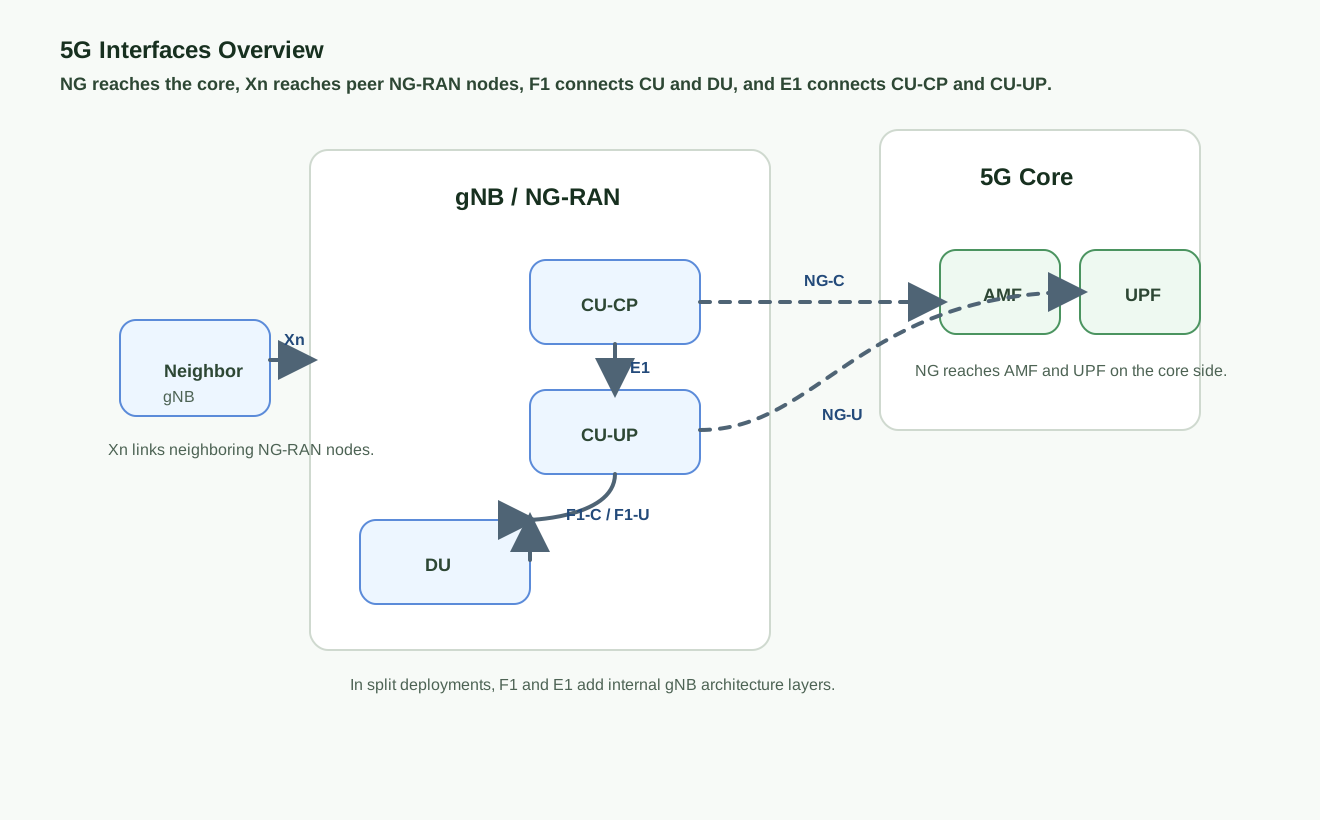
The main 5G interfaces define how the NG-RAN connects to the 5G Core (5GC) and how NG-RAN nodes and split-gNB components communicate with each other. In the overall NG-RAN architecture, the key interfaces are NG, Xn, and F1, while split-CU architectures also use E1.
In the wider 5G system, the most important reference points toward the core include N1, N2, N3, N4, and N6. That is why the best way to read a 5G interfaces page is as one combined system view: RAN interfaces, split-gNB interfaces, and 5GC reference points.
Quick facts
| Main RAN interfaces | NG, Xn, F1, and E1. |
|---|---|
| Main 5GC reference points | N1, N2, N3, N4, N6, and N11. |
| SBA-facing interface family | Service-Based Interfaces connect 5GC functions through API-style service exposure and discovery. |
| Access-to-core split | NG-C / N2 reaches the AMF, while NG-U / N3 reaches the UPF. |
| Inter-node RAN split | Xn-C and Xn-U support inter-gNB signaling and forwarding. |
| Split-gNB boundaries | F1 connects CU and DU, while E1 connects CU-CP and CU-UP. |
| Why it matters | The interface map is one of the fastest ways to place registration, PDU session, handover, and split-RAN faults. |
5G interfaces in the architecture
Why 5G interfaces matter
5G interfaces are not just transport links. They define where signaling terminates, where user-plane traffic flows, how mobility is coordinated, how split-RAN deployments work, and how the 5GC separates access-side control from user-plane forwarding.
This is why interface design is one of the clearest ways to understand 5G architecture. If you understand the interfaces, you understand how the system is decomposed across radio access, split-gNB transport, and core network functions.
Overview of main 5G interfaces
| Interface | Connects | Plane | Main role |
|---|---|---|---|
| NG-C / N2 | NG-RAN and AMF | Control plane | Access signaling, NAS transport, paging, and UE context control. |
| NG-U / N3 | NG-RAN and UPF | User plane | User traffic between the RAN and the 5GC. |
| Xn-C | NG-RAN node and NG-RAN node | Control plane | Mobility, context transfer, and inter-node coordination. |
| Xn-U | NG-RAN node and NG-RAN node | User plane | Inter-node user-plane forwarding support. |
| F1-C | gNB-CU and gNB-DU | Control plane | Split-gNB control coordination. |
| F1-U | gNB-CU and gNB-DU | User plane | Split-gNB user-plane transport. |
| E1 | gNB-CU-CP and gNB-CU-UP | Control-plane coordination | CU split control and user separation. |
| N4 | SMF and UPF | Control plane | User-plane programming and session control. |
| SBI | 5GC functions and 5GC functions | Service-based control communication | API-style service exposure, discovery, and consumption inside SBA. |
| N6 | UPF and external data network | User plane | External connectivity and data-network access. |
NG interface
The NG interface is the interface between the NG-RAN and the 5G Core. In practical terms, it is split into NG-C toward the AMF and NG-U toward the UPF.
NG is the main access-to-core interface of 5G. It carries control-plane signaling toward the AMF, transports NAS signaling, forwards user-plane traffic toward the UPF, and supports mobility and session-related handling at the access-to-core boundary.
Open the NG interface deep dive for the full control and user-plane view.
Xn interface
The Xn interface connects NG-RAN nodes to each other. It is the main inter-gNB coordination interface in 5G and is split into Xn-C for signaling and Xn-U for user-plane forwarding support.
Xn supports mobility, context transfer, inter-node coordination, dual-connectivity support, and user-plane forwarding behavior between neighboring NG-RAN nodes.
Open the Xn interface deep dive for the inter-gNB view.
F1 interface
The F1 interface connects the gNB-CU and the gNB-DU in a split-gNB deployment. This is one of the clearest signs that 5G RAN architecture is more decomposed and more deployment-flexible than LTE.
F1 enables the functional split by separating higher-layer or more centralized behavior in the CU from lower-layer and timing-sensitive radio behavior in the DU. In practice, F1-C handles control coordination and F1-U handles user-plane transport inside the split gNB.
Open the F1 interface deep dive for the CU-DU split view.
E1 interface
The E1 interface is used when the central unit is itself split into gNB-CU-CP and gNB-CU-UP. This adds another layer of decomposition inside the gNB by separating central control-plane logic from central user-plane logic.
E1 matters most in scalable and cloud-oriented deployments where control and user processing are deployed independently. It is not an access-to-core interface and not a peer-gNB interface; it is an internal coordination boundary inside the central unit.
Open the E1 interface deep dive for the CU-CP and CU-UP split view.
N1, N2, N3, N4, N6 and N11 in the 5G Core
The wider 5G system uses key reference points defined on the core side. These matter because they show how the interface story continues beyond NG-RAN and into the 5GC control-plane and user-plane architecture.
| Reference point | Main role |
|---|---|
| N1 | UE-to-AMF NAS reference point for 5GC control signaling. |
| N2 | Control-plane reference point between NG-RAN and AMF, practically the 5GS control side of NG. |
| N3 | User-plane reference point between NG-RAN and UPF, practically the 5GS user side of NG. |
| N4 | Control-plane reference point between SMF and UPF for session and forwarding control. |
| N11 | Internal 5GC control-plane reference point between AMF and SMF for access and session coordination. |
| N6 | User-plane reference point between UPF and the data network, including Internet, IMS, or enterprise services. |
Open the N1 interface deep dive for the UE-to-AMF NAS view, open the N2 interface deep dive for the gNB-to-AMF control-plane transport and NGAP view, open the N11 interface deep dive for the AMF-to-SMF internal control relationship, or open the N6 interface deep dive for the UPF-to-data-network service edge.
Service-based interfaces in the 5G Core
Beyond the reference-point model, the 5G Core also uses service-based interfaces inside the Service-Based Architecture. This is where functions such as AMF, SMF, PCF, UDM, AUSF, NSSF, and NRF expose and consume services through a more API-style model.
If N1 through N11 tell you where functions and domains meet, SBI tells you how the internal 5GC service layer actually behaves in a cloud-native design.
Open the service-based interfaces deep dive for the SBA-facing 5GC view.
Control plane and user plane across 5G interfaces
A useful way to understand the whole interface set is by grouping it by plane.
| Plane | Main interfaces |
|---|---|
| Control plane | N1, NG-C / N2, N11, Xn-C, F1-C, E1, N4, and service-based interfaces inside the 5GC. |
| User plane | NG-U / N3, Xn-U, F1-U, and N6. |
5G interfaces and the gNB split
One of the clearest reasons this page matters is that the gNB may be deployed in more than one form. A monolithic gNB mainly uses NG toward the core and Xn toward neighboring NG-RAN nodes. A split gNB additionally uses F1 between CU and DU, and may use E1 if the CU is further split.
This is one of the main architectural reasons 5G RAN is more flexible than LTE RAN. The interface model directly supports decomposition and scalable deployment.
Why this page matters for troubleshooting
- If the issue is between gNB and AMF or UPF, inspect NG / N2 / N3.
- If the issue is between neighboring gNBs, inspect Xn.
- If the issue is inside a split gNB, inspect F1 or E1.
- If the issue is between SMF and UPF, inspect N4.
- If the issue is between the UPF and external services, inspect N6.
Start exploring 5G interfaces
UE to AMF
Use the N1 page for NAS signaling, registration, authentication, and the logical UE-to-core control path.
gNB to AMF
Use the N2 page for NGAP, NAS transport, paging coordination, and core-involved mobility signaling.
gNB to UPF
Use the N3 page for GTP-U, PDU session traffic, QoS-aware user-plane delivery, and post-handover data continuity.
SMF to UPF
Use the N4 page for PFCP, UPF programming, QoS enforcement rules, and user-plane control behavior.
AMF to SMF
Use the N11 page for internal 5GC control coordination between access management and session management.
5GC Service APIs
Use the SBI page for NRF-based discovery, HTTP/2 service communication, and API-style interaction inside SBA.
UPF to Data Network
Use the N6 page for Internet access, IMS reachability, enterprise connectivity, and service-side breakout.
UPF to UPF
Use the N9 page for multi-UPF chaining, distributed user plane, and edge-to-central forwarding paths.
NG-RAN to Core
Use the NG page for the access-to-core control and user-plane split.
Inter-gNB
Use the Xn page for inter-node mobility and coordination.
CU-DU Split
Use the F1 page for F1-C, F1-U, F1AP, and split-gNB transport.
CU-CP to CU-UP
Use the E1 page for E1AP, bearer context, and split-CU coordination.
5G Architecture
Return to the main 5G architecture map if you want the broader UE to 5GC picture.
5G RAN
Read this next for gNB structure, CU/DU split, and access-side function placement.
gNB in 5G
Use this node-level guide to connect NG, Xn, F1, E1, NR-Uu, AMF, and UPF.
5G NR Mobility
Use this mobility guide to connect Xn, NG/N2, measurements, handover, and bearer continuity.
5G CU-DU Split
Use this split-RAN guide for CU, DU, CU-CP, CU-UP, F1, and E1 placement.
5G Core Network
Read this next for AMF, SMF, UPF, policy, and wider 5GC reference points.
FAQ
What are the main interfaces in 5G?
The main 5G interfaces are NG, Xn, F1, and E1 on the NG-RAN side, together with key 5GS reference points such as N1, N2, N3, N4, and N6.
What is the difference between NG and Xn?
NG connects the NG-RAN to the 5G Core, while Xn connects NG-RAN nodes to each other.
What is F1 in 5G?
F1 is the interface between the gNB-CU and the gNB-DU in a split-gNB deployment.
What is E1 in 5G?
E1 is the interface between gNB-CU-CP and gNB-CU-UP when the central unit is split into separate control-plane and user-plane units.
Why are 5G interfaces important?
They define how signaling, user-plane traffic, mobility coordination, service delivery, and split-RAN behavior are distributed across the 5G system.
Key takeaways
- The main 5G interfaces are NG, Xn, F1, and E1, supported by key 5GS reference points such as N1, N2, N3, N4, and N6.
- NG connects NG-RAN to the 5GC, while Xn connects NG-RAN nodes to each other.
- F1 and E1 enable the split-gNB architecture used in modern 5G deployments.
- The interface model reflects the broader 5GS separation of control plane and user plane.
- Understanding these interfaces is essential for analyzing registration, PDU session setup, mobility, QoS delivery, and cloud-RAN deployment models.
References
- 3GPP TS 38.401 - NG-RAN architecture description Primary NG-RAN architecture reference covering NG, Xn, F1, split-gNB roles, and access-side decomposition.
- 3GPP TS 23.501 - System architecture for the 5G System (5GS) 5GS architecture reference for N1, N2, N3, N4, N6, control-plane and user-plane separation, and core reference points.
- 3GPP TS 38.470 - F1 general aspects F1 interface reference for CU-DU split architecture and protocol structure.
- 3GPP TS 38.460 - E1 general aspects E1 interface reference for CU-CP and CU-UP split architecture.