N1 Interface in 5G Explained
The N1 interface in 5G is the logical interface between the UE and the AMF. It carries NAS (Non-Access Stratum) signaling, which is the main control-plane conversation between the device and the 5G Core.
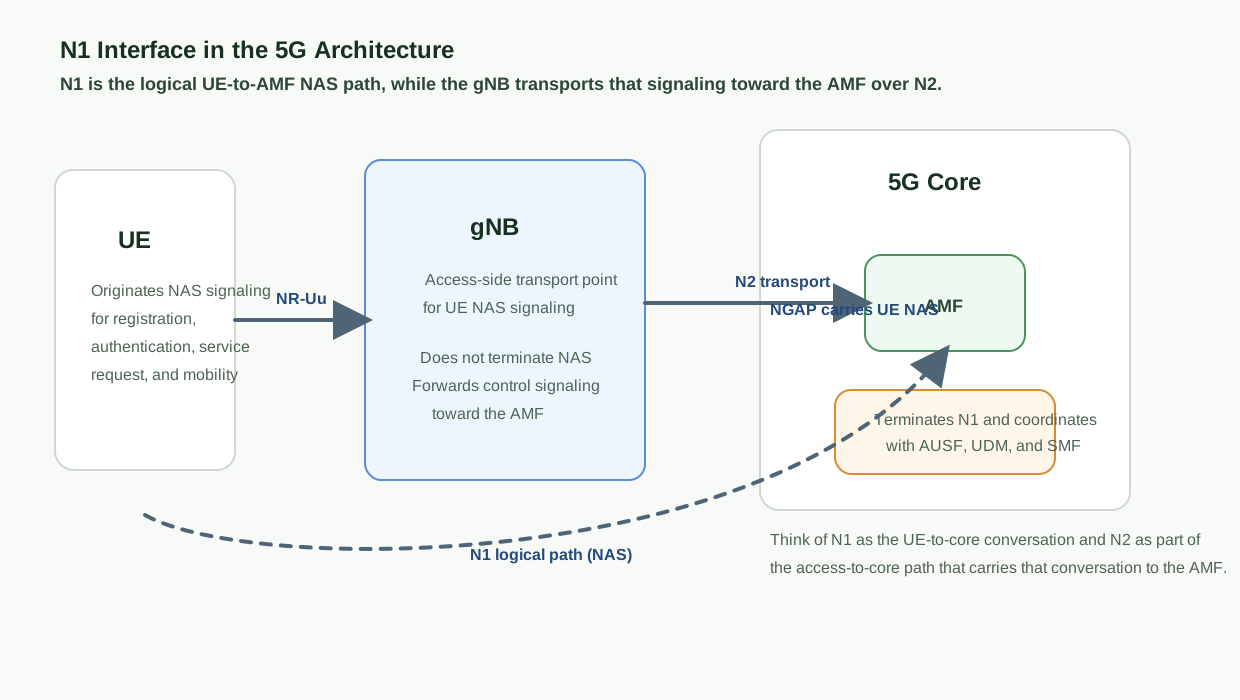
The important architectural detail is that N1 is logical, not a direct physical wire. The UE reaches the AMF through the gNB, which transports the N1 NAS signaling over the N2 side toward the core. That is why registration and authentication often need both N1 understanding and N2 troubleshooting.
Quick facts
| What it is | N1 is the logical interface between the UE and the AMF in the 5G System. |
|---|---|
| Main protocol | N1 carries NAS signaling between the device and the 5G Core. |
| Transport reality | The UE does not reach the AMF directly. The gNB transports N1 NAS signaling over N2 toward the AMF. |
| Main engineering use | Registration, authentication, security setup, service request, and mobility-related core signaling all rely on N1. |
| Best companion page | Pair N1 with the AMF page, the NG page, and initial registration call flows. |
| Specification baseline | 3GPP TS 23.501, TS 24.501, and TS 38.300. |
Why N1 matters
If the UE needs to identify itself to the 5GC, authenticate, establish NAS security, request service, or send session-related control signaling, that story usually starts on N1. In practical terms, N1 is the cleanest way to think about the UE-to-core control path.
This matters for troubleshooting because a failure can look like “registration broke” or “authentication failed,” but the issue might be in the NAS content itself, in AMF handling, or in the transport path through the gNB and N2. Understanding N1 helps separate the logical signaling problem from the transport path that carries it.
Where N1 fits in the network
| Element | Role around N1 |
|---|---|
| UE | Originates NAS signaling such as Registration Request, Authentication Response, Security Mode Complete, and service-related messages. |
| gNB | Does not terminate NAS. It carries the signaling across the access side and forwards it toward the AMF over the control path. |
| AMF | Terminates N1 on the core side and processes the NAS signaling with help from functions such as AUSF, UDM, SMF, and PCF where needed. |
| N2 | Provides the gNB-to-AMF transport and coordination path that carries N1-related signaling across the access-to-core boundary. |
Where N1 fits in 5G architecture
What does the N1 interface do?
- UE registration signaling.
- Authentication and security-related NAS exchange.
- Mobility-management signaling between the device and the 5GC control side.
- PDU-session-related UE signaling toward session-control functions through the AMF.
- Reachability and service signaling when the network needs to restore or continue UE service.
Put simply, N1 is the main UE-facing control-plane interface into the 5GC. If the UE needs to say something important to the core, it usually does it through NAS on N1.
N1 and the NAS protocol
The protocol that matters most on N1 is NAS. NAS is responsible for registration management, session-management-related signaling, authentication exchange, security setup, and several state-management procedures between the UE and the core.
| Protocol | Why it matters on N1 |
|---|---|
| 5GS NAS | Main signaling family between UE and AMF for registration, authentication, security, service request, and session-related control. |
| RRC | Carries the NAS payload across the radio side so the gNB can forward it toward the AMF. |
| NGAP / N2 | Appears on the gNB-to-AMF side when the access network transports the UE-originated signaling toward the core. |
N1 message flow
| Step | What happens |
|---|---|
| 1 | The UE creates a NAS message such as Registration Request or Authentication Response. |
| 2 | The message is carried over the radio side through RRC-related access signaling toward the gNB. |
| 3 | The gNB forwards the signaling toward the AMF over the control path on N2. |
| 4 | The AMF processes the NAS message directly or coordinates with AUSF, UDM, SMF, or other 5GC functions. |
| 5 | The response comes back toward the UE over the same logical N1 relationship. |
N1 in key 5G procedures
- 5G Initial Registration uses N1 for the UE-to-AMF NAS exchange that starts network access.
- 5G Authentication Procedure uses N1 for the UE-side authentication responses and related security signaling.
- 5G PDU Session Establishment uses N1 for the UE-originated session request path before deeper session control continues through the core.
- 5G Service Request uses N1 when the UE requests restored service or resumed activity.
- 5G Mobility Registration Update uses N1 when mobility-related UE state has to be refreshed toward the core.
N1 vs N2 interface
| Feature | N1 | N2 |
|---|---|---|
| Type | Logical interface | Transport and coordination interface |
| Endpoints | UE and AMF | gNB and AMF |
| Main protocol view | NAS | NGAP over the control path |
| Main role | UE-to-core control signaling | Access-network transport and AMF coordination |
A simple way to remember it is this: N1 is the conversation, while N2 is part of the way the network carries that conversation between the gNB and the AMF.
N1 protocol stack
| Layer view | What it means |
|---|---|
| NAS | The N1 signaling content itself. |
| RRC | Carries the NAS payload across the access side. |
| PDCP / RLC / MAC / PHY | Carry the actual radio transport needed to move the signaling between UE and gNB. |
This is why N1 problems are sometimes mistaken for “radio problems.” The signaling is logically NAS, but it still depends on the access-side protocol stack to reach the gNB.
N1 and security
N1 is one of the most important interfaces in the 5GS security model because it carries the NAS signaling that establishes identity, authentication state, and NAS security protection. The AMF coordinates with AUSF and UDM, but the UE-facing exchange remains visible at the N1 level.
| Security area | Why N1 matters |
|---|---|
| Authentication | UE and core exchange authentication-related NAS messages over N1. |
| NAS security | Integrity protection and ciphering state are built around the NAS relationship terminated in the AMF. |
| Reachability and trust | Registration acceptance, service continuity, and many access decisions depend on a healthy N1 security context. |
N1 and the AMF role
The AMF is the core function that terminates N1. It processes NAS signaling directly, coordinates with subscriber and authentication functions, and makes access-side control decisions visible back to the UE.
That is why the AMF page is such a strong companion for N1. When you want to know “what happens after the UE sends this NAS message,” you are usually following the path from N1 into AMF logic.
N1 and UE states
| UE state view | How N1 behaves |
|---|---|
| RRC Connected | NAS signaling can be exchanged actively while the UE already has a live radio connection through the gNB. |
| RRC Idle / Inactive | N1 still matters logically, but signaling appears when the network re-establishes the needed access-side path to the AMF. |
In day-to-day traces, this means an N1 issue may show up differently depending on whether the UE is already connected or whether the network first has to restore reachability.
Common N1 issues
| Symptom | What to check around N1 |
|---|---|
| Registration failure | Check whether the UE generated the expected NAS message, whether the gNB forwarded it, and whether the AMF accepted and processed it correctly. |
| Authentication failure | Check the NAS exchange on N1 together with AMF, AUSF, and UDM coordination. |
| Security mode problems | Check NAS security context, message integrity, and whether the UE and AMF agree on the current security state. |
| Service request stalls | Check whether the UE-side NAS signaling reached the AMF and whether the access-side path was restored correctly. |
| Mobility update problems | Check the NAS signaling content as well as the AMF-side state update that should follow it. |
FAQ
What is the N1 interface in 5G?
The N1 interface is the logical interface between the UE and the AMF. It carries the NAS signaling used for registration, authentication, security, and other control-plane procedures.
What protocol does N1 use?
N1 uses the NAS protocol for 5GS signaling between the UE and the AMF.
Does N1 pass through the gNB?
Yes. N1 is logically UE-to-AMF, but the gNB carries and forwards the signaling toward the AMF over the access-side control path.
What is the difference between N1 and N2?
N1 is the logical UE-to-AMF NAS interface, while N2 is the control-plane interface between the gNB and the AMF that transports related access signaling.
Why is N1 important?
Because it carries the NAS signaling that drives registration, authentication, security setup, service request, and several mobility-related core procedures.
Key takeaways
- The N1 interface is the logical control-plane path between the UE and the AMF.
- NAS is the main protocol family to know on N1.
- The gNB transports N1 signaling toward the AMF, which is why N1 and N2 are closely related in practical traces.
- N1 is central to registration, authentication, security, service request, and mobility-related control.
- When UE-to-core control behavior fails, N1 is one of the first interfaces to inspect before blaming deeper session or user-plane functions.