AMF in 5G Explained
The AMF (Access and Mobility Management Function) is one of the most important control-plane functions in the 5G Core (5GC). It handles access-related control signaling, UE registration state, reachability, and mobility management on behalf of the 5G system.
Unlike LTE MME, the AMF is designed for a service-based 5G core architecture. It works with specialized functions such as SMF, AUSF, UDM, PCF, and NSSF, while session management and user-plane forwarding remain separated from the AMF.
Quick facts
| Full name | Access and Mobility Management Function. |
|---|---|
| Main role | Access-side control, registration, reachability, NAS handling, and mobility management in the 5G Core. |
| Key reference points | N1 between UE and AMF for NAS signaling, and N2 between NG-RAN and AMF for access-network control. |
| Not responsible for | User-plane forwarding and session management. Those belong mainly to UPF and SMF. |
| Works with | AUSF, UDM, PCF, NSSF, SMF, NG-RAN, and service-based 5GC functions. |
| Specification baseline | 3GPP TS 23.501, TS 23.502, TS 23.503, TS 29.518, and TS 29.507. |
AMF in the 5G Core architecture
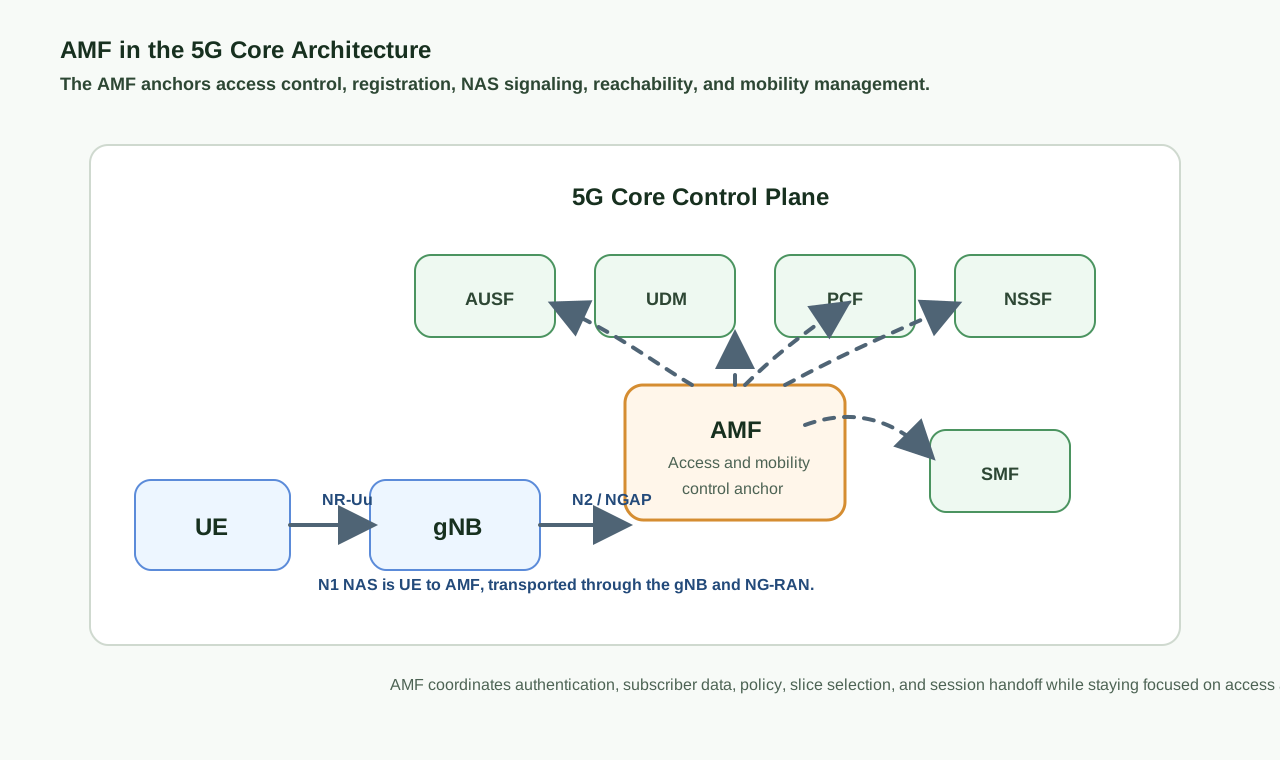
In the 5GS architecture, the AMF is the access-side control anchor for the UE. The UE reaches the AMF over N1 for NAS signaling, while the NG-RAN reaches the AMF over N2 for access network signaling.
What the AMF does in 5G
A simple way to think about the AMF is this: the AMF is the UE-facing control-plane anchor of the 5G Core. It does not carry user traffic and it is not the session-management function. Instead, it tracks UE access-side control state and coordinates with the rest of the 5GC.
- Registration management.
- Connection and reachability management.
- Mobility management.
- NAS signaling termination and relay coordination.
- Authentication and security coordination with AUSF and UDM.
- Slice and access-related control decisions together with NSSF, PCF, and other 5GC functions.
AMF and the Service-Based Architecture
The AMF is one of the core service-based functions in the 5GC. It participates in the 5G Core Service-Based Architecture (SBA) as both a service consumer and service producer depending on the procedure.
This is a major difference from LTE MME design. The AMF does not only sit on fixed point-to-point interfaces; it also participates in the internal service framework that improves flexibility, scaling, and modularity.
AMF and N1 / N2 interfaces
| Interface | Connects | Main role |
|---|---|---|
| N1 | UE to AMF | NAS signaling for registration and other UE-to-core control procedures. |
| N2 | NG-RAN to AMF | Access-network control signaling, typically visible as NGAP between gNB and AMF. |
N1 is the logical NAS path between UE and AMF. N2 is the access-side control path between the gNB and AMF, used for UE context control, paging support, mobility-related signaling, and registration-related access signaling.
AMF and registration in 5G
The AMF is central to the 5G Registration Procedure. It handles registration state, processes the UE Registration Request, coordinates with authentication and subscriber functions, and finalizes the UE control-plane presence in the 5GS.
- The UE reaches the network through the gNB.
- NAS signaling is carried toward the AMF over N1/N2.
- The AMF coordinates with AUSF, UDM, and related functions.
- The network accepts registration and establishes UE control-plane state.
AMF and mobility management
Mobility is one of the AMF's defining roles. AMF mobility handling includes tracking UE access-side presence, coordinating mobility-related control-plane actions, supporting idle and connected reachability logic, and participating in AMF-related mobility changes when required.
This does not mean the AMF performs radio handover by itself. NG-RAN still handles radio-side mobility execution. When mobility needs 5GC coordination, the AMF is one of the key core functions involved.
AMF and UE reachability
The AMF is deeply tied to UE reachability. It helps determine whether a UE is considered reachable for signaling and service purposes at the 5GC control-plane level.
That makes AMF behavior central to paging, inactivity handling, control-plane availability, and loss of connectivity interpretation.
AMF and authentication
The AMF does not perform authentication on its own in isolation, but it is a major coordinator in the authentication flow. During registration, the AMF works with AUSF and UDM as part of authentication and security setup.
| Function | Role around authentication |
|---|---|
| AMF | Coordinates the access-side registration and authentication flow. |
| AUSF | Dedicated authentication function. |
| UDM | Subscriber and identity-related data source. |
AMF and session management
One of the most important things to understand about AMF is what it does not do. The AMF is not the session-management function. Session management is handled by the SMF, while user traffic is handled by the UPF.
- The AMF does not replace the SMF.
- AMF and SMF work together during PDU session procedures.
- The AMF participates in signaling transport and coordination, while SMF owns session control.
AMF, policy control, and network slicing
The AMF also interacts with the 5G policy and slicing architecture. The PCF provides access and mobility policy decisions relevant to AMF behavior, while NSSF participates in slice-related selection logic.
This makes the AMF more advanced than LTE MME in practical deployments. It operates in a slice-aware, service-based core that may support multiple logical network behaviors on the same infrastructure.
AMF selection and AMF change
The AMF is part of AMF selection and AMF change scenarios in 5GS procedures. This means AMF handling is both architectural and procedural: it is a defined core function, but the selected AMF may change depending on access, location, load, mobility, and system logic.
AMF vs LTE MME
| Feature | LTE MME | 5G AMF |
|---|---|---|
| Main role | Mobility and control-plane management in EPC. | Access and mobility management in 5GC. |
| Session management | More tightly coupled with EPC procedures. | Decoupled from session management, which is handled by SMF. |
| Core architecture | Node-based EPC. | Service-based 5GC. |
| Slice awareness | No native 5G slice model. | Built into 5GS architecture and procedures. |
Common troubleshooting angles for the AMF
- Registration failures where the UE cannot complete 5GS registration.
- NAS signaling issues on the UE-to-AMF path.
- N2 or NGAP problems between gNB and AMF.
- Authentication coordination failures involving AUSF or UDM.
- Access and mobility policy issues involving PCF.
- Reachability, paging, or inactivity-state problems.
- AMF selection, AMF change, or slice-selection-related failures.
FAQ
What is the AMF in 5G?
The AMF is the Access and Mobility Management Function in the 5G Core. It handles access-side control, registration, mobility management, NAS signaling, and UE reachability.
Is the AMF the same as the LTE MME?
Not exactly. AMF is the closest 5G counterpart to LTE MME, but it is service-based and separated from session management, which belongs to SMF.
What interfaces does the AMF use?
The AMF is especially associated with N1 for UE NAS signaling and N2 for NG-RAN control-plane signaling.
Does the AMF handle user-plane traffic?
No. The AMF is a control-plane function. User-plane traffic is handled through the UPF, while session control is handled through the SMF.
Why is the AMF important?
Because AMF is the main 5GC function for registration, mobility, reachability, NAS handling, and access-side control-plane coordination.
Key takeaways
- The AMF is the 5G Core function for access and mobility management.
- It anchors registration, NAS signaling, UE reachability, and mobility-related handling.
- The AMF is associated especially with N1 and N2.
- The AMF works with AUSF, UDM, PCF, NSSF, and SMF, but it is not the session-management or user-plane function.
- Understanding AMF is essential for registration, mobility, paging, slice-aware access, and 5GC control-plane troubleshooting.
References
- 3GPP TS 23.501 - System architecture for the 5G System Primary 5GS architecture reference for AMF, N1, N2, SBA, slicing, and function separation.
- 3GPP TS 23.502 - Procedures for the 5G System Procedure reference for registration, mobility, AMF change, authentication flow, and session coordination.
- 3GPP TS 29.518 - AMF services AMF service specification, including service exposure and reachability-related behavior.
- 3GPP TS 29.507 - AM policy control service Policy service context relevant to AMF and access and mobility policy control.