5G Core Network Architecture Explained
The 5G Core Network (5GC) is the cloud-native, service-based core network defined for the 5G system. Unlike LTE EPC, which is more node-and-interface-centric, the 5GC is built around a Service-Based Architecture (SBA) where control-plane functions expose services and discover each other dynamically.
At a practical level, the 5GC is where 5G registration, authentication, policy, slicing, session management, and user-plane forwarding come together. This is the page to read when you want the full system view of AMF, SMF, UPF, UDM, AUSF, PCF, NRF, and NSSF before diving into procedures or individual interfaces.
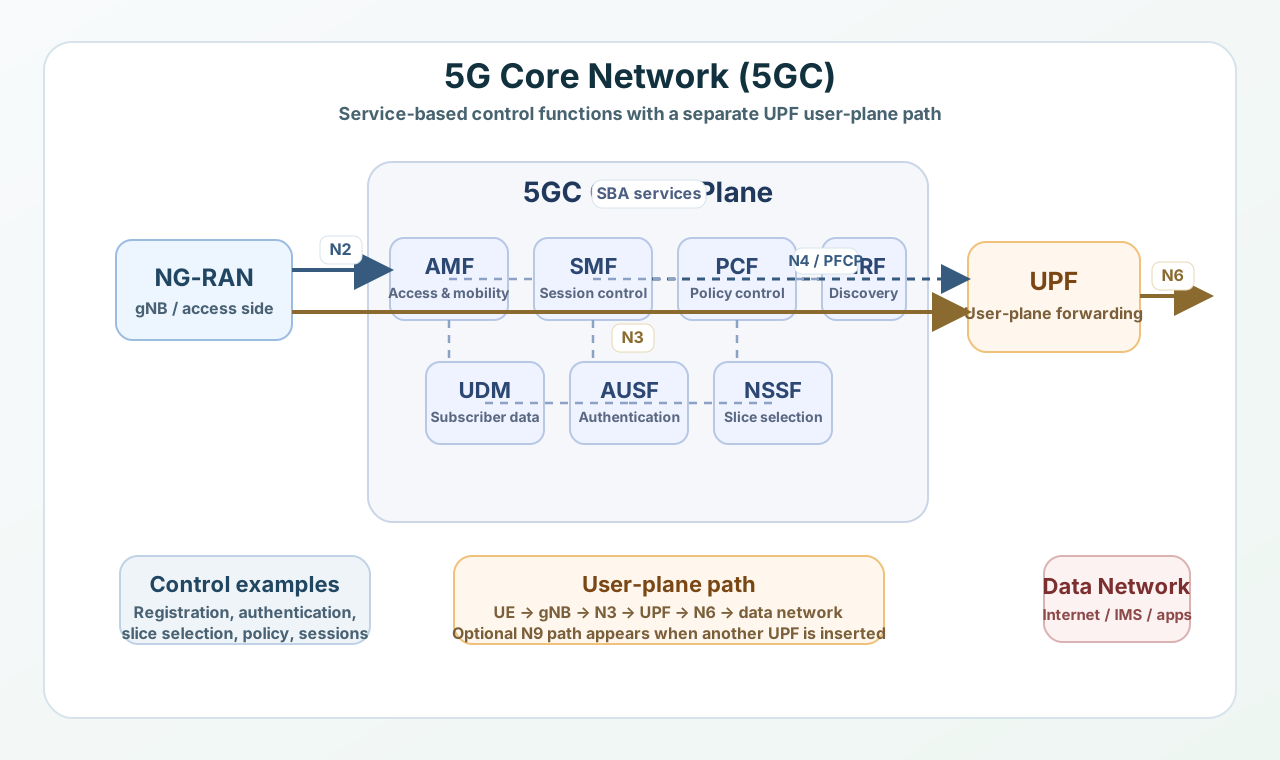
5G Core Network Diagram
Quick facts
| Core design style | Service-Based Architecture for control functions, with a separate UPF-based user plane |
|---|---|
| Main access-facing anchor | AMF for registration, reachability, and mobility control |
| Main session anchor | SMF for PDU session management and UPF control |
| Main user-plane node | UPF for packet forwarding, QoS enforcement, and traffic steering |
| Key interfaces | N1, N2, N3, N4, N6, N9, plus service-based internal control interactions |
| Operational focus | Registration, authentication, PDU sessions, policy, slicing, service discovery, and data-path continuity |
Contents
- 5G Core Network Diagram
- 5G Core Architecture Overview
- Key Design Principle: Service-Based Architecture (SBA)
- Control Plane vs User Plane in 5G
- Key 5G Core Network Functions
- 5G Core Interfaces and Reference Points
- End-to-End Data Flow in the 5G Core
- 5G Core vs LTE EPC
- Network Slicing in the 5G Core
- 5G Core and Cloud-Native Design
- Common Troubleshooting Angles in 5G Core
- Related Pages
- Related Procedures
- Key takeaways
- FAQ
- References
5G Core Architecture Overview
At the highest level, the 5GC separates the control plane from the user plane more explicitly than LTE EPC. AMF, SMF, UDM, AUSF, PCF, NRF, and NSSF form the main control ecosystem, while the UPF anchors the user-plane data path toward external networks.
This matters because a 5G service path is no longer just one core node chain. Registration, authentication, session setup, policy, slice selection, and packet forwarding can each depend on a different network function inside the 5GC.
| 5GC area | Main role |
|---|---|
| Access-facing control | AMF handles registration, mobility management, and NAS reachability from the RAN side. |
| Session control | SMF creates and manages PDU sessions and controls UPF forwarding behavior. |
| User plane | UPF carries user traffic toward data networks and service platforms. |
| Subscriber and security | UDM and AUSF provide subscriber, identity, and authentication support. |
| Policy and discovery | PCF, NRF, and NSSF support policy, service discovery, and slice-related decisions. |
Key Design Principle: Service-Based Architecture (SBA)
The biggest shift from LTE EPC to 5GC is the Service-Based Architecture. Instead of relying only on rigid point-to-point interfaces between fixed nodes, many 5GC control-plane functions expose services and consume each other through service-based interactions.
That makes the 5GC more cloud-native and modular. The NRF plays a major role here because it allows network functions to register themselves and discover other functions dynamically.
- Network functions expose services via APIs.
- The control plane can scale more flexibly than a rigid node chain.
- SBA makes cloud-native and microservice-style deployment more practical.
- Function discovery becomes a live operational part of the architecture.
Control Plane vs User Plane in 5G
Like LTE, 5G separates the control plane from the user plane, but the separation is stronger and more explicit in the core. The control plane handles signaling, mobility, session management, authentication, policy, and slicing decisions. The user plane is centered on the UPF.
This is one of the main reasons 5GC troubleshooting feels different from EPC troubleshooting. A registration failure may live entirely in the control plane, while a no-data problem may point more directly at the UPF, SMF-to-UPF control, or external data-network reachability.
| Plane | Main 5GC functions | Operational focus |
|---|---|---|
| Control plane | AMF, SMF, UDM, AUSF, PCF, NRF, NSSF | Registration, mobility, policy, authentication, session control, slicing, and service discovery. |
| User plane | UPF | Packet forwarding, QoS enforcement, traffic steering, edge breakout, and transport continuity. |
Key 5G Core Network Functions
| Function | Main role | Closest LTE comparison |
|---|---|---|
| AMF | Entry point for access-side control, registration, mobility management, NAS signaling, and reachability. | Closest to MME on the mobility and access side. |
| SMF | PDU session establishment, session control, IP address allocation, and UPF control. | Takes over key session-control responsibilities that were spread differently in EPC. |
| UPF | Packet routing, forwarding, QoS enforcement, traffic steering, and edge breakout. | Roughly maps to the user-plane roles of S-GW and P-GW. |
| NRF | Function registration and discovery for service-based interactions. | No direct EPC equivalent in the same architectural form. |
| PCF | Policy control, charging-related policy influence, and service rules. | Closest to PCRF. |
| UDM | Subscriber data, profile handling, and identity-related core data support. | Closest to HSS for subscriber data. |
| AUSF | Authentication handling and security support. | Part of the 5G authentication architecture rather than a simple single-node EPC clone. |
| NSSF | Network slice selection support. | Adds slice-awareness that EPC does not expose in the same way. |
5G Core Interfaces and Reference Points
5G uses both service-based interactions and more familiar architectural reference points. The reference-point view is still extremely useful when reading traces and procedures, because it tells you where control or user traffic is actually crossing a system boundary.
| Interface | Description |
|---|---|
| N1 | UE to AMF NAS signaling path. |
| N2 | gNB to AMF control-plane path. |
| N3 | gNB to UPF user-plane path. |
| N4 | SMF to UPF control path, typically using PFCP. |
| N6 | UPF to external data networks. |
| N9 | UPF to UPF user-plane path when multiple UPFs are used. |
| Service-based interfaces | Control interactions between AMF, SMF, UDM, AUSF, PCF, NRF, NSSF, and related functions. |
End-to-End Data Flow in the 5G Core
A simplified user-plane path in a standalone 5G system is UE -> gNB -> N3 -> UPF -> N6 -> external network.
A simplified control path is UE -> gNB -> N2 -> AMF -> SMF -> UPF. This is the cleanest way to understand how the 5GC separates session-control decisions from actual packet forwarding.
- AMF is central for registration and access-side control.
- SMF decides how the PDU session should be built and which UPF should be used.
- UPF carries user traffic and may be placed centrally or at the edge.
5G Core vs LTE EPC
| Feature | LTE EPC | 5G Core |
|---|---|---|
| Architecture style | More node-and-interface-centric | Service-based, modular control architecture |
| Core transport and control model | Diameter + GTP-based EPC model | SBA for control functions plus GTP-U and PFCP where relevant |
| Cloud-native fit | More limited | Designed for cloud-native deployment |
| Network slicing | Not a native architectural pillar | Built in as a major design goal |
| Control vs user separation | Present but less cleanly modular | More explicit and stronger separation |
Network Slicing in the 5G Core
One of the most important new architectural features in the 5GC is network slicing. The core can support multiple logical service environments on shared infrastructure, with different policy, QoS, and operational behavior per slice.
The NSSF and AMF are especially important here because slice-selection logic affects how the UE is mapped into the wider 5G system.
- Different slices can support eMBB, URLLC, or mMTC style service goals.
- Slice selection is a core-network architecture issue, not just a RAN issue.
- Policy, session, and subscriber logic may all be slice-sensitive.
5G Core and Cloud-Native Design
The 5GC is designed for virtualization, containerization, microservices-oriented deployment, and cloud-native operation. This is one of the practical reasons SBA matters so much: it aligns the architecture with modern distributed software design.
The UPF can also be placed centrally, regionally, or at the edge. That enables low-latency service delivery, local traffic breakout, and MEC-style deployment models.
- Dynamic scaling becomes more practical than in traditional monolithic core deployments.
- Edge UPFs can reduce latency for local applications.
- Function placement becomes an operational architecture question, not just a deployment afterthought.
Common Troubleshooting Angles in 5G Core
- Registration failures often point first to AMF, NAS handling, subscriber data, or authentication branches.
- PDU session failures often point toward SMF, UPF selection, N4 control, policy, or slice decisions.
- Good registration with no data service often points toward UPF, N3, N6, or policy-related user-plane issues.
- Service discovery failures can affect how control functions find each other through the NRF and SBA.
- Slice-selection issues often need AMF, NSSF, policy, and session behavior to be read together.
Key takeaways
- The 5G Core uses Service-Based Architecture (SBA) for many control functions.
- AMF, SMF, and UPF form the backbone of registration, session control, and user-plane forwarding.
- The 5GC separates control plane and user plane more explicitly than LTE EPC.
- The architecture is designed for cloud-native deployment, flexible scaling, and network slicing.
- Understanding the 5GC is essential for analyzing registration, PDU sessions, policy, authentication, slicing, and data-path issues.
FAQ
What is 5G Core (5GC)?
The 5GC is the cloud-native core network of the 5G system. It provides registration, mobility, session control, subscriber handling, policy, and user-plane forwarding.
What is the difference between 5GC and EPC?
5GC uses a more modular and service-based design, with stronger separation between control and user plane, while LTE EPC uses a more fixed node-and-interface model.
What is the role of the UPF?
The UPF handles user-plane traffic, packet forwarding, traffic steering, QoS enforcement, and breakout toward external data networks.
What is SBA in 5G?
The Service-Based Architecture is the 5GC control-plane model in which network functions expose services and discover each other dynamically.
Does 5G Core still use GTP?
Yes. GTP-U is still used on user-plane paths such as N3 and N9, even though many control functions use service-based signaling and SMF-to-UPF control commonly uses PFCP on N4.
Related pages
References
- 3GPP TS 23.501 - System architecture for the 5G System (5GS) Primary architecture reference for 5GC functions, reference points, and overall 5GS design.
- 3GPP TS 23.502 - Procedures for the 5G System (5GS) Procedure reference for registration, session handling, mobility, and other 5GC-driven workflows.
- 3GPP TS 23.503 - Policy and charging control framework for the 5G System (5GS) Policy-control reference for PCF-driven architecture and QoS or charging-related behavior.