5G Service-Based Architecture (SBA) Explained
The Service-Based Architecture (SBA) is the architectural foundation of the 5G Core (5GC). It allows network functions to expose services, discover each other dynamically, and communicate through service-based interfaces.
In plain language, SBA is what makes the 5GC feel more like a modern cloud-native system than a classic telecom node chain. Functions such as AMF, SMF, PCF, UDM, AUSF, NSSF, and NRF are no longer only placed side by side. They also behave like service producers and consumers inside the same control fabric.
Quick facts
| Full name | Service-Based Architecture. |
|---|---|
| Main role | Defines how 5GC network functions expose services, discover each other, and communicate dynamically. |
| Big shift from LTE | 5G Core moves away from only fixed point-to-point interfaces and adopts service-based interactions between functions. |
| Core enabler | NRF is central because it supports registration and service discovery between network functions. |
| Technology style | HTTP-based APIs, service-based interfaces, and cloud-native deployment principles. |
| Why it matters | SBA is the architectural reason 5GC can scale, evolve, and integrate functions more flexibly than LTE EPC. |
What is SBA in 5G?
In SBA, each network function can expose services that other functions consume. Instead of hard-coding every relationship, the 5GC becomes more modular and dynamic.
- Each NF provides one or more services.
- Other NFs consume those services when needed.
- Communication happens through service-based interfaces.
The shortest way to remember it is this: 5G Core functions behave more like microservices than the older point-to-point core-node model.
SBA architecture overview
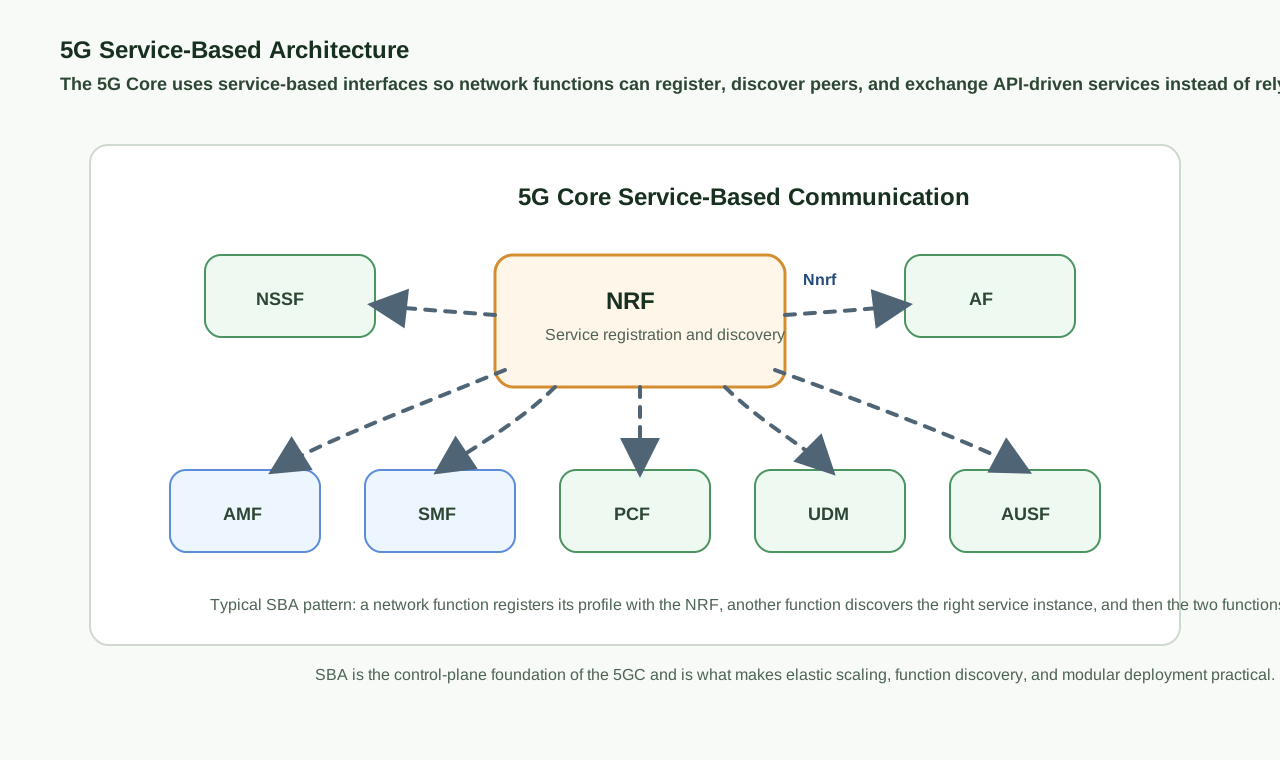
The diagram is intentionally simple because the important idea is not the artwork, it is the relationship: functions register, discover, and then communicate through service-based interactions rather than relying only on static peer mappings.
Key characteristics of SBA
| Characteristic | Why it matters |
|---|---|
| Service-based communication | Functions interact through services and APIs rather than only fixed point-to-point interfaces. |
| Loosely coupled NFs | Functions can evolve and scale more independently. |
| Dynamic discovery | NRF allows functions to find each other at runtime. |
| Cloud-native deployment | The architecture aligns better with virtualization, containers, and distributed scaling. |
| Operational flexibility | It becomes easier to add, replace, or scale service instances in the 5GC. |
Service-Based Interfaces (SBI)
SBA communication is built around service-based interfaces. In practice, this means the 5GC uses API-style interactions between functions instead of only older telecom-style fixed interface pairings.
- Commonly associated with HTTP/2.
- Uses API-driven service interactions.
- Supports more flexible integration between network functions.
This is a big part of why the 5GC is often described as cloud-native or microservice-inspired.
Role of NRF in SBA
The NRF (Network Repository Function) is one of the central enablers of SBA. Without NRF, the service-based model would be much more static and far less flexible.
- Supports network-function registration.
- Supports discovery of suitable target functions.
- Helps the 5GC stay dynamic rather than manually hard-wired.
If the SBA is the service model, then the NRF is one of the main reasons the model works operationally.
SBA communication flow
The basic SBA pattern is easy to summarize:
- A network function registers its service profile.
- Another network function queries NRF to discover the target service.
- The two functions communicate through the service-based interface.
That pattern shows up repeatedly across the 5GC control plane.
Network functions in SBA
SBA is not a separate subsystem beside the 5GC. It is the way many of the main 5GC functions communicate.
| Network function | How it fits into SBA |
|---|---|
| AMF | Consumes and exposes control-plane services for access and mobility handling. |
| SMF | Uses service-based interactions for session-related control behavior. |
| PCF | Provides policy-related services to other 5GC functions. |
| UDM and AUSF | Support subscriber-data and authentication services in the service-based control model. |
| NSSF | Supports slice-aware control and selection behavior. |
| NRF | Supports registration and service discovery for the whole model. |
SBA vs LTE architecture
| Aspect | LTE EPC | 5G SBA |
|---|---|---|
| Communication model | More node- and interface-oriented. | More explicitly service-based. |
| Function discovery | More static. | More dynamic through NRF. |
| Scalability style | More constrained by classic node relationships. | Better aligned with independent service scaling. |
| Cloud-native fit | More limited. | Much stronger architectural fit. |
SBA and microservices
SBA is often compared to microservices, and that is useful as long as it is taken as an architectural analogy rather than a strict software implementation rule.
- Functions are more modular.
- They can be deployed and scaled more independently.
- The system is better aligned with cloud and container operations.
That is one of the reasons SBA matters so much for modern 5GC deployment strategy.
SBA and network slicing
SBA also helps the 5GC support network slicing more naturally. Slice-aware behavior depends on flexible control interaction across functions such as AMF, SMF, NSSF, PCF, and UDM, and SBA gives that interaction a better architectural foundation.
SBA and security
Service-based communication also brings a stronger need for secure NF-to-NF interaction. Once the 5GC becomes more API-driven, authentication, authorization, trust, and secure service exposure become even more important.
SBA and deployment models
SBA is one of the reasons 5GC works well with:
- Virtualized deployment.
- Containerized deployment.
- Cloud-native orchestration.
- Edge-integrated service placement.
Benefits of SBA
- Higher flexibility.
- Better scalability.
- Faster service evolution.
- Easier integration of new control functions.
- Stronger fit with cloud-native operations.
Challenges of SBA
SBA improves flexibility, but it also introduces new complexity.
- More moving parts across the control plane.
- Greater dependence on service discovery and API health.
- More operational focus on inter-service observability.
- Security and trust management become even more important.
Common SBA issues
- NRF registration or discovery failures.
- API communication issues between network functions.
- Service profile mismatches or stale discovery data.
- Scaling inconsistencies between function instances.
- Configuration mismatches across service-based interactions.
FAQ
What is SBA in 5G?
It is the Service-Based Architecture of the 5G Core, where network functions expose and consume services dynamically.
Why is SBA important?
Because it gives the 5GC much more flexibility, scalability, and cloud-native deployment freedom.
What protocol style does SBA use?
It is built around service-based interfaces and commonly HTTP-based API communication between functions.
What is the role of NRF?
NRF supports service registration and discovery, which is central to dynamic SBA operation.
Key takeaways
- SBA is the architectural foundation of the 5G Core.
- It enables dynamic service-based communication between network functions.
- NRF is central because it supports registration and discovery.
- SBA is one of the reasons 5GC is more flexible, scalable, and cloud-native than LTE EPC.
- Understanding SBA makes the rest of the 5GC pages make much more sense.
References
- 3GPP TS 23.501 - System architecture for the 5G System Primary 5GS architecture reference for SBA, network-function roles, and service-based relationships.
- 3GPP TS 23.502 - Procedures for the 5G System Procedure reference showing how service-based control functions coordinate in live 5GC procedures.
- 3GPP TS 29.500 - 5G System; Technical Realization of Service Based Architecture Core technical reference for the service-based architecture framework and interface realization.
- 3GPP TS 29.510 - Network Repository Services Useful companion reference for NRF behavior inside the SBA model.