PCF in 5G Explained
The PCF (Policy Control Function) is a core function in the 5G Core (5GC) responsible for policy control, QoS direction, and charging-related rules. It helps decide how subscriber traffic and sessions should be treated across the network.
In practical terms, the split is clean: PCF defines policy direction, SMF turns that direction into session-side behavior, UPF applies traffic handling in the user plane, and AMF consumes access and mobility-related policy where relevant.
Quick facts
| Full name | Policy Control Function. |
|---|---|
| Main role | Defines policy direction for QoS, charging-related behavior, access decisions, and slice-aware treatment inside the 5G Core. |
| Works with | SMF for session and QoS policy enforcement, AMF for access and mobility-related policy use, and UDM or AF where subscriber and application context matters. |
| Closest LTE comparison | Closest to PCRF, but redesigned for the service-based 5GC control model. |
| Key reference points | N7 toward SMF, N15 toward AMF, and N5 toward AF. |
| Why it matters | If PCF decisions are wrong, sessions may come up with the wrong QoS, charging behavior, or slice-related treatment even when transport itself is healthy. |
PCF in the 5G Core architecture
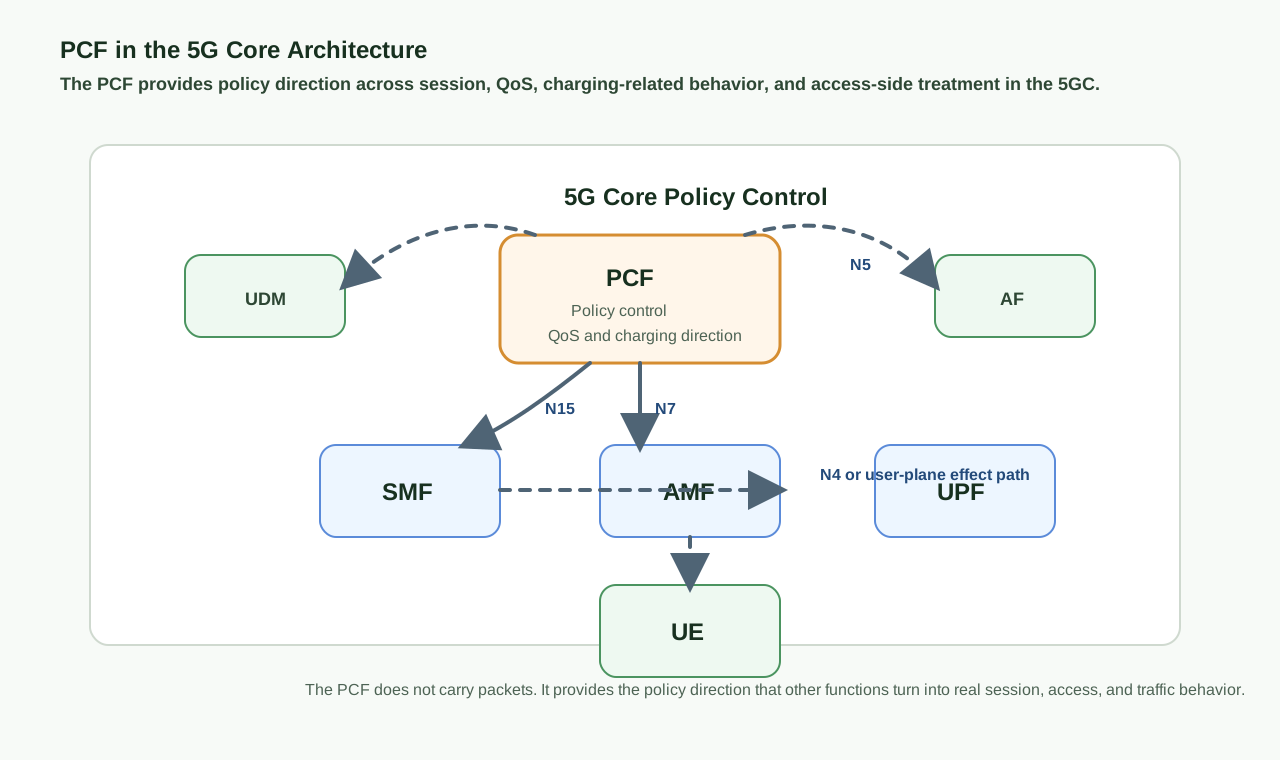
The PCF is not a user-plane forwarding node. It sits in the 5GC control ecosystem and provides the policy direction that other functions translate into real service behavior.
What does the PCF do?
A simple way to think about the PCF is this: the PCF is the policy brain of the 5G Core. It decides how sessions and traffic should be treated and provides those decisions to the functions that can actually apply them.
- Defines QoS policy direction.
- Supports charging-related rules and service behavior.
- Provides policy decisions to SMF and AMF.
- Supports slice-aware service differentiation.
- Allows application influence where the architecture supports it.
PCF and QoS control
The PCF is one of the main places where QoS intent is defined in the 5GC. It helps determine how a session or service should be treated before that intent is turned into concrete session and user-plane behavior.
- Provides QoS policy rules.
- Influences priority and service treatment.
- Helps align session behavior with subscriber and service intent.
In practical engineering terms, the PCF decides the direction, the SMF applies that direction to the session, and the UPF becomes one of the places where the result shows up.
PCF and charging
The PCF is also associated with charging-related policy behavior. That does not mean it is a billing platform by itself. It means the PCF helps define the rules that control how charging-aware service behavior should be applied in the wider 5GC flow.
PCF and SMF interaction
The SMF is the most important operational companion to the PCF. The PCF provides policy decisions, while the SMF converts those decisions into session-level behavior, UPF programming, and QoS-related treatment in the data path.
- Policy rules exchange over N7.
- Session-side QoS and charging-related policy handling.
- Policy-driven shaping of session behavior and UPF control.
PCF and AMF interaction
The AMF uses policy in the access and mobility part of the 5GC. This is where the PCF matters beyond pure session behavior. Access-side handling, mobility-related choices, and reachability-related behavior can all depend on policy direction consumed by the AMF.
PCF and UDM interaction
Policy decisions are often more useful when they are subscriber-aware. That is why PCF reading often goes together with UDM. Subscriber profile, service entitlement, and slice-related context help the PCF produce policy that matches the actual user and service.
PCF and network slicing
The PCF is one of the functions that makes slice-aware policy behavior practical. Policy does not always need to be generic. Different slices may need different service treatment, priorities, or traffic behavior, and the PCF helps provide those distinctions.
PCF interfaces
| Interface | Connects | Main role |
|---|---|---|
| N7 | PCF to SMF | Session-management policy control, QoS policy, and charging-related rules. |
| N15 | PCF to AMF | Access and mobility-related policy handling. |
| N5 | PCF to AF | Application influence on policy where supported by the deployment. |
PCF and Application Function (AF)
The AF (Application Function) is where service or application intent can influence network policy. In practical terms, this means the PCF can receive application-side context and use it to shape the resulting policy behavior for the session.
A simple example is a service asking for a particular treatment profile so the network can align session behavior more closely with the application experience it is trying to deliver.
PCF in Service-Based Architecture
The PCF is a service-based function in the 5GC. That matters because policy is no longer just a tightly coupled side feature attached to one gateway. In 5G it becomes part of a broader modular control ecosystem that can serve multiple functions and service scenarios.
PCF vs LTE PCRF
| Feature | LTE PCRF | 5G PCF |
|---|---|---|
| Architecture | More tightly tied to EPC-era control style. | Built for the service-based 5GC model. |
| Flexibility | More limited. | Higher, especially for slice-aware and application-aware policy use. |
| Integration | Policy and charging control in EPC. | Modular policy function in the 5GC control ecosystem. |
PCF and traffic control
The PCF does not forward packets, but it strongly shapes how traffic should be treated. That includes the policy direction behind bandwidth handling, service priority, charging-related treatment, and slice-aware behavior.
PCF and QoS flow mapping
In 5G, policy intent eventually has to reach the real transport layers. The PCF helps define the policy side of QoS flow behavior, while the SMF and user-plane path make that behavior real. On the access side, those QoS flows still have to be represented through the NG-RAN bearer model and DRB handling.
That is one reason PCF study pairs well with 5G radio bearers. Policy only matters if it reaches the actual bearer and transport behavior the UE experiences.
Common PCF issues
- Incorrect QoS policy for a session or service.
- Charging-related policy mismatch.
- Policy conflicts between subscriber profile, slice intent, and application influence.
- Communication issues between PCF and SMF.
- Access or mobility behavior that does not match the intended policy direction.
FAQ
What is PCF in 5G?
The PCF is the Policy Control Function in the 5G Core. It defines policy direction for QoS, charging-related treatment, and service behavior.
Does PCF enforce policies itself?
No. Functions such as SMF and UPF apply those policies in session behavior and user-plane treatment.
What is the N7 interface in 5G?
N7 is the PCF-to-SMF reference point used for session-management policy decisions, including QoS and charging-related rules.
How is PCF different from PCRF?
PCF is the service-based 5GC evolution of LTE PCRF, with a more modular architecture and stronger fit for slicing and application influence.
Why is PCF important?
Because correct QoS, charging-related treatment, slice-aware service behavior, and application-aware policy all depend on it.
Key takeaways
- The PCF is the 5GC policy-control function for QoS, charging-related rules, and service behavior.
- It works closely with SMF and AMF, but it does not forward packets itself.
- Understanding PCF is essential for diagnosing policy mismatch, QoS problems, slice-related behavior, and service-treatment issues in 5G.
References
- 3GPP TS 23.501 - System architecture for the 5G System Primary 5GS architecture reference for PCF role, 5GC function relationships, and reference-point behavior.
- 3GPP TS 23.503 - Policy and charging control framework for the 5G System Primary policy-control reference for QoS, charging, application influence, and policy decisions in 5GS.
- 3GPP TS 23.502 - Procedures for the 5G System Procedure reference for how policy interacts with registration, session establishment, and mobility-related handling.
- 3GPP TS 29.512 - Session Management Policy Control Service Service specification for PCF session-management policy interactions in the service-based 5GC.