SMF in 5G Explained
The SMF (Session Management Function) is one of the most important control-plane functions in the 5G Core (5GC). It owns PDU session management, controls the user-plane path, and coordinates with the UPF so that the UE gets real data connectivity.
In practical 5G architecture, the split is clean: AMF handles access and mobility, SMF handles session control, and UPF forwards packets. That separation is a core part of the service-based 5GC design and one of the biggest differences from older EPC thinking.
Quick facts
| Full name | Session Management Function. |
|---|---|
| Main role | Owns PDU session control and programs the user-plane path through the UPF. |
| Closest partners | AMF on the access-side control path, UPF on the user-plane control side, and PCF for policy decisions. |
| Key reference points | N11 toward AMF, N4 toward UPF, N7 toward PCF, and N10 toward UDM where relevant. |
| Does not do | It does not forward user traffic itself. Actual packet forwarding belongs to the UPF. |
| Why it matters | If the SMF is wrong, PDU sessions, IP allocation, UPF programming, QoS, and traffic steering all suffer. |
SMF in the 5G Core architecture
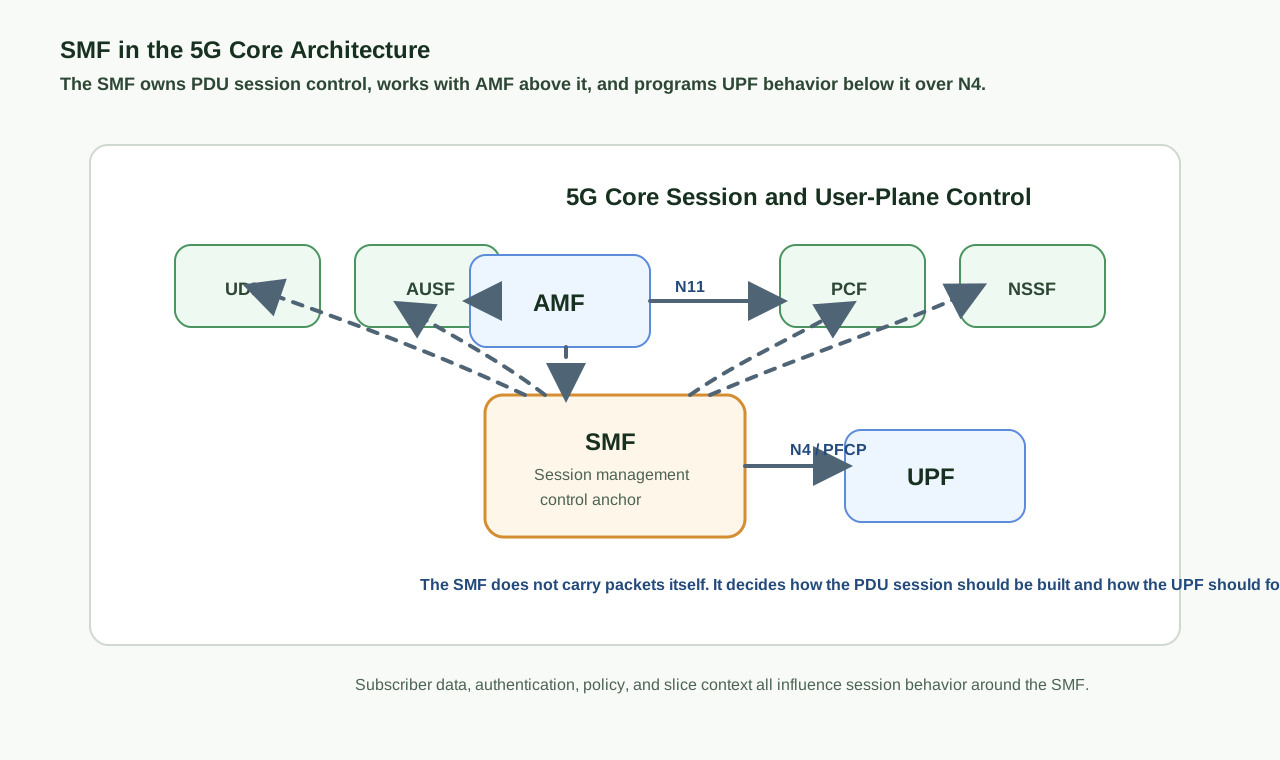
The SMF sits between the access-side control world and the user-plane execution world. It takes session intent from the control path above and turns that into concrete forwarding and policy behavior through the UPF below.
What the SMF does in 5G
The simplest way to think about the SMF is this: the SMF is the session-control brain of 5G data connectivity. It decides how the PDU session should be built, how the user plane should be programmed, and how policy and QoS decisions should be reflected in the data path.
- PDU session establishment, modification, and release.
- User-plane path selection and UPF control.
- IP address allocation or coordination for UE connectivity.
- QoS-related session treatment and flow handling.
- Traffic steering and path updates.
- Interaction with policy, subscriber, and slice-aware functions.
SMF and PDU sessions
The SMF is the main control function behind the PDU session lifecycle. A PDU session is the logical connection that lets the UE reach a data network such as the Internet, IMS, or an enterprise service.
- Establishment creates the session and selects the user-plane path.
- Modification changes QoS treatment, forwarding behavior, or session parameters.
- Release tears the session down cleanly.
If you want one sentence to remember, it is this: the AMF helps the session request reach the right place, but the SMF owns the session itself.
SMF interfaces
| Interface | Connects | Main role |
|---|---|---|
| N11 | AMF to SMF | Control-plane coordination for PDU session handling. |
| N4 | SMF to UPF | User-plane control, commonly using PFCP. |
| N7 | SMF to PCF | Policy control interaction affecting session treatment and QoS. |
| N10 | SMF to UDM | Subscriber and subscription-related session support where relevant. |
SMF and UPF control
One of the most important practical duties of the SMF is controlling the UPF. This is where the SMF stops being an abstract session concept and becomes the function that actively shapes the data path.
- Creates or updates forwarding rules.
- Selects or changes the user-plane path.
- Programs session-related treatment in the UPF.
- Coordinates tunnel and path behavior tied to PDU sessions.
That is why N4 and PFCP matter so much. If the SMF cannot program the UPF correctly, the UE may register fine and still end up with broken or incomplete data service.
SMF and QoS
The SMF is deeply involved in QoS handling. In 5G, QoS flows and policy decisions need to turn into real session treatment, and the SMF is one of the key functions that makes that happen.
- Coordinates with the PCF for policy-driven session behavior.
- Applies session-side QoS treatment and rule handling.
- Helps ensure user-plane behavior aligns with the intended service profile.
A useful mental model is that the PCF decides the policy direction, while the SMF turns that direction into concrete session behavior.
SMF and IP address allocation
The SMF also plays a central role in how the UE receives addressing for data connectivity. Depending on the deployment, that can mean direct session-side IP allocation behavior or coordination with external mechanisms.
This matters because successful registration is not enough for data service. The UE still needs a valid session, a viable user-plane path, and usable addressing before real connectivity exists.
SMF and traffic steering
The SMF decides how user traffic should be steered through the user plane. That includes choosing the appropriate UPF and supporting path designs that fit edge breakout, local service placement, or slice-sensitive traffic handling.
- UPF selection for the session.
- Traffic steering based on service architecture.
- Support for low-latency or edge-oriented session placement.
SMF and network slicing
The SMF also works inside the wider slice-aware 5G architecture. Session control is not always generic; it may depend on which slice the UE is using and what kind of service behavior that slice is meant to support.
That is why SMF reading often goes together with AMF, NSSF, and PCF. Slice selection, policy, and session logic frequently need to be read together.
SMF vs AMF
| Feature | AMF | SMF |
|---|---|---|
| Main role | Access and mobility control. | Session management and UPF control. |
| Plane | Control plane. | Control plane. |
| User-plane control | No. | Yes, through N4 and UPF programming. |
| PDU session ownership | Participates in signaling transport and coordination. | Owns the PDU session lifecycle. |
SMF and the user-plane path
UE -> gNB -> UPF -> Data Network
       ^
      SMF (control)
The SMF does not sit inside the user-plane packet path, but it strongly shapes that path. It decides how the session should be built and how the UPF should forward traffic once the session becomes active.
SMF and mobility
During mobility, the SMF may need to update user-plane handling so that session continuity survives movement across access conditions or path changes. Mobility is not only a RAN or AMF topic; it also has a session and path-control side.
That is one reason some mobility problems show up as user-plane failures rather than clean handover failures. The radio move may succeed while session-side path control is still wrong.
Common SMF issues
- PDU session setup failure where the UE cannot obtain data connectivity.
- Incorrect or missing IP address allocation behavior.
- QoS handling that does not match policy intent.
- PFCP or N4 control failures between SMF and UPF.
- Wrong UPF selection or traffic-steering behavior.
- Session continuity problems during mobility or path update.
FAQ
What is SMF in 5G?
The SMF is the Session Management Function in the 5G Core. It manages PDU sessions and controls the user-plane path through the UPF.
What protocol does the SMF use with the UPF?
The SMF commonly uses PFCP on the N4 interface to control UPF forwarding behavior.
Does the SMF carry user traffic?
No. The SMF is a control-plane function. Actual packet forwarding belongs to the UPF.
What is the N4 interface in 5G?
N4 is the SMF-to-UPF control interface used to program forwarding and session behavior.
Why is the SMF important?
Because it owns PDU session lifecycle, UPF control, QoS-related session treatment, and the session logic behind real data connectivity.
Key takeaways
- The SMF is the 5G Core control-plane function for PDU session management.
- It controls the user plane through the UPF and the N4 interface.
- The SMF works closely with AMF, PCF, and other 5GC functions, but it does not forward user packets itself.
- Understanding SMF is essential for diagnosing session setup, QoS, traffic steering, and no-data issues in 5G.
References
- 3GPP TS 23.501 - System architecture for the 5G System Primary 5GS architecture reference for SMF, PDU sessions, reference points, and 5GC function separation.
- 3GPP TS 23.502 - Procedures for the 5G System Procedure reference for PDU session establishment, modification, release, and mobility-related session handling.
- 3GPP TS 23.503 - Policy and charging control framework for the 5G System Policy and QoS context relevant to how SMF applies service and session treatment decisions.
- 3GPP TS 29.244 - Interface between the Control Plane and the User Plane nodes PFCP reference for SMF-to-UPF control on N4.