UPF in 5G Explained
The UPF (User Plane Function) is the user-plane data forwarding function in the 5G Core (5GC). It carries user packets between the NG-RAN and external data networks such as the Internet, IMS, or enterprise platforms.
In practical 5G architecture, the split is straightforward: AMF handles access and mobility control, SMF handles session and user-plane control, and UPF forwards actual user traffic. The UPF is the only core function that directly carries the packets themselves.
Quick facts
| Full name | User Plane Function. |
|---|---|
| Main role | Forwards user packets between the NG-RAN and external data networks. |
| Key reference points | N3 toward the gNB, N6 toward the data network, N4 toward the SMF, and N9 toward other UPFs when used. |
| Control relationship | The SMF programs the UPF through N4, commonly using PFCP. |
| Why it matters | If the UPF is wrong, sessions may establish but user traffic still blackholes, degrades, or reaches the wrong destination. |
| Deployment flexibility | UPFs may sit centrally, regionally, or near the edge depending on latency and traffic-steering needs. |
UPF in the 5G architecture
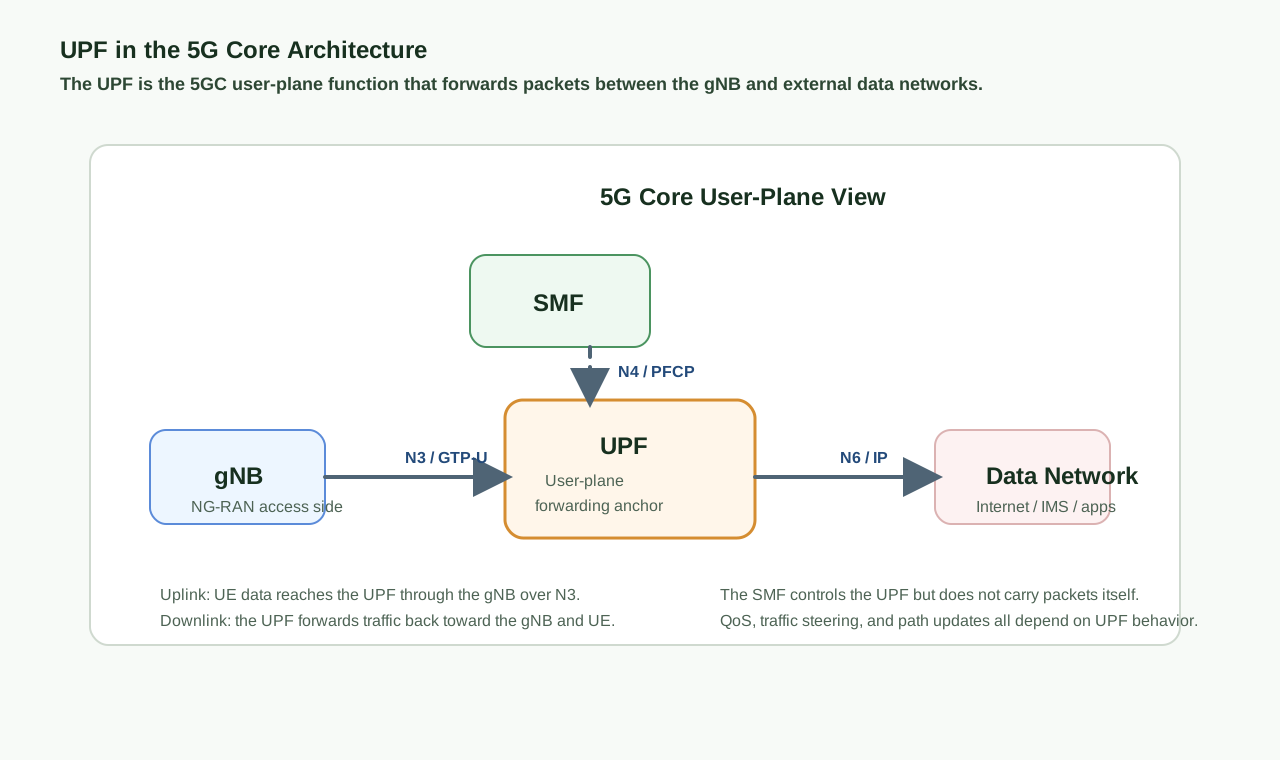
The UPF sits between the access-side user-plane path and the service-facing data-network path. That makes it the place where the 5G system stops being mostly control logic and becomes real packet transport.
What the UPF does in 5G
The simplest way to think about the UPF is this: the UPF is the packet-forwarding engine of the 5G Core. It handles the user plane only, but that does not make it simple. It is where routing, forwarding, QoS treatment, and traffic-steering decisions become real packet behavior.
- Packet forwarding.
- Routing and switching behavior for session traffic.
- Traffic steering and local breakout.
- QoS enforcement in the user plane.
- Buffering and forwarding behavior where relevant.
- User-plane anchoring for continuity across session and mobility events.
UPF interfaces
| Interface | Connects | Main role |
|---|---|---|
| N3 | gNB to UPF | User-plane transport, commonly using GTP-U over UDP/IP. |
| N6 | UPF to data network | Reachability toward Internet, IMS, enterprise, or application networks. |
| N4 | SMF to UPF | Control-plane programming of forwarding and session treatment, commonly using PFCP. |
| N9 | UPF to UPF | User-plane extension path for multi-UPF deployments. |
UPF and packet flow
UE -> gNB -> UPF -> Data Network
In the uplink, the UE sends traffic through the gNB and the UPF forwards it toward the data network. In the downlink, traffic arrives at the UPF from the service side and the UPF sends it back through the gNB toward the UE.
That is why the UPF is so visible in no-data problems. Registration may be healthy and session setup may look good, but real service still fails if the UPF cannot forward the packets correctly.
UPF and PFCP (N4 interface)
The SMF controls the UPF through N4, commonly using PFCP (Packet Forwarding Control Protocol). This is one of the clearest places where 5G separates control and user plane.
- Installs forwarding rules.
- Updates session state.
- Programs QoS-related behavior.
- Controls path updates and user-plane treatment.
UPF and PDU sessions
Every active PDU session needs a real user-plane anchor, and the UPF fills that role. The SMF owns the session logic, but the UPF is where the session becomes packet forwarding.
A useful shortcut is this: the SMF decides what the session should look like, and the UPF is where that session actually carries traffic.
UPF and QoS enforcement
The UPF is one of the main places where QoS enforcement becomes real. Policy decisions and QoS flow handling need to turn into actual packet treatment, and that happens in the user plane through the UPF.
- Packet classification.
- Traffic prioritization.
- Enforcement of user-plane session treatment derived from policy and QoS rules.
UPF and traffic steering
The UPF supports traffic steering toward different service destinations and deployment targets. That matters for local breakout, content optimization, enterprise access, and service-aware forwarding designs.
- Routing traffic to different destinations.
- Supporting policy-driven forwarding behavior.
- Enabling edge-oriented or service-specific breakout models.
UPF as a mobility anchor
During mobility, the UPF can remain the user-plane anchor while access-side paths change. That is one of the reasons 5G mobility is not only a RAN topic; the user-plane anchor and session treatment still need to remain coherent as the UE moves.
In practical terms, the gNB may change while the SMF updates the relevant path state and the UPF continues to anchor the user-plane side of the session.
UPF deployment models
| Model | Main idea |
|---|---|
| Centralized UPF | Placed deeper in the core for simpler architecture and more centralized control. |
| Distributed UPF | Placed closer to the edge for lower latency and local breakout. |
| Multi-UPF | Uses more than one UPF with paths such as N9 to support scale, optimization, or distributed services. |
UE -> gNB -> UPF1 -> UPF2 -> Data Network
UPF and network slicing
The UPF also participates in slice-aware data handling. Different slices may require different user-plane treatment, different UPF placement, or different path behavior, which is why UPF decisions often cannot be separated from slice and policy context.
UPF and edge computing
Edge computing is one of the best examples of why UPF placement matters. A UPF near the edge can support low-latency services, MEC, and local breakout so traffic does not always have to travel deep into the network before reaching the application.
UPF vs SMF
| Feature | SMF | UPF |
|---|---|---|
| Role | Control. | Data forwarding. |
| Plane | Control plane. | User plane. |
| Handles packets | No. | Yes. |
| Uses PFCP | Yes, to program the UPF. | Yes, as the controlled side of N4 behavior. |
UPF vs LTE PGW
| Feature | LTE PGW | 5G UPF |
|---|---|---|
| Architecture | EPC gateway role. | 5GC user-plane function. |
| Flexibility | More limited. | Higher, especially for distributed and edge deployment. |
| Deployment style | More traditionally centralized. | Can be centralized, distributed, or chained with other UPFs. |
Common UPF issues
- Packet loss or blackholing.
- GTP-U tunnel or N3 path issues.
- PFCP control failure on N4.
- QoS mismatch between intended treatment and real forwarding behavior.
- Routing or steering issues toward the data network.
- Latency or local-breakout placement problems.
FAQ
What is UPF in 5G?
The UPF is the User Plane Function in the 5G Core. It forwards user traffic between the NG-RAN and external data networks.
Does the UPF handle signaling?
No. The UPF is a user-plane function. Control signaling belongs to functions such as AMF and SMF.
What protocol is used on N3?
N3 commonly uses GTP-U over UDP/IP between the gNB and the UPF.
What controls the UPF?
The SMF controls the UPF through the N4 interface, commonly using PFCP.
What is the N6 interface?
N6 is the UPF-to-data-network interface where traffic leaves the 5G system toward Internet, IMS, or enterprise services.
Key takeaways
- The UPF is the data-plane function of the 5G Core.
- It forwards packets between the gNB and the data network over paths such as N3 and N6.
- The UPF is controlled by the SMF through N4, commonly using PFCP.
- Understanding the UPF is essential for diagnosing no-data, QoS, traffic steering, and edge breakout problems in 5G.
References
- 3GPP TS 23.501 - System architecture for the 5G System Primary 5GS architecture reference for UPF, reference points, distributed user plane, and session anchoring.
- 3GPP TS 23.502 - Procedures for the 5G System Procedure reference for session setup, path updates, and mobility-related user-plane behavior.
- 3GPP TS 23.503 - Policy and charging control framework for the 5G System Policy and QoS context relevant to how the UPF enforces user-plane treatment.
- 3GPP TS 29.244 - Interface between the Control Plane and the User Plane nodes PFCP reference for the N4 control relationship between SMF and UPF.