NRF in 5G Explained
The NRF (Network Repository Function) is a core function in the 5G Core (5GC) responsible for service registration, discovery, and selection of network functions. It is one of the main architectural foundations behind the Service-Based Architecture (SBA) in 5G.
In practical terms, the NRF acts like the directory of the 5G Core. Functions such as AMF, SMF, PCF, UDM, AUSF, and NSSF register their capabilities there so other functions can discover and use them dynamically.
Quick facts
| Full name | Network Repository Function. |
|---|---|
| Main role | Acts as the service registry and discovery point for network functions inside the 5G Core service-based architecture. |
| Works with | AMF, SMF, PCF, UDM, AUSF, NSSF, and other network functions that need to register, discover, or select service instances. |
| Core idea | Dynamic service registration and discovery instead of hard-coded static node relationships. |
| Key reference point | Nnrf for NF registration and NF discovery in the service-based 5GC. |
| Why it matters | If NRF behavior is wrong, control functions may exist but still fail to find or use each other correctly. |
NRF in the 5G Core architecture
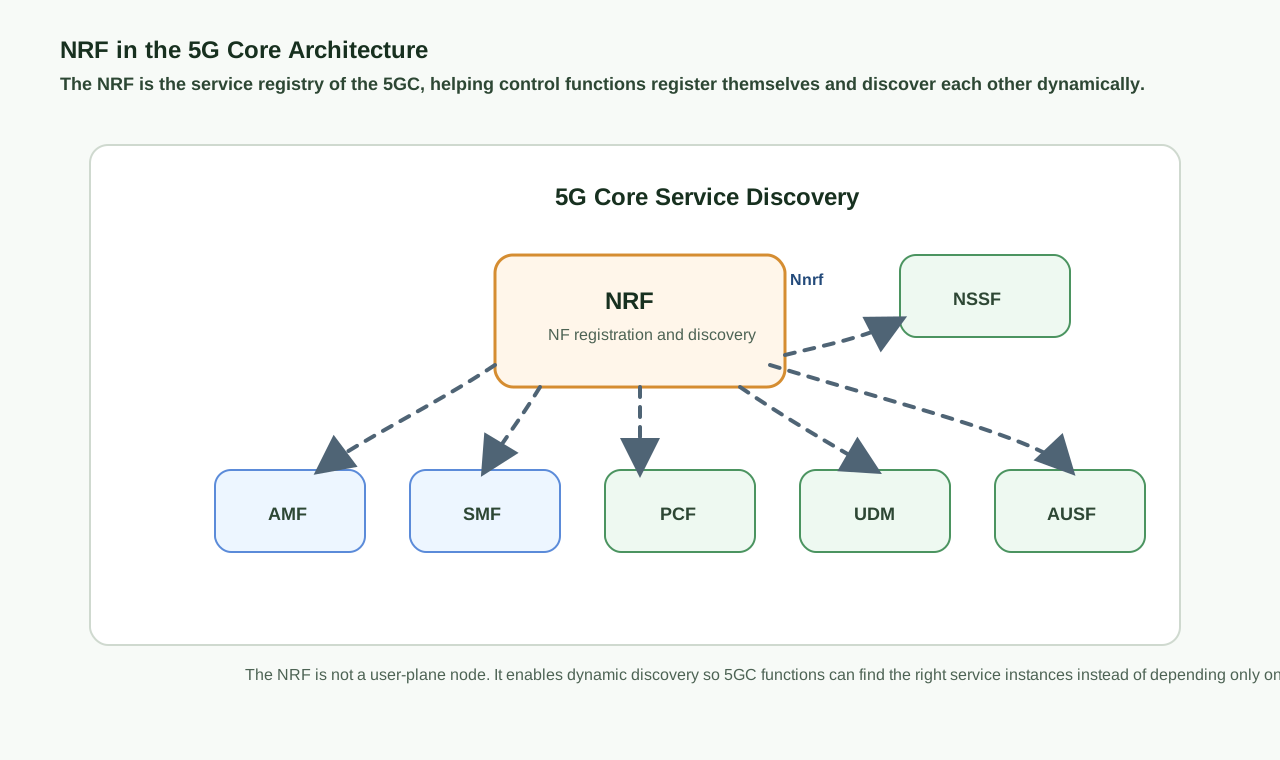
The NRF does not handle user-plane packets and it is not a traditional gateway. It is the control-plane registry that makes the modular 5GC design practical at runtime.
What does the NRF do?
A simple way to think about the NRF is this: the NRF is the service directory of the 5G Core. It knows which functions are available, what services they expose, and how other functions can find them.
- Handles network function registration.
- Supports service discovery.
- Helps with NF selection.
- Maintains NF profiles and capabilities.
- Enables dynamic service-based communication.
NRF and Service-Based Architecture (SBA)
The 5G Core is not built only around fixed point-to-point node relationships. It uses a service-based architecture where functions expose services and consume services from each other. The NRF is one of the main reasons that model works in practice.
| Without NRF | With NRF |
|---|---|
| More static function knowledge and tighter coupling. | Dynamic discovery and more scalable service interaction. |
| Harder to add or replace instances cleanly. | Easier to scale, replace, or distribute control functions. |
NRF functions in detail
| Function | Main idea |
|---|---|
| NF registration | Each network function registers its presence and exposed services. |
| NF discovery | Functions query the NRF to find matching service instances. |
| NF selection | The discovery result can help choose the right function instance based on policy, topology, or other criteria. |
| NF profile management | NRF stores service, capability, and instance-related profile information. |
NRF interfaces
| Interface | Main role |
|---|---|
| Nnrf | Used for NF registration and NF discovery in the 5GC. |
| SBI context | NRF operates as part of the wider service-based interface model used for control-plane APIs in 5G. |
NRF workflow
Registration:   NF -> NRF
Discovery:      NF -> NRF -> NF list
Communication:  NF1 -> NRF-assisted discovery -> NF2
The NRF does not usually sit inline for every control-plane message after discovery, but it is central to how the functions find each other in the first place and how that function map stays current.
NRF and network functions
Most major 5GC functions interact with the NRF at some point.
- AMF can discover related control functions it needs for registration and security handling.
- SMF can discover functions involved in session control and policy behavior.
- PCF and UDM still live in the same service-discovery ecosystem.
- NSSF can participate in slice-aware discovery patterns where needed.
NRF and network slicing
The NRF can support slice-aware discovery, which matters in more advanced 5GC deployments. In other words, discovery is not always generic. The network may need to find the function instance that is right for a particular slice or service context.
NRF and load balancing
Because the NRF maintains function profiles and instance information, it helps the system choose between available instances more intelligently. This supports more balanced and more resilient control-plane behavior in distributed deployments.
NRF and scalability
One of the biggest operational advantages of the NRF is that it makes dynamic scaling more practical. New function instances can be introduced, registered, and discovered without forcing the whole control plane back into a static configuration mindset.
NRF vs LTE architecture
| Feature | LTE EPC | 5G with NRF |
|---|---|---|
| Discovery style | More static node knowledge. | Dynamic service registration and discovery. |
| Architecture | More node-and-interface-centric. | Service-based and more modular. |
| Flexibility | Lower. | Higher, especially for distributed cloud-native control. |
NRF and security
The NRF matters to security because service discovery should not be open-ended or uncontrolled. The 5GC still needs trusted registration, authorized discovery, and sensible control over which functions can use which services.
Common NRF issues
- NF registration failure.
- Service discovery failure even though the target function exists.
- Incorrect or stale NF profile information.
- Load imbalance caused by poor discovery or selection behavior.
- API-level communication problems in the service-based control plane.
FAQ
What is NRF in 5G?
The NRF is the Network Repository Function in the 5G Core. It provides service registration and discovery for network functions.
Why is NRF important?
Because it enables dynamic communication between network functions instead of relying only on static configuration.
What protocol style does NRF use?
NRF belongs to the 5G service-based architecture, where functions expose services through service-based interfaces commonly associated with HTTP-based APIs.
Does LTE have NRF?
No. LTE EPC does not use an NRF-style service registry in the same architectural form as the 5G Core.
Which functions use NRF?
AMF, SMF, PCF, UDM, AUSF, NSSF, and other 5GC functions can register with and discover services through the NRF.
Key takeaways
- The NRF enables service discovery in the 5G Core.
- It acts as the central registry of network functions in the service-based architecture.
- Understanding NRF is essential for diagnosing SBA discovery, control-function coordination, and dynamic scaling issues in 5G.
References
- 3GPP TS 23.501 - System architecture for the 5G System Primary 5GS architecture reference for NRF, service-based architecture, and NF interaction patterns.
- 3GPP TS 23.502 - Procedures for the 5G System Procedure reference for how service discovery and control-function coordination appear in 5GC procedures.
- 3GPP TS 29.510 - Network Repository Services Service specification for NRF registration and discovery behavior in the service-based 5GC.