NSSF in 5G Explained
The NSSF (Network Slice Selection Function) is a core function in the 5G Core (5GC) responsible for helping the network choose the appropriate network slice for a UE during registration and slice-aware service handling.
In practical terms, the split is clear: NSSF supports slice selection, AMF uses that information in access-side control, SMF uses it when building session behavior inside the slice, and PCF applies slice-specific policy on top of that selection.
Quick facts
| Full name | Network Slice Selection Function. |
|---|---|
| Main role | Helps determine which network slice or slices a UE can use during registration and session-related handling. |
| Works with | AMF for slice-aware access control, SMF for session behavior inside the selected slice, PCF for slice-specific policy, and UDM for subscriber slice entitlement. |
| Key concepts | Network slicing, NSSAI, requested NSSAI, allowed NSSAI, and slice-aware service differentiation. |
| Key reference points | N22 toward AMF, with wider service-based interactions where slice-aware control needs discovery or coordination. |
| Why it matters | If slice selection is wrong, the UE may register to the wrong service context, fail to obtain the intended session behavior, or hit policy and entitlement mismatches. |
NSSF in the 5G Core architecture
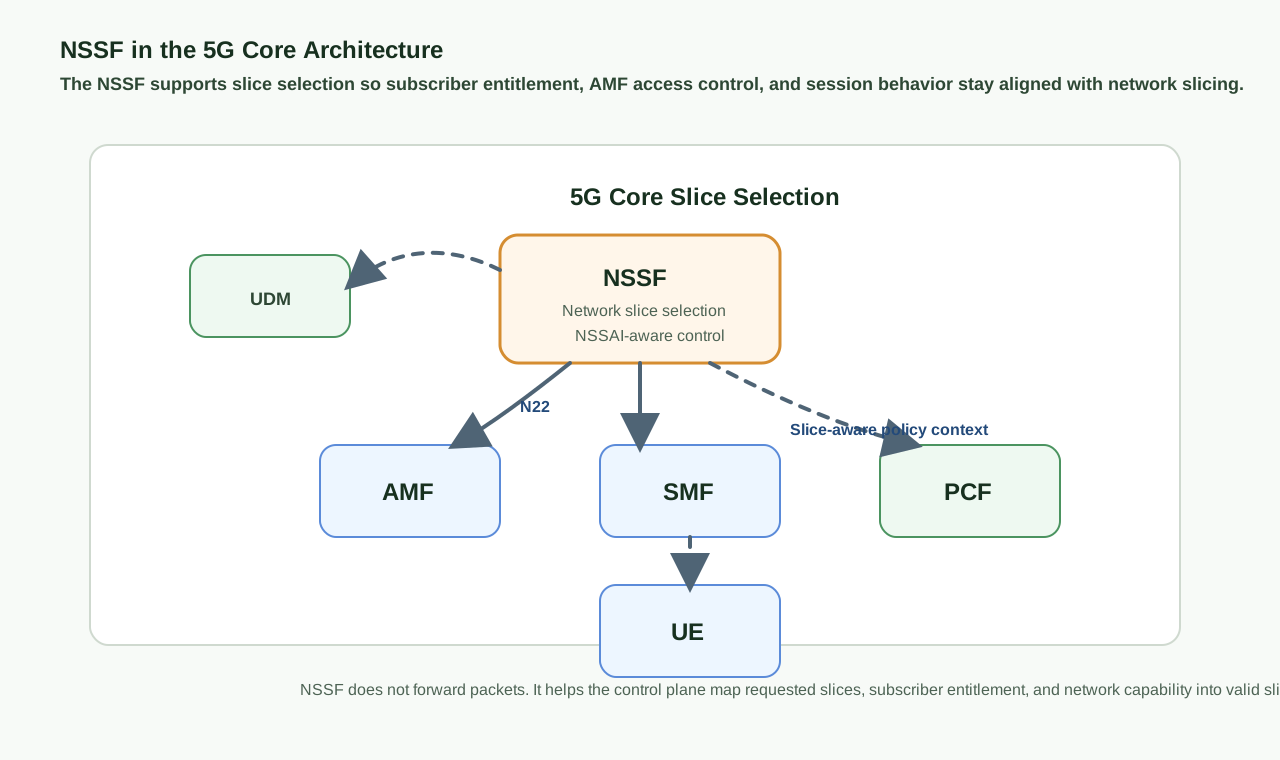
The NSSF sits in the control plane and supports one of the most 5G-specific architectural ideas: network slicing. It is not a packet-forwarding node. It helps determine which logical service environment the UE should be placed into.
What does the NSSF do?
A simple way to think about the NSSF is this: the NSSF is the slice-selection guide of the 5G Core. It helps map UE requests and subscriber entitlement into the slice or slices that the network should allow and use.
- Selects or helps validate appropriate slices for the UE.
- Maps requested slice information to allowed slice behavior.
- Provides slice information to AMF and the wider 5GC control path.
- Supports slice-aware service differentiation.
- Helps keep slice handling aligned with subscriber entitlement and network capability.
What is a network slice?
A network slice is a logical network instance built to support a particular type of service behavior. Instead of treating all users and services the same way, 5G can expose more than one logical service environment on the same physical infrastructure.
| Slice idea | Main purpose |
|---|---|
| eMBB | Enhanced mobile broadband behavior with high throughput focus. |
| URLLC | Very low-latency and high-reliability service behavior. |
| mMTC | Massive device scale and IoT-oriented service behavior. |
NSSAI in 5G
The NSSAI (Network Slice Selection Assistance Information) is how slice identity is carried in the system. It gives the network a structured way to understand what the UE is asking for and what the network is prepared to allow.
- Requested NSSAI reflects what the UE asks for.
- Allowed NSSAI reflects what the network permits.
- Configured NSSAI reflects slice information already provisioned for the UE context.
At the identifier level, slices are commonly described through SST and optionally SD, which together help distinguish slice type and slice variant.
NSSF and slice selection process
UE -> AMF -> NSSF -> AMF -> SMF
- The UE arrives with requested slice information.
- The AMF evaluates the request and consults the NSSF.
- The NSSF helps determine which slice or slices are allowed and appropriate.
- The AMF continues access-side handling with that slice context.
- The SMF builds session behavior within the selected slice context.
NSSF and AMF interaction
The AMF is the most visible companion to the NSSF in the access path. When the UE registers, the AMF needs to understand whether the requested slice is allowed and how the slice selection should shape further control behavior.
- Requested NSSAI validation.
- Allowed NSSAI determination.
- Slice-aware access control behavior.
NSSF and SMF interaction
The SMF uses slice context when establishing and controlling sessions. Slice selection is not only an access concern. It also affects how the user-plane path and session behavior should be built inside the 5GC.
NSSF and PCF interaction
The PCF provides slice-aware policy on top of slice selection. A useful mental model is that the NSSF helps answer which slice, while the PCF helps answer how that slice should behave from a policy and QoS perspective.
NSSF and UDM interaction
Slice selection becomes much more reliable when it is aligned with subscriber entitlement. That is why NSSF reading often goes together with UDM. Subscriber slice subscription data helps the network decide which slice choices actually make sense for the UE.
NSSF interfaces
| Interface | Connects | Main role |
|---|---|---|
| N22 | AMF to NSSF | Slice-selection information and slice-aware access support. |
| N31 | NSSF to NRF | Service discovery support where needed in the wider SBA context. |
NSSF in Service-Based Architecture
The NSSF is a service-based function in the 5GC. That matters because slice selection is not bolted onto the system as an afterthought. It is part of the wider modular control architecture that lets 5G expose differentiated services and logical network behavior.
NSSF and roaming
In roaming scenarios, slice handling can become more complicated because home and visited networks may not expose slices in exactly the same way. The NSSF helps the control plane manage that mapping so slice-aware service remains coherent across network boundaries.
Benefits of NSSF
- Enables network slicing as a real operational feature.
- Improves service differentiation across different use cases.
- Helps align subscriber entitlement with actual slice access.
- Supports more efficient resource and service separation.
NSSF vs traditional networks
| Feature | Traditional LTE-era model | 5G with NSSF |
|---|---|---|
| Slicing | Not exposed as a native architecture feature in the same way. | Native slice-aware control support. |
| Service differentiation | More limited and less slice-centric. | More explicit and slice-aware. |
| Flexibility | Lower. | Higher, especially for multi-service 5GC design. |
Common NSSF issues
- Incorrect slice selection for the UE.
- NSSAI mismatch between UE request and network allowance.
- Subscriber slice entitlement issues.
- Roaming-related slice mapping problems.
- Policy and slice behavior that do not line up across NSSF, PCF, and session control.
FAQ
What is NSSF in 5G?
The NSSF is the Network Slice Selection Function in the 5G Core. It helps determine which slice or slices a UE can use.
What is NSSAI?
NSSAI is the information used to identify and manage requested, allowed, or configured network slices.
Does NSSF enforce policies?
No. NSSF supports slice selection. Policy behavior is handled through other functions such as PCF, SMF, and the wider 5GC path.
Why is NSSF important?
Because correct network slicing depends on proper slice selection, subscriber entitlement matching, and alignment across the 5GC control plane.
Which functions work closely with NSSF?
AMF, SMF, PCF, and UDM all matter in slice-aware deployments.
Key takeaways
- The NSSF is the 5GC function that enables network slice selection.
- It works with NSSAI and supports slice-aware behavior across AMF, SMF, PCF, and UDM.
- Understanding NSSF is essential for diagnosing slice mismatch, registration issues, entitlement problems, and slice-aware session behavior in 5G.
References
- 3GPP TS 23.501 - System architecture for the 5G System Primary 5GS architecture reference for network slicing, NSSF role, NSSAI handling, and 5GC function relationships.
- 3GPP TS 23.502 - Procedures for the 5G System Procedure reference for registration, slice selection behavior, and slice-aware session handling.
- 3GPP TS 29.531 - Network Slice Selection Services Service specification for NSSF services in the service-based 5GC.
- 3GPP TS 23.503 - Policy and charging control framework for the 5G System Useful companion reference for slice-aware policy treatment around PCF and wider 5GC behavior.