What does Service Request do in 5G?
It asks the network to restore active service when the UE is already registered.
| Protocol | nas | Network | 5g |
|---|---|---|---|
| Spec | 3GPP TS 24.501 | Spec Section | 8.2.15 |
| Direction | UE to AMF | Message Type | 5GMM signaling |
| Full message name | 5G NAS - Service Request |
|---|---|
| Protocol | NAS |
| Technology | 5G |
| Direction | UE to AMF |
| Interface | N1 |
| Signaling bearer / channel | NAS signaling / Dedicated NAS message carried after access or resume-related signaling |
| Typical trigger | UE has uplink or downlink service need while already registered but not in active connected service state. |
| Main purpose | Lets the UE request service handling without performing a full fresh registration, typically to resume data or signaling activity using existing context. |
| Main specification | 3GPP TS 24.501, 8.2.15 |
| Release added | Release 15 |
| Procedures where used | Service Request, Idle / Inactive Service Resume |
| Related timers | T3517, T3525 |
Service Request is the NAS message the UE uses to request service resumption when it already has a valid registration context but needs active signaling again.
Lets the UE request service handling without performing a full fresh registration, typically to resume data or signaling activity using existing context.
Service Request is the UE asking the network to restart active service using its existing registration context.
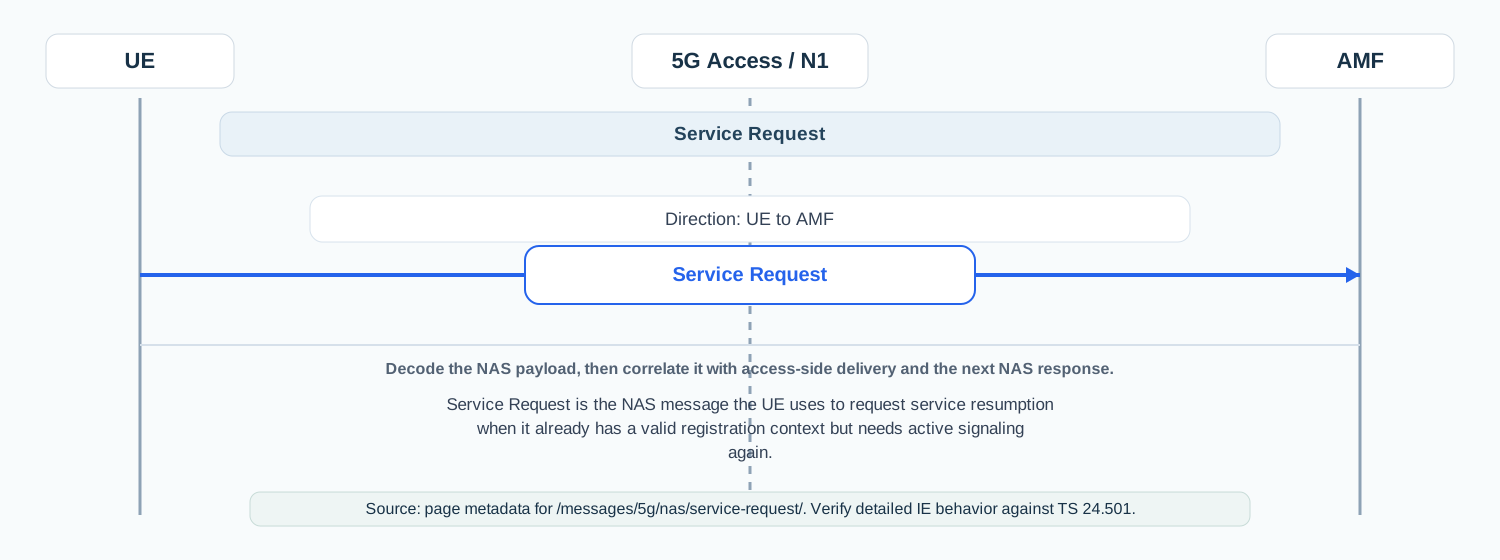
Call flow position: Used when the UE already has registration context and wants active service restored.
Typical state: UE is registered but needs active service handling.
Preconditions:
Next likely message: Service Accept or Service Reject
Previous message(s): Paging, RRC Resume, Stored registration context
Next message(s): Service Accept, Service Reject
Security context: Normally protected because Service Request usually relies on an existing NAS security context.
This message is not typically analyzed as ASN.1 on the wire. It is usually read as a NAS or protocol field structure instead.
Service Request is a NAS 24.501 message, not ASN.1.
Service Request
  Extended Protocol Discriminator: 5G Mobility Management
  Security Header Type: Integrity protected and ciphered
  Message Type: Service Request
  Service Type: Mobile originating data
| IE | Presence | Description |
|---|---|---|
Service type | Mandatory | Explains what kind of service handling the UE is requesting. |
TMSI-based identity context | Mandatory | Lets the network correlate the request with the UE's existing registered context. |
Service typeExplains what kind of service handling the UE is requesting.
Presence: Mandatory
In practice: In practice, compare this field with the original request and with any later release-dependent optional fields so you can see whether the network accepted the same service model the UE asked for.
TMSI-based identity contextLets the network correlate the request with the UE's existing registered context.
Presence: Mandatory
In practice: In practice, compare this field with the original request and with any later release-dependent optional fields so you can see whether the network accepted the same service model the UE asked for.
Likely cause: The issue may be in NAS service handling rather than the earlier paging or radio path.
What to inspect: Check Service Request fields, security state, and the resulting Service Accept or Reject.
Next step: Correlate with AMF decision and session state.
It asks the network to restore active service when the UE is already registered.
Decode this message with the 3GPP Decoder, inspect the related message database, or open the matching call flow to see where this signaling step fits in the full procedure.