What does Service Accept mean in 5G?
It means the network accepted the UE's service request and active service can continue.
| Protocol | nas | Network | 5g |
|---|---|---|---|
| Spec | 3GPP TS 24.501 | Spec Section | 8.2.17 |
| Direction | AMF to UE | Message Type | 5GMM signaling |
| Full message name | 5G NAS - Service Accept |
|---|---|
| Protocol | NAS |
| Technology | 5G |
| Direction | AMF to UE |
| Interface | N1 |
| Signaling bearer / channel | NAS signaling / Dedicated NAS message, commonly via DL Information Transfer |
| Typical trigger | Sent after the AMF accepts a Service Request. |
| Main purpose | Confirms successful service continuation after Service Request. |
| Main specification | 3GPP TS 24.501, 8.2.17 |
| Release added | Release 15 |
| Procedures where used | Service Request |
Service Accept is the NAS message confirming that the network accepted the UE's service request and that active service can continue.
Confirms successful service continuation after Service Request.
Service Accept means the network approved the UE's request to continue active service.
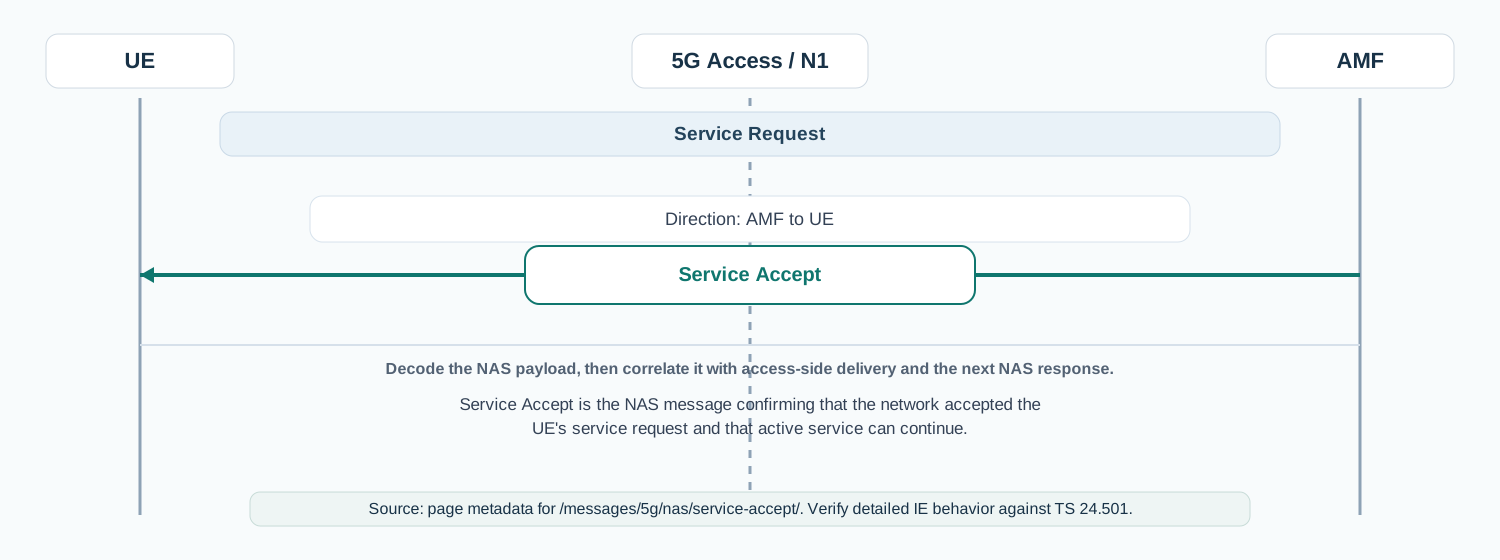
Call flow position: Positive network response after Service Request.
Typical state: UE remains registered and returns to active service use.
Preconditions:
Next likely message: Normal data or signaling activity
Previous message(s): Service Request
Next message(s): Normal user-plane or signaling activity
Security context: Normally protected because it follows a protected Service Request path.
This message is not typically analyzed as ASN.1 on the wire. It is usually read as a NAS or protocol field structure instead.
Service Accept is a NAS 24.501 message.
Service Accept
  Extended Protocol Discriminator: 5G Mobility Management
  Security Header Type: Integrity protected and ciphered
  Message Type: Service Accept
| IE | Presence | Description |
|---|---|---|
PDU session status / optional context | Optional | Optional context that can help explain session state following service restoration. |
PDU session status / optional contextOptional context that can help explain session state following service restoration.
Presence: Optional
In practice: In practice, compare this field with the original request and with any later release-dependent optional fields so you can see whether the network accepted the same service model the UE asked for.
Likely cause: The service request path succeeded, but the later problem may be in session, user-plane, or radio-layer handling.
What to inspect: Check PDU session state, user-plane setup, and radio bearer behavior.
Next step: Move from 5GMM analysis into PDU session and RAN troubleshooting.
It means the network accepted the UE's service request and active service can continue.
Decode this message with the 3GPP Decoder, inspect the related message database, or open the matching call flow to see where this signaling step fits in the full procedure.