N3 Interface in 5G Explained
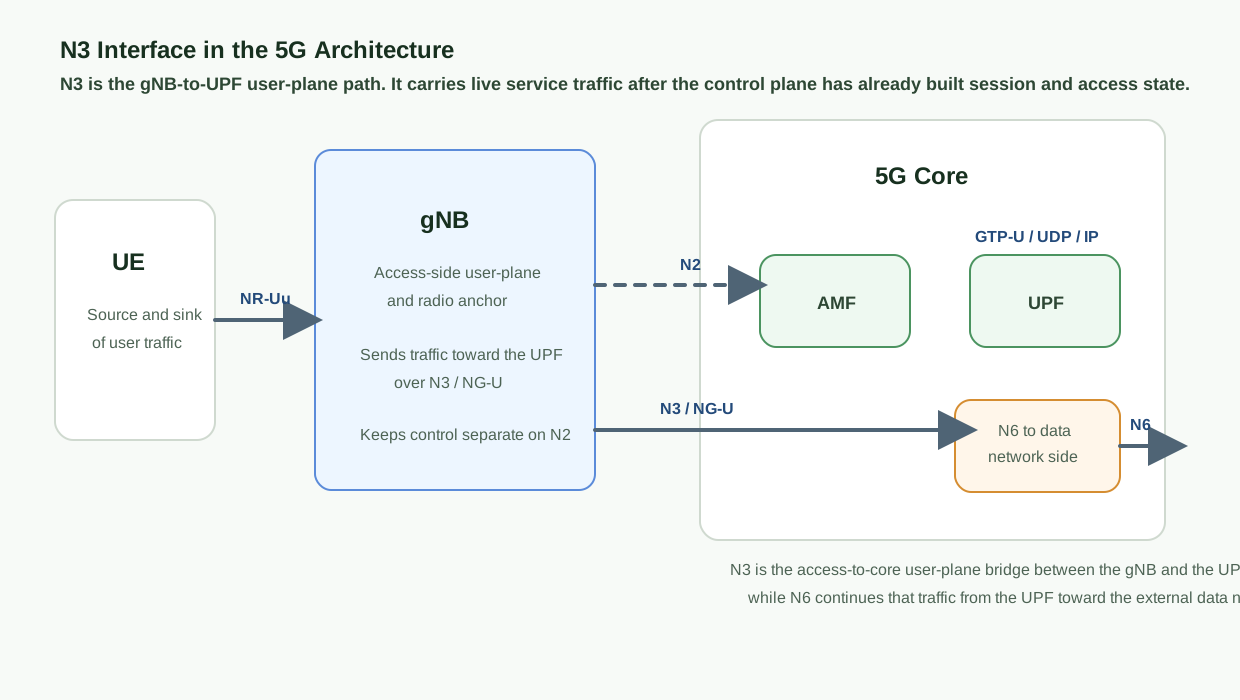
The N3 interface is the user-plane reference point between the access network and the UPF in the 5G System. In practical deployment terms, this means the N3 interface connects the gNB in the NG-RAN to the UPF in the 5G Core.
N3 matters because it carries the actual user data between the radio-access network and the 5GC user plane. If N2 is the control-plane path to the AMF, N3 is the data path to the UPF. In real network behavior, N3 is where active PDU session traffic leaves the gNB and enters the 5GC user plane.
Quick facts
| What it is | N3 is the user-plane reference point between the access network and the UPF. |
|---|---|
| Main protocol | N3 mainly uses GTP-U on the gNB-to-UPF user-plane path. |
| What it carries | Active PDU session traffic, application data, IMS-related user traffic, and the access-side user-plane path toward the 5GC. |
| How it relates to NG | N3 is the 5GS user-plane view of the NG-U side of the NG interface. |
| Best companion pages | Pair N3 with N2, NG, UPF, and PDU session establishment or mobility procedures. |
| Specification baseline | 3GPP TS 23.501, TS 29.281, and TS 38.401. |
Why N3 matters
N3 is one of the fastest ways to separate a successful control-plane story from a broken data-plane story. A UE may register perfectly, authenticate cleanly, and look healthy from the AMF side, yet still have no usable service because the user-plane path between the gNB and the UPF is broken.
That makes N3 one of the most important interfaces for real service troubleshooting. When the user says “5G is connected but nothing loads,” N3 is often one of the first places worth checking.
N3 interface in the 5G architecture
What the N3 interface is used for
- Traffic belonging to active PDU sessions.
- Internet and application traffic leaving the access network.
- IMS and service traffic that needs to reach the data network through the UPF.
- QoS-sensitive user-plane data after the control plane has completed session setup.
A simple summary is that N3 is the main access-to-core user-plane interface between the gNB and the UPF.
N3 is the user-plane side of NG
The broader NG interface in 5G is split into NG-C for the control plane and NG-U for the user plane. N3 is the 5GS user-plane view of that access-to-core relationship, while N2 is the control-plane companion toward the AMF.
| Interface | Connects | Plane | Main role |
|---|---|---|---|
| N2 / NG-C | gNB and AMF | Control plane | Signaling, NAS transport, and access-side control coordination. |
| N3 / NG-U | gNB and UPF | User plane | User data transport. |
GTP-U on N3
The main user-plane protocol on N3 is GTP-U. This is the tunnel protocol that carries user traffic between the gNB and the UPF on the access-to-core user plane.
| Layer | Role on N3 |
|---|---|
| User data | The actual service traffic for the UE. |
| GTP-U | Encapsulates the user-plane packets between the gNB and UPF. |
| UDP / IP | Transport-layer and network-layer carriage under the GTP-U tunnel. |
| Transport network | Underlying path that still has to be healthy for the user plane to work. |
This layered view matters because an N3 issue may be a GTP-U tunnel problem, UDP or IP transport problem, or a mismatch between session state and the actual user-plane tunnel.
N3 and the UPF
The UPF is the core-side endpoint of N3. The gNB terminates the NR access side, the UPF anchors the 5GC user plane, and N3 is the tunnelled bridge between them.
In practical terms, N3 is the first core-facing user-plane hop after the radio side. Once traffic crosses N3, it is inside the 5GC user-plane environment and can continue onward over N6 toward the data network.
N3 and PDU sessions
N3 is tightly tied to PDU sessions. The control plane creates and manages session state, but the user plane is what actually carries the packets, and N3 is the access-to-core user-plane segment for that session.
- The session is established through control-plane procedures.
- The user-plane traffic becomes real service delivery only when the N3 path is healthy.
- A session that exists on paper but has a broken N3 path will still look like “no data” to the user.
N3 and QoS flow transport
In 5G, the user-plane architecture is built around QoS flows inside PDU sessions, with the access side mapping those flows to radio bearers. N3 is the tunnelled user-plane segment that connects those access-side decisions to the 5GC user-plane path.
That is why QoS problems can appear to be:
- a radio-side bearer issue,
- a policy issue,
- or an N3 user-plane delivery issue.
N3 and mobility continuity
N3 is important during mobility because the user-plane path must remain continuous while the UE changes radio context. The gNB may change during handover, but the UPF remains the user-plane function in the core, and the N3 path has to be updated correctly to keep service alive.
This is one of the most practical reasons to understand N3: a handover can look successful on the signaling side while user data still fails because the N3 path is no longer aligned with the updated access-side state.
N3 vs N2
| Interface | Plane | Connects | Used for |
|---|---|---|---|
| N2 | Control plane | gNB and AMF | Signaling, UE context, NAS transport, paging, and mobility coordination. |
| N3 | User plane | gNB and UPF | User data transport. |
A useful rule of thumb is simple: if the issue is about registration, paging, NAS, or AMF signaling, inspect N2. If the issue is about actual data traffic, inspect N3.
N3 vs N6
| Interface | Connects | Main role |
|---|---|---|
| N3 | gNB and UPF | Access-to-core user-plane transport. |
| N6 | UPF and data network | Core-to-external-network connectivity. |
N3 is still inside the 5GS user-plane path. N6 is the point where that path exits the core toward the outside data network.
N3 and security
N3 is not just an architecture-diagram label. It is a real user-plane interface with transport and deployment security implications. Operators need to think about the user-plane path between the gNB and the UPF as a live transport domain that can affect confidentiality, integrity assumptions, and operational trust.
Common troubleshooting angles for N3
| Symptom | What to check on N3 |
|---|---|
| Registration succeeds but no data flows | Check whether the N3 user-plane tunnel exists and whether the UPF is actually receiving traffic. |
| Tunnel misconfiguration | Check the GTP-U tunnel state and whether it matches the expected session context. |
| Post-handover traffic failure | Check whether the user-plane path was updated correctly after the access-side change. |
| QoS behavior looks wrong | Check whether the problem is in radio mapping, policy, or the user-plane delivery path on N3. |
| Packet loss or blackholing | Check transport reachability below GTP-U as well as UPF-side forwarding behavior. |
FAQ
What is the N3 interface in 5G?
The N3 interface is the user-plane reference point between the access network and the UPF in the 5G System.
What protocol runs on N3?
The main user-plane protocol on N3 is GTP-U.
What does N3 connect?
N3 connects the gNB in the NG-RAN to the UPF in the 5G Core.
What is the difference between N2 and N3?
N2 is the control-plane interface between gNB and AMF, while N3 is the user-plane interface between gNB and UPF.
Why is N3 important?
Because it carries the actual user data for PDU sessions between the NG-RAN and the 5GC user plane. Without a working N3 path, data service fails even if registration succeeds.
Key takeaways
- N3 is the user-plane reference point between the access network and the UPF.
- It is the user-plane side of the NG / NG-U access-to-core relationship.
- The main protocol on N3 is GTP-U.
- N3 is essential for real PDU session data transport, QoS-aware user-plane delivery, and mobility continuity.
- Understanding N3 is essential for diagnosing no-data problems, UPF path issues, post-handover traffic failures, and user-plane tunnel problems.