E1 Interface in 5G Explained
The E1 interface is the interface between the gNB-CU-CP and the gNB-CU-UP in the 5G NG-RAN architecture. In 3GPP architecture, a gNB may consist of a gNB-CU-CP, one or more gNB-CU-UPs, and one or more gNB-DUs. E1 is the internal interface that interconnects the control-plane and user-plane parts of the split CU.
This makes E1 one of the most important interfaces in modern 5G cloud-RAN architecture. F1 splits the gNB into CU and DU. E1 goes one step further and splits the CU itself into separate control-plane and user-plane units.
Quick facts
| What it is | The E1 interface connects gNB-CU-CP and gNB-CU-UP inside the split CU architecture. |
|---|---|
| Main signaling protocol | E1AP is the 5G radio network layer signaling protocol used on E1. |
| Transport layer | E1 signaling is carried over SCTP/IP in the transport network layer. |
| Main engineering use | E1 coordinates CU control-plane logic with CU user-plane handling, bearer context state, and split-CU deployment behavior. |
| What to pair it with | Use this page with CU-DU split, F1 interface, gNB architecture, and 5G RAN troubleshooting. |
| Specification baseline | 3GPP TS 38.401, TS 38.460, TS 38.463, and TS 37.480. |
E1 interface in the 5G architecture
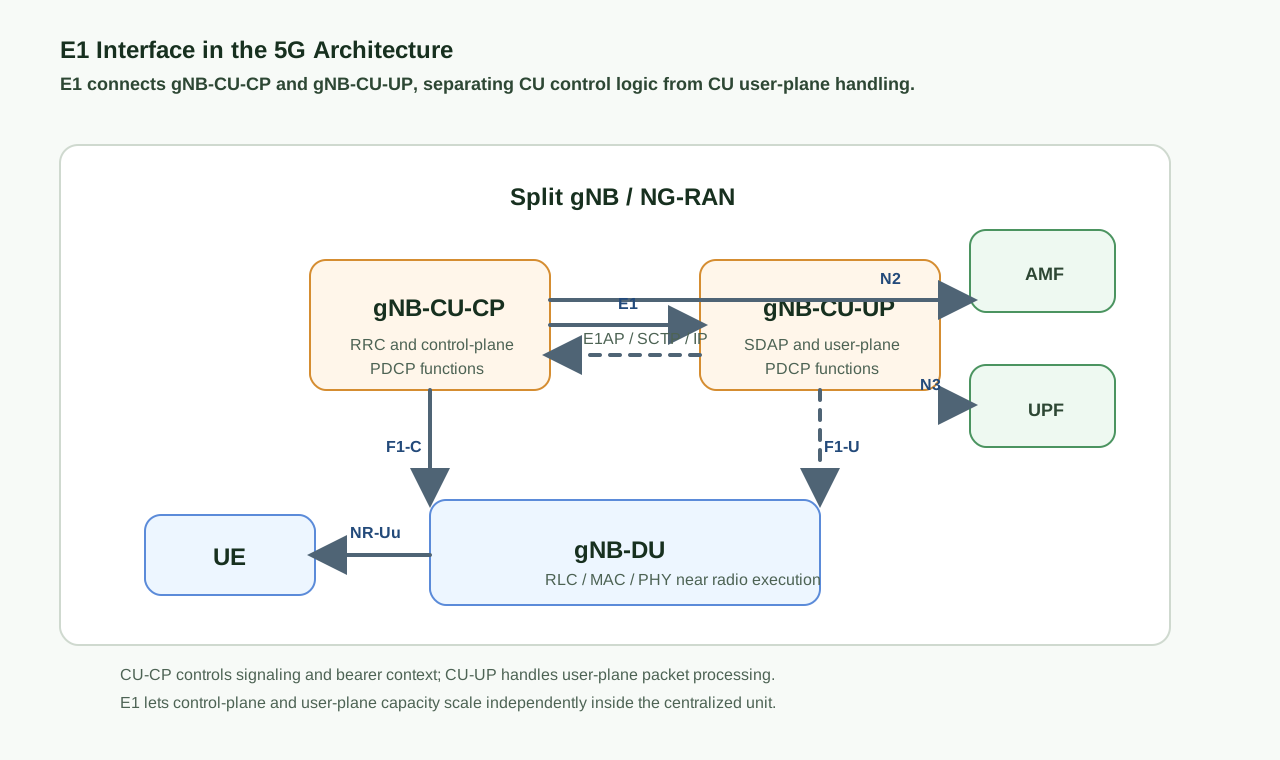
In this split-gNB model, the gNB-CU-CP handles control-plane functions, the gNB-CU-UP handles user-plane functions, the gNB-DU handles lower-layer radio-distributed functions, and E1 connects the two CU-side units so they can work as one logical gNB.
A simple way to remember it is: F1 splits the gNB into CU and DU, while E1 further splits the CU into control-plane and user-plane parts.
What the E1 interface is used for
The E1 interface coordinates the control-plane and user-plane parts of a split gNB-CU. In practice, E1 is used for setting up the relationship between CU-CP and CU-UP, exchanging application-level configuration data, managing bearer context, updating transport-network-layer associations, and coordinating UE-specific user-plane behavior under control-plane direction.
TS 38.460 describes E1 as the means for interconnecting the gNB-CU-CP and gNB-CU-UP, while TS 38.463 defines E1AP as the radio network layer signaling protocol used on the interface.
Why the E1 interface matters
The E1 interface matters because it enables a further split inside the CU, giving operators and vendors more deployment flexibility. Without E1, CU control-plane and user-plane scaling would remain tied together. With E1, the control plane can scale independently from the user plane.
That means user-plane-heavy deployments can add CU-UP capacity without changing CU-CP logic, and user-plane placement can become more flexible in cloud-native and edge-oriented RAN designs. This is an engineering inference from the split-gNB model and the E1 specification family.
gNB-CU-CP and gNB-CU-UP
| Logical node | Hosts | Terminates |
|---|---|---|
| gNB-CU-CP | RRC and the control-plane part of PDCP. | E1 toward gNB-CU-UP and F1-C toward gNB-DU. |
| gNB-CU-UP | SDAP and the user-plane part of PDCP. | E1 toward gNB-CU-CP and F1-U toward gNB-DU. |
This split makes clear that CU control and CU user transport do not have to live in the same logical node.
E1AP: the main signaling protocol on E1
The main signaling protocol on the E1 interface is E1AP. TS 38.463 defines E1AP as the 5G radio network layer signaling protocol for the E1 interface.
E1AP is used when the CU-CP sets up or updates a relationship with the CU-UP, when bearer context for a UE must be established, modified, or released in the CU-UP, and when transport or application-level coordination data must be exchanged.
Protocol stack on E1
The E1 transport network layer is based on SCTP over IP, and the application-layer protocol is E1AP.
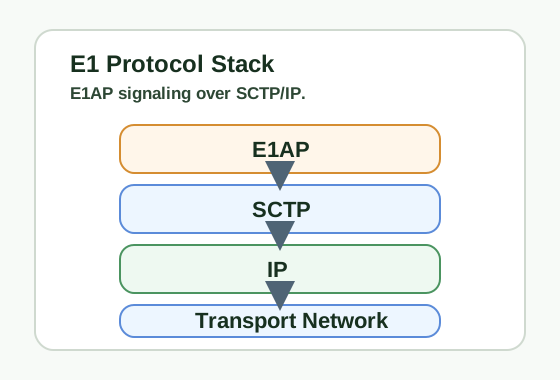
This matters operationally because E1 issues can come from E1AP procedure failures, SCTP association failures, IP reachability problems, or transport-network association mismanagement.
E1 setup procedure
One of the key E1 functions is E1 Setup. E1 setup exchanges the application-level data needed for the gNB-CU-UP and gNB-CU-CP to interoperate correctly on the E1 interface. Depending on transport-network association establishment, setup may be initiated by either side.
Before UE-specific bearer context can be managed, the E1 relationship must exist, application-level capability or configuration data must be exchanged, and both units must know how to interoperate.
E1 and bearer context management
One of the most important operational roles of E1 is Bearer Context Management. The split-CU architecture means the CU-CP controls UE and session-related logic, while the CU-UP handles the user-plane side. The two must stay synchronized for each UE and relevant bearer.
This is why E1 is not just a static management interface. It is actively involved in UE-specific user-plane handling through bearer context establishment, modification, and release behavior.
E1 and mobility / resume procedures
E1 bearer-context procedures are involved when user-plane and access-side state must be preserved or updated, including scenarios where PDCP status needs to be preserved or where the UE resumes from RRC Inactive.
This makes E1 part of real UE procedure execution: mobility-related state handling, resume-related state handling, forwarding coordination, and user-plane continuity all depend on CU-CP and CU-UP staying aligned.
E1 and transport network layer associations
E1 is not only about application signaling. It also depends on the transport side being healthy. In practice, that means SCTP associations, IP reachability, and transport-network-layer association management all matter for stable CU-CP and CU-UP communication.
This is one of the reasons E1 troubleshooting has to think in layers: an E1AP problem may be real application signaling trouble, but it may also be driven by an SCTP or transport-association issue below it.
E1 and the CU-DU split
The best way to understand E1 is in relation to F1.
| Interface | Connects | Main role |
|---|---|---|
| F1 | gNB-CU to gNB-DU | Split between centralized and distributed RAN functions. |
| E1 | gNB-CU-CP to gNB-CU-UP | Split inside the CU itself. |
F1 makes a split gNB possible. E1 makes a further split inside the CU possible. Together, they define one of the most flexible deployment patterns in 5G RAN architecture.
E1 and cloud-native RAN
The E1 interface is a major enabler for cloud-native RAN, scalable CU deployments, user-plane-heavy traffic engineering, and distributed edge user-plane placement with centralized control-plane logic.
That conclusion follows from the fact that 3GPP defines independent CU-CP and CU-UP logical nodes connected by E1. If those functions can be separated logically, they can also be deployed, scaled, and managed more flexibly.
Common troubleshooting angles for E1
| Area | Typical issues |
|---|---|
| Setup and transport | E1 setup failure, SCTP association failure, IP reachability problems, or transport-network association issues. |
| E1AP procedures | E1AP failure, bearer-context establishment failure, bearer-context modification failure, or release mismatch. |
| State alignment | Mismatch between CU-CP signaling state and CU-UP user-plane state. |
| Mobility / resume | Forwarding information not updated correctly or CU-UP continuity not aligned with CU-CP decisions. |
FAQ
What is the E1 interface in 5G?
The E1 interface is the interface between gNB-CU-CP and gNB-CU-UP in the 5G NG-RAN split-gNB architecture.
What protocol runs on E1?
The main signaling protocol on E1 is E1AP, and the transport layer is based on SCTP over IP.
What is the difference between F1 and E1?
F1 connects the CU and DU, while E1 connects CU-CP and CU-UP inside the split CU architecture.
Why is the E1 interface important?
E1 enables independent control-plane and user-plane decomposition inside the CU, improving deployment flexibility, scaling, and cloud-RAN design.
Is E1 used for UE-specific procedures?
Yes. E1 bearer-context procedures are used for UE-specific coordination between CU-CP and CU-UP, including bearer context modification and release.
Key takeaways
- The E1 interface connects gNB-CU-CP and gNB-CU-UP in 5G NG-RAN.
- A gNB may be split into CU-CP, CU-UP, and DU, which is one of the key 5G architectural differences from LTE.
- The main signaling protocol on E1 is E1AP, running over SCTP/IP.
- E1 is used for E1 setup, bearer-context management, configuration exchange, and CU control/user coordination.
- Understanding E1 is essential for analyzing split-CU architecture, cloud RAN, and advanced 5G deployment models.
References
- 3GPP TS 38.401 - NG-RAN architecture description Defines split-gNB architecture, gNB-CU-CP, gNB-CU-UP, gNB-DU, and E1/F1 relationships.
- 3GPP TS 38.460 - E1 general aspects and principles Introduces the E1 specification family and general interface principles.
- 3GPP TS 38.463 - E1AP protocol Defines E1AP signaling for the E1 interface.
- 3GPP TS 37.480 - E1/X2 interworking context Includes E1 setup and interworking procedure context referenced by split architecture discussions.