F1 Interface in 5G Explained
The F1 interface is the interface between the gNB Central Unit (gNB-CU) and the gNB Distributed Unit (gNB-DU) in the 5G NG-RAN architecture. It enables the functional split of the gNB into centralized and distributed components, which is a key design feature of 5G.
3GPP defines the F1 interface across TS 38.470 for general aspects, TS 38.473 for F1AP control-plane signaling, and TS 38.474 for F1-U user-plane behavior. In practical deployments, F1 is essential for Cloud RAN, vRAN, and Open RAN-style decomposition.
Quick facts
| What it is | The F1 interface connects the gNB-CU and gNB-DU in split 5G NG-RAN architecture. |
|---|---|
| Control-plane side | F1-C carries F1AP signaling between the gNB-CU control side and the gNB-DU. |
| User-plane side | F1-U carries user-plane traffic between the gNB-CU-UP and the gNB-DU, typically using GTP-U over UDP/IP. |
| Main engineering use | F1 enables CU-DU split, Cloud RAN, vRAN, Open RAN-style deployment, and scalable gNB decomposition. |
| What to pair it with | Use this page with CU-DU split, gNB architecture, F1AP messages, and 5G RAN troubleshooting paths. |
| Specification baseline | 3GPP TS 38.401, TS 38.470, TS 38.473, and TS 38.474. |
F1 interface in 5G architecture
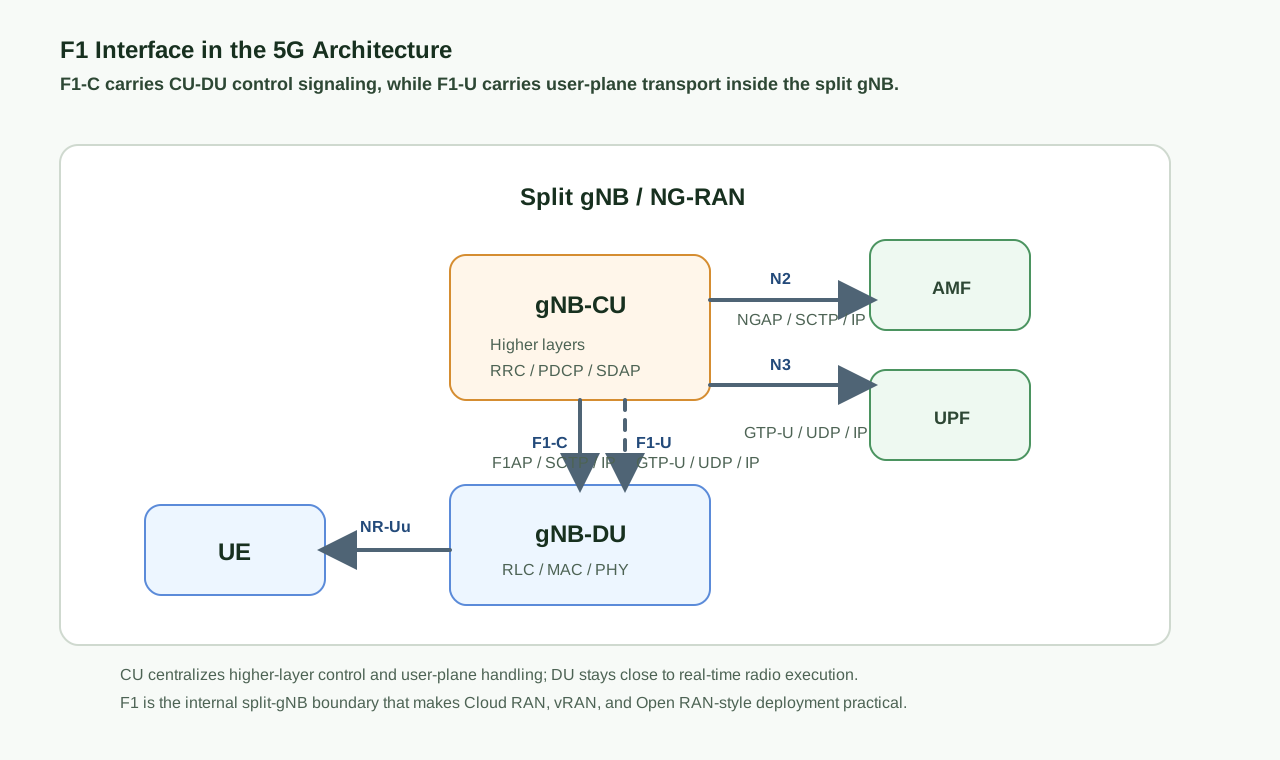
The CU connects toward the 5G Core, the DU connects toward the UE over NR-Uu, and F1 connects the CU and DU inside the split-gNB architecture.
What is CU-DU split?
In modern 5G deployments, the gNB is often split into a Central Unit (CU) and a Distributed Unit (DU). This is one of the key architectural shifts that makes Cloud RAN, virtualized RAN, and Open RAN-style deployment practical.
| Unit | Typical responsibilities |
|---|---|
| CU | RRC, PDCP, SDAP, and higher-layer control or user-plane processing. |
| DU | RLC, MAC, PHY, scheduling, and time-sensitive radio execution. |
The F1 interface is the internal boundary that keeps those two sides working together as one logical gNB.
What is the F1 interface?
The F1 interface enables the logical separation of radio functions. The CU handles higher-layer and more centralized processing, while the DU handles lower-layer and time-sensitive radio processing closer to the cell site.
The key idea is simple: F1 acts as the bridge between centralized control and distributed radio execution. This makes centralized processing, distributed deployment, and flexible scaling possible without treating the gNB as one fixed monolithic box.
F1 interface split: F1-C and F1-U
| Component | Plane | Description |
|---|---|---|
| F1-C | Control plane | Signaling between the CU and DU. |
| F1-U | User plane | User data transport between the CU and DU. |
F1-C (control plane)
The F1-C interface handles signaling between the gNB-CU control side and the gNB-DU. In split-CU deployments, this is commonly associated with CU-CP to DU control coordination.
The main protocol is F1AP (F1 Application Protocol), typically running over SCTP/IP. F1-C is responsible for DU configuration, UE context management, radio bearer setup, mobility coordination, and resource management.
F1AP protocol (F1-C)
F1AP is the control-plane protocol defined in TS 38.473. It uses message-based signaling and supports both UE-specific and cell-specific procedures.
| Procedure | Purpose |
|---|---|
| F1 Setup | Establishes the CU-DU control-plane relationship. |
| UE Context Setup | Creates UE context in the DU. |
| UE Context Modification | Updates radio configuration and UE-related handling in the DU. |
| UE Context Release | Removes UE context from the DU. |
| Paging | Forwards paging-related control from the CU toward the DU. |
F1-U (user plane)
The F1-U interface carries user data between the gNB-CU-UP and the gNB-DU. It supports user-plane data forwarding, QoS flow transport, and data path continuity inside the split gNB.
User Data
GTP-U
UDP
IP
F1 and QoS handling
In 5G, QoS is based on QoS flows. Around F1, the CU maps QoS flows toward radio bearers, the DU schedules radio transmission, and F1-U transports user-plane data with the right bearer and QoS context.
This keeps QoS treatment consistent from the 5G Core toward the radio side, while still allowing real-time radio scheduling decisions to remain close to the DU.
F1 and CU-DU split
F1 is the key enabler of the CU-DU split. The common high-level functional placement is:
| Layer | Typical location |
|---|---|
| RRC | CU |
| PDCP | CU |
| SDAP | CU |
| RLC | DU |
| MAC | DU |
| PHY | DU |
This split keeps real-time processing in the DU while allowing centralized control and higher-layer processing in the CU.
F1 vs other interfaces
| Interface | Connects | Role |
|---|---|---|
| F1 | CU to DU | Split gNB coordination and transport. |
| NG | gNB to 5GC | Access-to-core connectivity. |
| Xn | gNB to gNB | Inter-node mobility and coordination. |
| E1 | CU-CP to CU-UP | Control/user split inside the CU. |
F1 vs Xn interface
| Interface | Connects | Role |
|---|---|---|
| F1 | CU and DU | Internal split-gNB interface. |
| Xn | gNB and gNB | Inter-node communication for mobility and coordination. |
F1 vs NG interface
| Interface | Connects | Role |
|---|---|---|
| F1 | CU and DU | Internal RAN split interface. |
| NG | gNB and 5GC | RAN-to-core interface. |
F1 deployment considerations
- Latency: F1 requires low enough latency between CU and DU to keep split-RAN behavior stable.
- Bandwidth: F1-U may carry high user-plane throughput, so transport capacity matters.
- Synchronization: strict timing and synchronization are important for reliable split-gNB operation.
F1 in Cloud RAN
F1 enables a centralized CU in a data center or aggregation location while DUs remain distributed closer to cell sites. This can support resource pooling, easier software upgrades, and more flexible scaling.
F1 and mobility
F1 supports intra-CU mobility, DU-level handovers, and coordination between CU and DU as UE context, radio configuration, and bearer handling change during mobility events.
Common F1 troubleshooting areas
| Area | Typical issues |
|---|---|
| Control plane | F1AP setup failure, UE context setup failure, DU configuration issues, or inconsistent CU-DU state. |
| User plane | Packet loss on F1-U, QoS mismatch, tunnel issues, or user data not reaching the DU. |
| Performance | High latency between CU and DU, synchronization problems, transport congestion, or bandwidth constraints. |
FAQ
What is F1 interface in 5G?
F1 is the interface between gNB-CU and gNB-DU.
What is F1-C and F1-U?
F1-C is the control-plane side of F1, while F1-U is the user-plane side.
What protocol is used in F1-C?
F1AP over SCTP/IP is used on F1-C.
What protocol is used in F1-U?
GTP-U over UDP/IP is used on F1-U.
Why is F1 important?
F1 enables CU-DU split, Cloud RAN, vRAN, and scalable 5G RAN deployment models.
Key takeaways
- F1 connects gNB-CU and gNB-DU.
- F1 is split into F1-C for control and F1-U for user-plane traffic.
- F1-C uses F1AP, while F1-U commonly uses GTP-U.
- F1 enables the CU-DU split architecture.
- F1 is critical for Cloud RAN, vRAN, Open RAN-style decomposition, and scalable 5G deployment.
References
- 3GPP TS 38.401 - NG-RAN architecture description Overall NG-RAN architecture reference for the CU-DU split and the role of F1 inside split-gNB deployments.
- 3GPP TS 38.470 - F1 general aspects and principles General F1 interface architecture, principles, and split-gNB context.
- 3GPP TS 38.473 - F1AP protocol Control-plane F1AP protocol and procedures between gNB-CU and gNB-DU.
- 3GPP TS 38.474 - F1-U user plane User-plane F1-U protocol behavior and transport principles.