Xn Interface in 5G Explained
The Xn interface is the interface between NG-RAN nodes in 5G. It is the main inter-node interface inside the radio access network and is split into Xn-C for the control plane and Xn-U for the user plane.
In practical engineering terms, Xn is where neighboring gNBs coordinate mobility, exchange UE-related context, support forwarding when needed, and share information that keeps the NG-RAN behaving like a coordinated network rather than a set of isolated nodes.
Quick facts
| What it is | The Xn interface connects NG-RAN nodes to each other inside the 5G radio access network. |
|---|---|
| Control-plane side | Xn-C supports inter-node signaling, mobility coordination, UE context transfer, and configuration-related exchange. |
| User-plane side | Xn-U supports user-plane forwarding between NG-RAN nodes when inter-node traffic handling is needed. |
| Main signaling protocol | XnAP is the main signaling family on Xn-C, typically over SCTP and IP. |
| Why engineers care | Xn is central to inter-gNB handover, dual connectivity, load coordination, and many internal NG-RAN fault domains. |
| Specification baseline | 3GPP TS 38.401, TS 38.420, TS 38.423, and TS 38.300. |
Why this matters
Many 5G mobility and coordination problems do not start on the UE side and do not start in the core. They start in the space between RAN nodes. That is exactly where Xn lives.
If inter-gNB handover is unstable, if context transfer looks incomplete, or if dual-connectivity behavior feels inconsistent between nodes, Xn is one of the first interfaces to inspect. It is also the place where control signaling and temporary user-plane forwarding can diverge, which makes it especially important during mobility debugging.
Where it fits in the network
| Interface | What it connects | Main role |
|---|---|---|
| NG | NG-RAN and 5GC | Access-to-core control and user-plane connectivity. |
| Xn | NG-RAN and NG-RAN | Inter-node mobility, coordination, context exchange, and forwarding support. |
| F1 | CU and DU | Internal split-RAN coordination inside a gNB deployment. |
A simple rule of thumb is useful here: if the issue is between a gNB and the core, think NG. If the issue is between one RAN node and another, think Xn. If the issue is inside a split gNB, think F1 or E1.
Xn interface in the 5G architecture
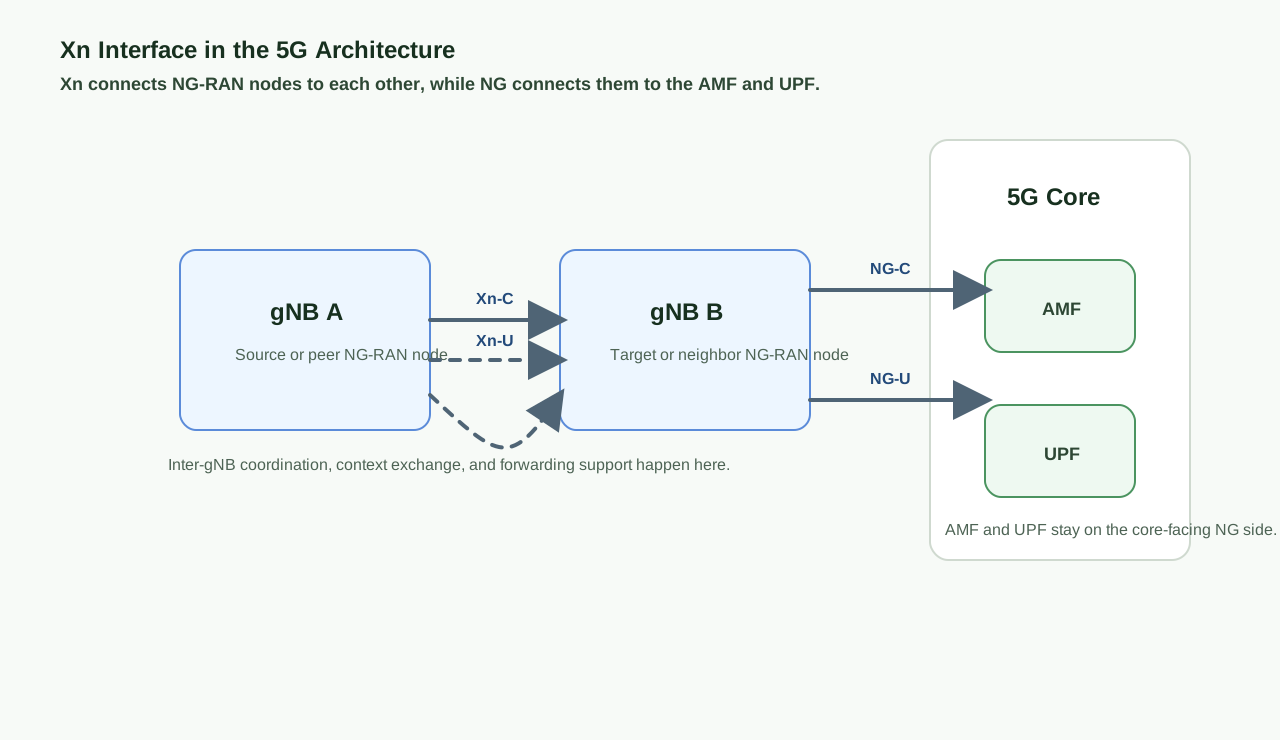
Main nodes / functions / entities
| Node or function | What it does around Xn |
|---|---|
| Source gNB | Provides the current serving context and often starts the mobility or coordination exchange toward the target node. |
| Target gNB | Receives UE context, prepares target-side resources, and cooperates with the source node for mobility or multi-node handling. |
| Neighbor NG-RAN node | Acts as the peer in coordination, load management, SON information exchange, and configuration-related interaction. |
| Xn-C signaling context | Carries the control-plane state and procedure coordination between NG-RAN nodes. |
| Xn-U forwarding path | Provides temporary or scenario-specific user-plane forwarding between nodes when the mobility or coordination case requires it. |
Xn-C and Xn-U
| Part | Connects | Plane | Main purpose |
|---|---|---|---|
| Xn-C | NG-RAN node and NG-RAN node | Control plane | Mobility signaling, context exchange, load management, configuration exchange, SON-related information, and dual-connectivity coordination. |
| Xn-U | NG-RAN node and NG-RAN node | User plane | User-plane forwarding between RAN nodes when mobility or coordination scenarios require temporary inter-node data transfer. |
This split matters because an inter-gNB procedure can look healthy on the signaling side while still failing on the forwarding side, or the reverse. Control success on Xn-C does not automatically prove that Xn-U forwarding is correct during a mobility transition.
Protocols used
| Xn side | Typical stack or protocol | Why it matters |
|---|---|---|
| Xn-C | XnAP over SCTP over IP | XnAP is the main radio-network-layer signaling family for inter-node coordination, while SCTP and IP form the control transport path. |
| Xn-U | User-plane forwarding transport between NG-RAN nodes | Used when data needs to move between RAN nodes during mobility or related inter-node scenarios. |
A practical comparison helps here: NG-C uses NGAP toward the AMF, while Xn-C uses XnAP between RAN nodes. That distinction becomes very useful when deciding whether a failure is on the access-to-core side or entirely inside the NG-RAN.
Xn and handover
The Xn interface is heavily used in Xn-based handover, where a source gNB and target gNB coordinate directly instead of pushing the whole mobility exchange through the core. That makes Xn one of the most important interfaces for practical 5G mobility work.
- The source gNB initiates handover preparation toward the target gNB over Xn-C.
- The target gNB prepares resources and returns the outcome to the source side.
- The UE is moved toward the target side, while context and temporary forwarding behavior stay aligned.
In healthy operation, Xn handover usually feels faster and more local because the neighboring gNBs can coordinate directly without making the AMF the center of every exchange.
Xn vs N2 handover
| Handover type | Main path | Typical character |
|---|---|---|
| Xn handover | Direct gNB-to-gNB coordination over Xn | Usually lower-latency and more local to the RAN. |
| N2 handover | Coordination involving the AMF over N2 | Used when direct Xn coordination is unavailable or unsuitable for the case. |
The easiest mental model is this: Xn handover is direct RAN coordination, while N2 handover brings the core control plane into the mobility loop much more explicitly.
Xn and dual connectivity
Xn is also important in dual connectivity, where a UE can depend on more than one node at the same time. In those deployments, neighboring nodes need a reliable way to coordinate control behavior, role alignment, and in some cases temporary user-plane handling.
This is why Xn shows up so often in discussions about master node and secondary node behavior. When dual connectivity feels unstable, the issue may be less about pure RF and more about whether the two nodes are staying aligned through the inter-node interface.
Xn and load balancing
The Xn interface is not only about handover. It also supports inter-node coordination for load balancing and capacity-aware behavior. Neighboring gNBs can exchange information that helps the RAN avoid pushing too much traffic into an already stressed node while nearby resources sit idle.
In practice, this matters most in dense deployments where several gNBs overlap and mobility decisions need to reflect both radio quality and node condition.
Xn and UE context transfer
During inter-gNB mobility, the source and target nodes need a shared understanding of the UE. That is why UE context transfer is one of the most important jobs done over Xn-C.
The context can include radio-related state, security context, and QoS-related handling information. If that transfer is incomplete or inconsistent, the handover may appear prepared on paper but still fail during execution or shortly afterward.
Xn vs LTE X2
| Feature | LTE X2 | 5G Xn |
|---|---|---|
| Nodes connected | eNB to eNB | gNB to gNB |
| Main signaling family | X2AP | XnAP |
| Architecture context | E-UTRAN / EPC-era mobility | NG-RAN with 5G mobility, slicing, and split-RAN awareness |
Xn is the natural 5G-era evolution of inter-node RAN coordination. If you already know LTE X2, Xn will feel familiar, but it lives inside a more modular NG-RAN and 5GC architecture.
Xn and network slicing
In slice-aware deployments, Xn coordination has to preserve more than plain radio continuity. The neighboring nodes also need to keep the UE on the right service behavior, QoS treatment, and slice-aware mobility path.
That does not make Xn the policy anchor by itself, but it does make Xn a practical part of keeping slice continuity intact when the UE moves between gNBs.
Used in procedures
- 5G Xn Handover is the clearest first procedure for seeing Xn-C signaling and inter-node preparation.
- 5G Inter-gNB Handover shows how a move across gNB boundaries depends on node-to-node coordination.
- 5G Conditional Handover is a good companion when comparing prepared mobility behavior with immediate handover execution.
- 5G N2 Handover is useful for comparing direct RAN coordination with handovers that involve stronger core participation.
Common troubleshooting notes
| Symptom | What to check on Xn |
|---|---|
| Inter-gNB handover fails early | Check whether Xn-C signaling completed, whether the target node accepted the preparation, and whether context transfer was complete. |
| Handover command looks good but service drops | Check whether Xn-U forwarding, target-side path activation, or post-handover context cleanup behaved correctly. |
| Dual-connectivity behavior is unstable | Check inter-node coordination, role alignment, and whether the Xn side is exchanging the expected control context. |
| Many neighboring-cell moves degrade together | Check Xn transport health, SCTP reachability, peer-node relationship status, and whether a wider inter-node management issue is present. |
| Load balancing looks ineffective | Check whether Xn-based load or configuration exchange is active and whether the neighboring nodes are sharing usable coordination information. |
FAQ
What is the Xn interface in 5G?
The Xn interface is the interface between NG-RAN nodes in 5G. It includes Xn-C for control plane and Xn-U for user plane.
What protocol runs on Xn-C?
The main signaling protocol on Xn-C is XnAP, typically carried over SCTP and IP.
What is Xn-U used for?
Xn-U is used for user-plane forwarding between NG-RAN nodes when inter-node forwarding is needed.
Is Xn mainly for handover?
Handover is one of the main uses, but Xn also supports dual connectivity, load coordination, configuration exchange, and broader inter-node NG-RAN coordination.
What is the difference between Xn and NG?
Xn connects NG-RAN nodes to each other, while NG connects the NG-RAN to the 5GC.
Key takeaways
- The Xn interface is the main inter-node interface inside the NG-RAN.
- Xn-C handles signaling, coordination, and context exchange, while Xn-U supports inter-node user-plane forwarding.
- XnAP is the main signaling family to know on Xn-C, especially for inter-gNB mobility work.
- Xn is central to handover, dual connectivity, load management, and other neighboring-node coordination tasks inside the RAN.
- If the issue is between one gNB and another, Xn is often the first interface to inspect.