N6 Interface in 5G Explained
The N6 interface is the user-plane reference point between the UPF and external data networks in the 5G System. It is the interface through which user traffic exits the 5G Core and reaches services such as the Internet, IMS, or enterprise networks.
If the UPF is the last user-plane function inside the 5GC, N6 is the service-side exit point. It completes the end-to-end data path that starts at the UE, crosses the gNB and N3, then leaves the 5G system toward the selected data network.
Quick facts
| What it is | N6 is the user-plane reference point between the UPF and external data networks. |
|---|---|
| What it carries | Normal IP traffic leaving the 5G system toward Internet, IMS, enterprise, cloud, or edge-hosted services. |
| Main transport model | Native IP routing rather than GTP-U tunneling. |
| What it completes | The final segment of the end-to-end 5G data path after N3 and UPF processing. |
| Best companion pages | Pair N6 with N3, N4, UPF, and PDU session establishment. |
| Specification baseline | 3GPP TS 23.501. |
Why N6 matters
N6 is one of the best interfaces for explaining the difference between a healthy internal 5G system and a healthy end-to-end service path. The UE can register correctly, the PDU session can exist, and the UPF can be reachable, yet the subscriber may still fail to reach real services if the N6 side is broken.
That makes N6 especially important for troubleshooting “5G is connected but the Internet does not work” or “one enterprise access path works and another does not” style problems.
Where N6 fits in 5G architecture
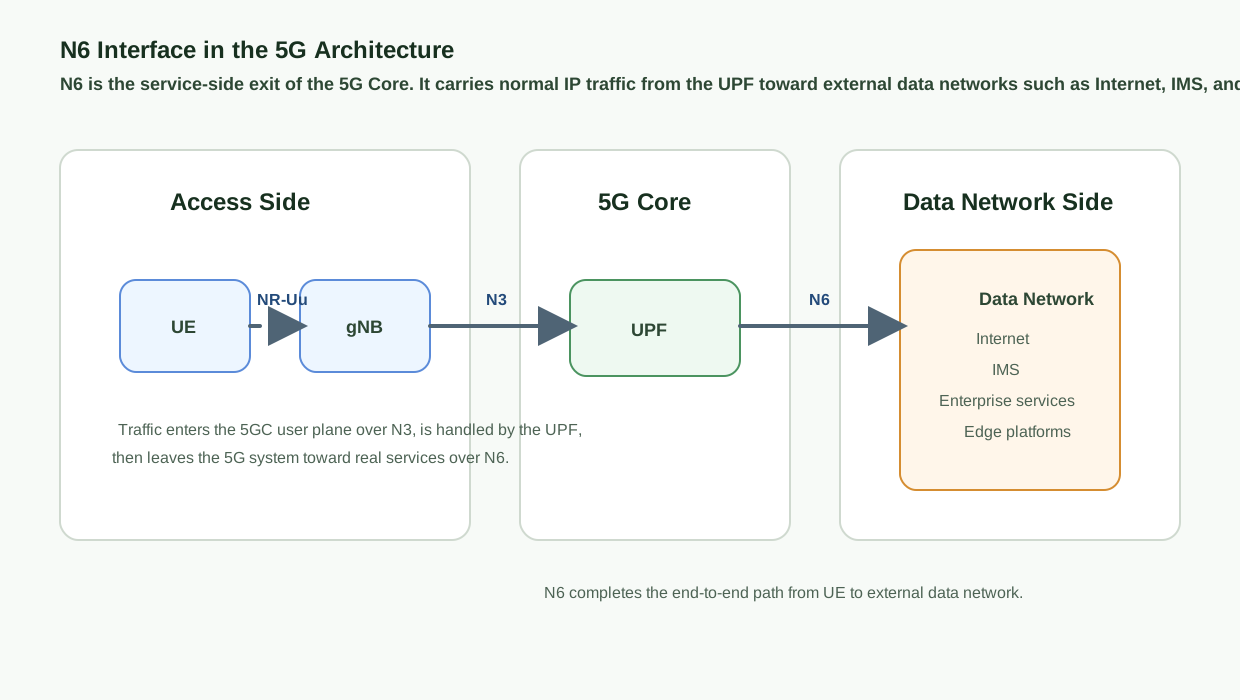
What the N6 interface does
- Connects the 5G Core to external data networks.
- Enables Internet, IMS, enterprise, and cloud-service reachability.
- Provides the final service-side segment of the user-plane path.
- Supports local breakout and edge-oriented traffic delivery.
A simple summary is that N6 is where 5G data connectivity stops being purely internal to the 5GC and becomes real service access.
N6 and data networks (DN)
The N6 interface can lead to several different types of data networks. In practical deployment terms, this may include the public Internet, operator service platforms such as IMS, private enterprise networks, cloud services, or edge-hosted applications.
| Data network type | Why N6 matters |
|---|---|
| Internet | Generic external connectivity for browsing, apps, and cloud services. |
| IMS | Service reachability for voice and multimedia platforms outside the core user-plane anchor. |
| Enterprise networks | Private access paths, managed services, and business application reachability. |
| Edge platforms | Low-latency breakout to applications placed near the UPF. |
N6 and PDU sessions
Every active PDU session needs an external service side, not just an internal 5GC path. The user-plane traffic may arrive at the UPF over N3, but it still needs N6 to reach the selected data network.
- N3 brings user traffic from the gNB to the UPF.
- The UPF applies forwarding and treatment behavior.
- N6 carries the traffic onward toward the external data network.
N6 and IP connectivity
N6 normally uses standard IP routing. Unlike N3, which typically uses GTP-U, the N6 side is the part of the path where traffic appears as normal IP traffic toward the external network environment.
That makes N6 simpler in one sense, but also closer to classic service-network problems such as routing, firewall, DNS, and reachability failures.
N6 protocol stack
| Layer | Role on N6 |
|---|---|
| IP | Normal network-layer user traffic leaving the 5G system. |
| Transport network | Underlying path toward the data network or service platform. |
| External service protocols | Application, enterprise, or platform-specific traffic beyond the UPF edge. |
N6 and traffic routing
The UPF performs packet forwarding and routing decisions, then sends the traffic out over N6. This makes N6 the interface where the 5GC user plane hands off to the external service world.
When traffic steering is wrong, the failure may look like a core problem, but it often becomes visible only at the N6-facing edge where the packet should have reached the correct destination network.
N6 and QoS enforcement
QoS is mainly enforced by the UPF before traffic reaches N6. In other words, N6 carries the traffic after the relevant 5GC user-plane treatment has already been applied.
This matters because a QoS problem can be caused by the policy side, the session-control side, or the UPF enforcement side, even though the symptom becomes visible when traffic exits over N6.
N6 and edge computing
N6 is especially important for edge computing and local breakout. When a UPF is deployed close to the edge, N6 may provide a short, low-latency path to nearby applications instead of sending traffic deeper into a centralized core environment.
N6 and enterprise networks
N6 also matters for private and enterprise connectivity. Different subscriber profiles or APN-like service selections may lead the UPF toward different external data networks, and the user experience depends on the specific N6-facing path behind that selection.
N6 vs N3
| Interface | Connects | Main role |
|---|---|---|
| N3 | gNB and UPF | User-plane transport inside the 5GS service path. |
| N6 | UPF and data network | External connectivity toward real services outside the 5GC. |
A simple way to remember it is that N3 brings the packets into the UPF, while N6 takes them out to the service world.
N6 vs LTE SGi
| Feature | LTE SGi | 5G N6 |
|---|---|---|
| Function | P-GW to data network edge. | UPF to data network edge. |
| Core architecture | EPC | 5GC |
| Flexibility | More fixed gateway model. | Works with more flexible and distributed UPF deployments. |
N6 and security
Security considerations around N6 often include IP filtering, firewall policy, and traffic inspection. Some of that is handled in or near the UPF, and some may depend on the external network environment beyond the 5GC boundary.
N6 and network slicing
Different slices may reach different data networks or use different external treatment paths. That makes N6 an important part of slice-aware service delivery, even though slice selection and policy are decided elsewhere in the system.
Common N6 issues
| Symptom | What to check on N6 |
|---|---|
| No Internet connectivity | Check whether the UPF can actually reach the intended external data network. |
| Enterprise access failure | Check the external route, filtering policy, and service-network reachability behind the UPF. |
| DNS works poorly or not at all | Check whether the user can reach the required external DNS infrastructure through the intended N6 path. |
| Good registration but no usable service | Check whether the end-to-end data path is failing at the UPF-to-data-network edge rather than on N1, N2, or N3. |
| Edge breakout misbehavior | Check whether the correct local N6-facing path and destination network were selected. |
FAQ
What is N6 interface in 5G?
The N6 interface is the interface between the UPF and the external data network.
Does N6 use GTP?
No. N6 normally uses native IP routing rather than GTP-U.
What connects to N6?
Internet, IMS, enterprise networks, cloud services, and edge-hosted applications can all sit behind N6.
Is N6 part of 5G Core?
It is the boundary where user traffic leaves the 5G Core toward external services and data networks.
Why is N6 important?
Because it completes the end-to-end data path. Without a healthy N6 path, users can look connected but still fail to reach real services.
Key takeaways
- N6 connects UPF to the data network.
- It provides Internet, IMS, enterprise, cloud, and edge service reachability.
- N6 normally uses native IP routing rather than GTP-U.
- It completes the end-to-end user-plane path after the traffic has crossed N3 and the UPF.
- Understanding N6 is essential for diagnosing no-Internet problems, enterprise reachability failures, and service-edge routing issues.