N4 Interface in 5G Explained
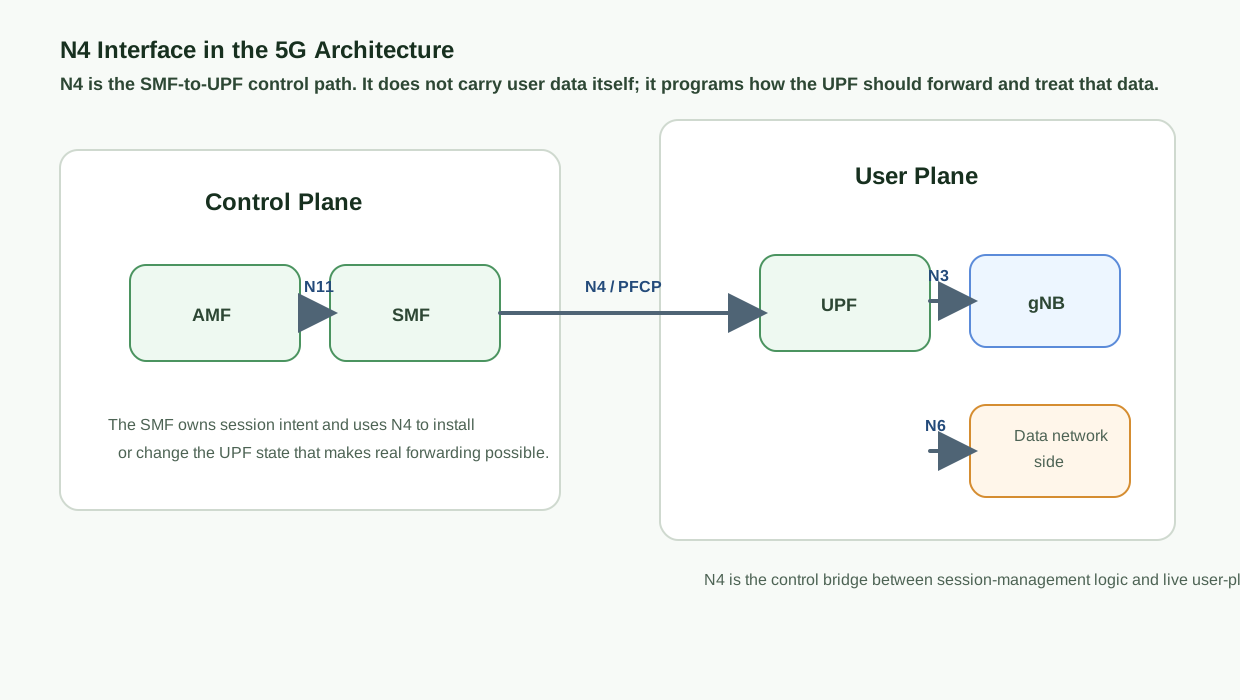
The N4 interface is the control-plane reference point between the SMF and the UPF in the 5G Core. It is used by the SMF to control, configure, and manage user-plane behavior inside the UPF.
This interface is essential because it connects session-management logic with actual data forwarding. The SMF decides how traffic should be handled; the UPF is where that behavior becomes real. N4 is the bridge between those two worlds.
Quick facts
| What it is | N4 is the control-plane reference point between the SMF and the UPF. |
|---|---|
| Main protocol | N4 mainly uses PFCP for user-plane control. |
| What it controls | PDU session state, forwarding rules, tunnel behavior, QoS enforcement, and traffic steering in the UPF. |
| Why it matters | N4 is the bridge between session-control logic and real user-plane forwarding. |
| Best companion pages | Pair N4 with N3, SMF, UPF, and PDU session establishment procedures. |
| Specification baseline | 3GPP TS 23.501 and TS 29.244. |
Why N4 matters
N4 is one of the clearest examples of the 5G control-plane and user-plane split. The SMF is the control-side owner of session behavior, while the UPF is the user-plane execution point. N4 is how those two stay aligned.
This makes N4 one of the most useful interfaces for diagnosing “the session exists, but traffic is wrong” problems. If the access side and session side look healthy but the user plane behaves incorrectly, N4 is often the interface that explains why.
Where N4 fits in 5G architecture
What the N4 interface does
- Creates and manages PDU session state in the UPF.
- Configures forwarding rules.
- Controls QoS-related user-plane behavior.
- Manages tunnel and path behavior in the user plane.
- Updates forwarding state during mobility or session changes.
Without N4, the UPF would not know how to forward traffic, which session state is active, or what treatment should apply to different traffic flows.
PFCP protocol on N4
The N4 interface uses PFCP (Packet Forwarding Control Protocol). PFCP is the protocol the SMF uses to program the UPF with the forwarding and treatment behavior needed for live service.
| What PFCP does | Why it matters on N4 |
|---|---|
| Session establishment | Creates new user-plane session state in the UPF. |
| Session modification | Changes path, forwarding, or treatment rules after the session already exists. |
| Session deletion | Removes user-plane state and releases UPF-side resources. |
PFCP message types
| Message family | Main purpose |
|---|---|
| Session Establishment | Create a new PDU session context and install the required rules in the UPF. |
| Session Modification | Update forwarding rules, path behavior, or QoS-related treatment. |
| Session Deletion | Release session-related state and remove UPF-side resources. |
N4 and PDU sessions
N4 is tightly linked to the PDU session lifecycle. The session becomes real in the user plane only when the SMF programs the UPF correctly over N4.
- During session establishment, the SMF selects a UPF and installs the initial forwarding state.
- During session modification, the SMF updates rules or path behavior already active in the UPF.
- During session release, the SMF removes session state and tells the UPF to free resources.
N4 and user-plane control
N4 lets the SMF control the user plane without carrying the user traffic itself. This is the architectural point that makes 5G feel different from older, more tightly coupled designs.
| Control area | What N4 lets the SMF influence |
|---|---|
| Forwarding behavior | Where packets go and which rules apply to them. |
| Tunnel handling | How the user-plane path is anchored and maintained in the UPF. |
| Traffic treatment | How packets are shaped, prioritized, or steered. |
N4 and QoS enforcement
N4 is one of the places where policy and session decisions become real packet treatment. The SMF uses N4 to configure rules in the UPF, and the UPF enforces the resulting user-plane behavior.
This is why a QoS problem can look like a policy issue, a session-control issue, or an N4 programming issue. The architecture spans all three.
N4 and traffic steering
The SMF can use N4 to steer traffic by changing how the UPF forwards packets. That can include selecting different paths, adjusting treatment, or supporting edge-oriented user-plane behavior when the deployment uses more than one UPF or different breakout choices.
N4 and mobility
During mobility, the access side may change even though the session remains active. N4 matters because the SMF may need to update the UPF so the user-plane path stays aligned with the new access-side state.
This is one reason a handover can look successful on the signaling side but still produce traffic failure: the session and the user-plane control state may no longer match after movement.
N4 vs N3
| Interface | Plane | Connects | Purpose |
|---|---|---|---|
| N3 | User plane | gNB and UPF | Data transport. |
| N4 | Control plane | SMF and UPF | User-plane control. |
A simple way to remember it is that N3 carries the packets, while N4 tells the UPF what to do with them.
N4 vs N11
| Interface | Connects | Purpose |
|---|---|---|
| N11 | AMF and SMF | Session signaling and control coordination. |
| N4 | SMF and UPF | User-plane programming and control. |
If N11 is the signaling path that helps create session intent, N4 is the path that turns that intent into real user-plane behavior inside the UPF.
N4 protocol stack
| Layer | Role on N4 |
|---|---|
| PFCP | Main application-layer control protocol. |
| UDP | Transport-layer carriage for PFCP. |
| IP | Network-layer connectivity between SMF and UPF. |
| Transport network | Underlying path that still has to be healthy for control to work. |
N4 and multi-UPF architecture
In more advanced 5GC deployments, a single SMF may control more than one UPF. N4 is the interface that lets the session-control side coordinate those user-plane resources and keep the forwarding path aligned with the session design.
N4 and network slicing
N4 also matters for slice-aware behavior because different slices may need different session-control and forwarding treatment. The SMF can use N4 to install the UPF-side state that supports separate user-plane paths or differentiated handling per slice.
Common N4 issues
| Symptom | What to check on N4 |
|---|---|
| PFCP session establishment failure | Check whether the SMF successfully created the required user-plane state in the UPF. |
| Mismatch between SMF and UPF state | Check whether the expected rules were actually installed, updated, or deleted correctly. |
| QoS misbehavior | Check whether the UPF received the correct PFCP-driven treatment rules from the SMF. |
| Traffic steering failure | Check whether the SMF programmed the intended path behavior into the correct UPF instance. |
| Mobility-related user-plane failure | Check whether path updates after movement were reflected correctly in the N4-controlled state. |
FAQ
What is the N4 interface in 5G?
The N4 interface is the control interface between the SMF and the UPF.
What protocol is used on N4?
The main protocol on N4 is PFCP.
Does N4 carry user data?
No. N4 carries control signaling used to program user-plane behavior, not user traffic itself.
What controls the UPF?
The SMF controls the UPF via N4 using PFCP.
Why is N4 important?
Because it connects session-management logic in the SMF to real user-plane behavior in the UPF.
Key takeaways
- N4 connects SMF and UPF.
- It uses PFCP as the main control protocol.
- N4 controls user-plane behavior rather than carrying user packets itself.
- N4 is critical for PDU session management, QoS treatment, and traffic steering.
- Understanding N4 is essential for diagnosing PFCP failures, SMF-to-UPF state mismatch, and session-control versus forwarding problems.