N9 Interface in 5G Explained
The N9 interface is the user-plane reference point between two UPFs in the 5G Core. It is used to forward user traffic between UPFs, which makes it important for multi-UPF architecture, traffic steering, and more distributed 5GC deployments.
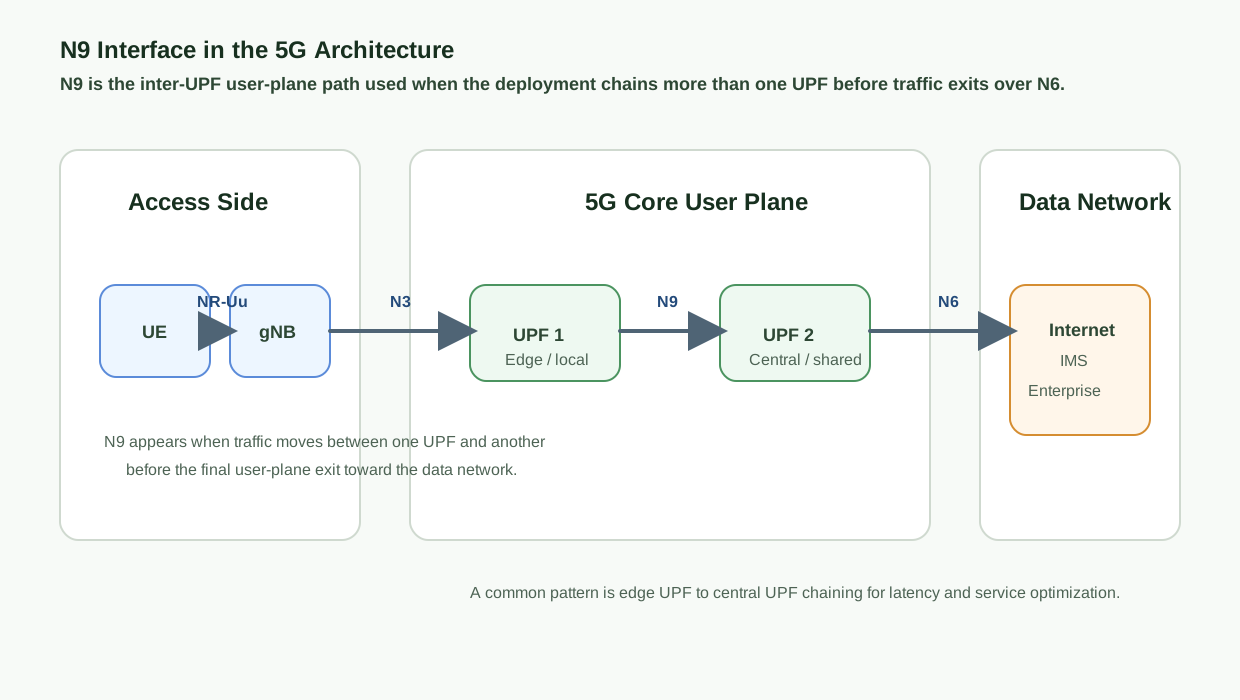
If N3 brings traffic from the gNB into the 5GC user plane and N6 takes traffic out toward the data network, N9 is the interface that connects one UPF to another inside the user-plane path.
Quick facts
| What it is | N9 is the user-plane reference point between two UPFs inside the 5G Core. |
|---|---|
| Main protocol | N9 mainly uses GTP-U for UPF-to-UPF user-plane transport. |
| When it appears | N9 is used in multi-UPF deployments, not in every simple 5G data path. |
| What it enables | Traffic steering, distributed user plane, edge breakout, and service chaining across UPFs. |
| Best companion pages | Pair N9 with N3, N4, N6, UPF, and SMF. |
| Specification baseline | 3GPP TS 23.501 and TS 29.281. |
Why N9 matters
N9 is one of the clearest signs that real 5G deployments can be more sophisticated than a simple “gNB to one UPF to one data network” picture. Once operators introduce edge UPFs, central UPFs, or different user-plane roles, N9 becomes the glue between those functions.
That makes N9 especially useful for understanding modern 5G topics like MEC, distributed user plane, and service chaining.
Where N9 fits in 5G architecture
What the N9 interface does
- Forwards user-plane traffic between UPFs.
- Enables multi-UPF architecture inside the 5GC.
- Supports traffic steering and distributed service paths.
- Helps enable edge and central UPF combinations.
- Provides the basis for service chaining across user-plane functions.
A simple summary is that N9 keeps the user-plane path alive when the deployment needs more than one UPF before traffic exits over N6.
N9 and GTP-U protocol
N9 mainly uses GTP-U, just like N3. That means the user data remains tunnelled while it moves between one UPF and the next.
This matters because some N9 problems look very similar to N3 problems: the tunnel exists on paper, but the actual user-plane behavior does not line up with the intended forwarding path.
N9 protocol stack
| Layer | Role on N9 |
|---|---|
| User data | Application traffic moving between one UPF and the next. |
| GTP-U | User-plane tunneling between UPFs. |
| UDP | Transport-layer carriage for GTP-U. |
| IP | Network-layer connectivity between the UPF instances. |
| Transport network | Underlying path that still has to stay healthy for inter-UPF forwarding to work. |
Why N9 exists
In a simple deployment, one UPF may be enough. In more advanced deployments, operators may want a more distributed user-plane design so they can place one UPF close to the edge and another deeper in the network.
- Scalability across more than one user-plane function.
- Lower latency through edge-oriented UPF placement.
- Traffic optimization through different breakout points.
- Support for specialized service paths or chained processing.
N9 and multi-UPF architecture
A common mental model is an edge UPF connected to a central UPF over N9. The first UPF may handle local or low-latency requirements, while the second UPF may provide the broader path toward shared services or Internet access.
| UPF role | Typical value in the chain |
|---|---|
| Edge UPF | Closer breakout, lower latency, or local service treatment. |
| Central UPF | Broader service reachability, shared connectivity, or onward path toward N6. |
N9 and traffic steering
The SMF can choose more than one UPF and shape the traffic path accordingly. N9 is what allows that chosen path to exist inside the 5GC user plane.
For example, one traffic class may stay close to the edge while another is forwarded toward a more central user-plane environment.
N9 and service chaining
N9 also supports service chaining, where traffic is intentionally passed through more than one user-plane function before reaching the external network. That can be useful for more specialized treatment, filtering, or optimization models.
N9 and edge computing
N9 is especially important for MEC and other distributed service designs. Traffic may first hit an edge UPF for local breakout or local processing, then continue over N9 to another UPF when the service path needs a deeper network stage.
N9 and mobility
During mobility, the user-plane path may need to stay continuous even when the access side changes. In deployments that use more than one UPF, N9 may be part of the path that has to stay aligned with the updated session and forwarding state.
N9 vs N3
| Interface | Connects | Role |
|---|---|---|
| N3 | gNB and UPF | Access-to-core user-plane transport. |
| N9 | UPF and UPF | Internal 5GC user-plane forwarding between user-plane functions. |
N9 vs N6
| Interface | Connects | Role |
|---|---|---|
| N9 | UPF and UPF | Internal user-plane continuation inside the 5GC. |
| N6 | UPF and data network | External connectivity toward services outside the 5GC. |
A simple way to remember it is that N9 is still inside the user-plane chain, while N6 is the exit toward the external service world.
N9 and network slicing
Different slices may use different user-plane paths, and in more advanced deployments that can include different N9 paths between UPFs. That makes N9 useful in slice-aware service design even though slice selection is handled elsewhere.
N9 and QoS
QoS treatment is applied by the relevant user-plane functions, but it still has to remain meaningful across the inter-UPF path. That is why QoS problems in distributed deployments can sometimes involve not just policy and UPF treatment, but also how the traffic traverses N9.
Common N9 issues
| Symptom | What to check on N9 |
|---|---|
| GTP-U tunnel mismatch | Check whether the expected inter-UPF tunnel state really exists and matches the intended path. |
| Incorrect UPF chaining | Check whether traffic is reaching the right next UPF in the chain. |
| Packet loss between UPFs | Check IP transport health and GTP-U continuity on the inter-UPF path. |
| Unexpected latency increase | Check whether traffic is being sent across the wrong inter-UPF path or to the wrong UPF role. |
| Edge versus central path failure | Check whether the intended local and central UPF relationship was programmed and reached correctly. |
FAQ
What is N9 interface in 5G?
The N9 interface is the user-plane interface between UPFs.
Does N9 use GTP-U?
Yes. N9 mainly uses GTP-U for inter-UPF user-plane transport.
Why use multiple UPFs in 5G?
To support scale, edge computing, traffic steering, and more distributed user-plane design.
Is N9 mandatory in 5G?
No. N9 is mainly used in deployments that insert more than one UPF into the user-plane path.
Why is N9 important?
Because it enables UPF chaining, distributed user plane, and more advanced 5G service paths.
Key takeaways
- N9 connects UPF to UPF.
- It mainly uses GTP-U as the inter-UPF user-plane transport protocol.
- N9 enables multi-UPF architecture, traffic steering, and edge-oriented user-plane design.
- It is especially important when the 5GC inserts more than one UPF before traffic exits toward the data network.
- Understanding N9 is essential for diagnosing inter-UPF tunnel problems, distributed user-plane path issues, and edge-versus-central routing failures.