VoNR Architecture Explained (Voice over New Radio)
VoNR (Voice over New Radio) is the native voice service in 5G Standalone networks. It enables voice calls to be carried entirely over 5G NR and the 5G Core without falling back to LTE for the voice bearer.
The cleanest way to think about VoNR is as a bridge between two worlds: the 5G transport architecture provides access, control, sessions, and packet delivery, while IMS provides the actual voice-session control and service logic. VoNR works only when both sides are ready at the same time.
Quick facts
| What it is | VoNR is the native IMS-based voice service used in 5G Standalone networks over NR and the 5G Core. |
|---|---|
| Radio and core path | UE over NR to gNB, then through 5GC control and user plane toward IMS. |
| Main service layer | IMS provides SIP-based call control and service logic above the 5G transport path. |
| QoS expectation | Voice uses prioritized QoS treatment with low latency, low loss, and voice-ready bearer handling. |
| Fallback companion | If native VoNR is unavailable, operators may use EPS fallback to LTE and VoLTE instead. |
| Specification baseline | 3GPP TS 23.501, TS 23.502, TS 23.228, and related IMS voice service specifications. |
Where VoNR fits in 5G architecture
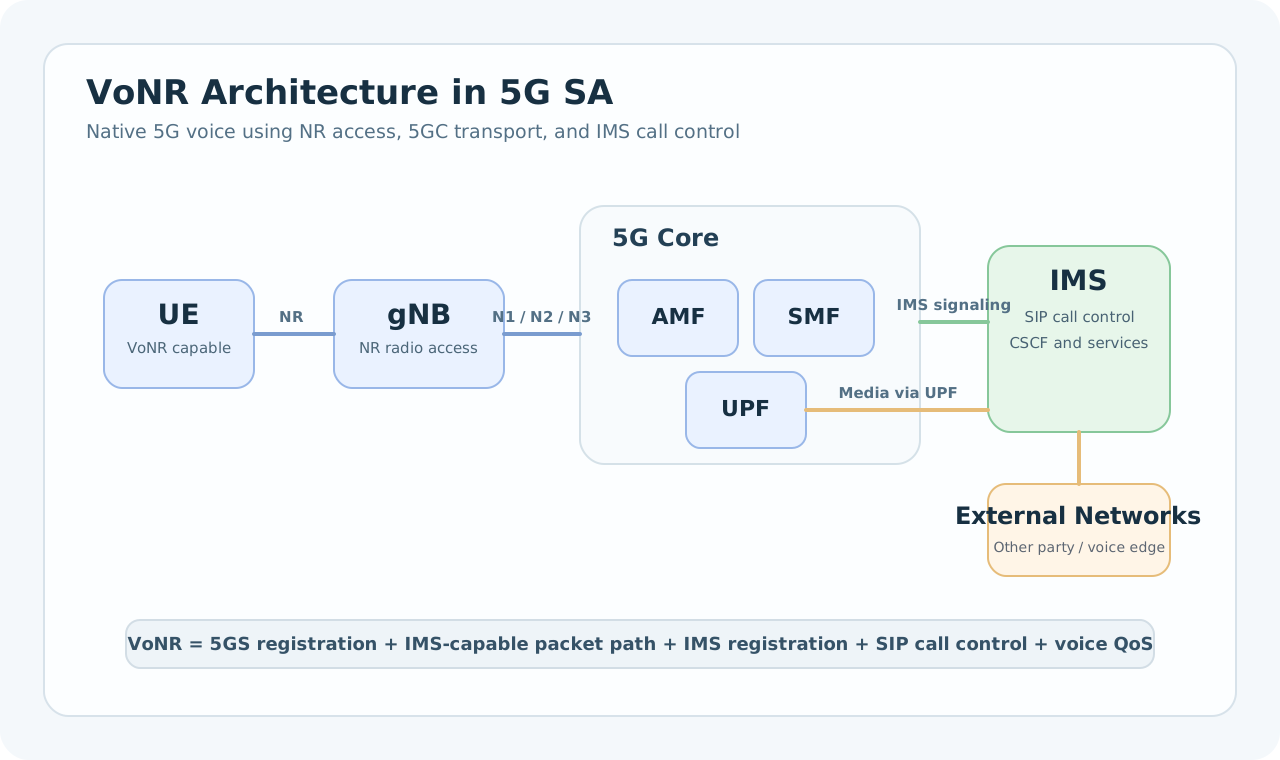
The architecture can be read as one end-to-end chain: UE -> NR -> gNB -> 5GC -> IMS -> other party or external voice network.
VoNR architecture overview
| Architecture block | Why it matters for VoNR |
|---|---|
| 5G Core | Provides access control, session control, and user-plane forwarding through functions such as AMF, SMF, and UPF. |
| IMS | Provides SIP-based call control, session management, service logic, and multimedia telephony behavior. |
| QoS framework | Provides the voice-priority treatment needed for low-latency and stable conversational quality. |
| NR access | Provides the radio link, scheduling, bearer mapping, and mobility path used by native 5G voice service. |
VoNR end-to-end flow
- The UE registers to the 5GC over NR.
- An IMS-capable packet path is available through the SMF and UPF.
- The UE performs IMS registration using SIP.
- Voice session setup is done through IMS call control.
- Media flows over the packet path with voice-ready QoS treatment.
That sequence is why VoNR failures are often cross-layer problems: access can be fine while IMS is broken, or IMS can be fine while the transport or QoS path is not really voice-ready.
VoNR vs VoLTE
| Feature | VoLTE | VoNR |
|---|---|---|
| Access | LTE | 5G NR |
| Core | EPC | 5GC |
| Architecture style | LTE voice over IMS | Native 5G SA voice over IMS |
| Long-term role | 4G voice foundation | 5G SA native voice path |
The service layer is still IMS in both cases. The big architectural difference is the transport and core environment underneath it.
VoNR call flow (high-level)
| Stage | What happens |
|---|---|
| Registration | The UE registers to 5GC and becomes IMS-ready for voice service. |
| Call setup | SIP session setup begins through IMS, typically starting with INVITE signaling. |
| Media path | Voice packets flow through the UPF with voice-priority QoS treatment. |
| Call release | SIP session release ends the voice session and media path state. |
Open VoNR Registration for the readiness path or open VoNR Mobile Originated Call for the live call sequence.
VoNR and IMS
IMS is required for VoNR. The 5G transport path gets packets where they need to go, but IMS is what provides the voice-session control model. That includes SIP-based signaling, service logic, and the multimedia-telephony context behind the actual call.
The functions most engineers keep in mind here are the CSCF family, subscriber and profile data, and the application servers that sit behind the voice service behavior. VoNR is therefore never just “radio voice over NR”; it is IMS voice riding on top of the 5G SA transport path.
VoNR QoS handling
Voice service depends on predictable QoS. That means low latency, low packet loss, and enough priority that conversational traffic does not compete with ordinary best-effort application traffic in the same way.
In practical deployment terms, VoNR needs the session and bearer side to recognize that the IMS voice flow is not just generic data. If the QoS policy is wrong, call setup may succeed while the actual audio experience still feels unstable or degraded.
VoNR QoS flow
The key architectural point is that voice quality depends on the whole chain staying aligned: policy, session handling, QoS mapping, bearer treatment, and the IMS-facing service path all have to cooperate.
VoNR deployment options
| Deployment model | What it means |
|---|---|
| Full VoNR | Pure 5G SA voice over NR, 5GC, and IMS. |
| EPS fallback | The network moves the UE toward LTE and serves voice through VoLTE when native VoNR is unavailable. |
| Mixed coverage / continuity | Operators may use NR, LTE, or continuity mechanisms depending on coverage, capability, and policy. |
VoNR and EPS fallback
If native VoNR is not supported or not allowed in the current scenario, the network may use EPS fallback. That means the UE is moved toward LTE so voice can be served through VoLTE instead.
This distinction matters a lot in troubleshooting. A user symptom like slow call setup or no call can look similar on the surface, but the fault domain is very different depending on whether the network intended native VoNR or fallback all along.
Open the EPS fallback procedure for the fallback branch.
VoNR and network slicing
VoNR can also fit into slice-aware deployment models, especially where operators want to control service quality, isolation, or policy more tightly for voice-sensitive traffic.
The important point is not that every voice deployment needs a dedicated slice. It is that 5G makes slice-aware voice treatment more natural than earlier architectures, especially in private or highly managed environments.
VoNR advantages
- Cleaner long-term alignment with 5G Standalone.
- Native 5G voice without relying on LTE access for every call.
- Better architectural fit for modern cloud-native 5GC deployments.
- Potential for lower-latency and more direct voice handling in mature SA networks.
VoNR challenges
- IMS dependency means the service layer has to be healthy, not just the 5G transport path.
- Device support has to match the operator’s VoNR profile and service policy.
- Coverage and mobility still matter because voice continuity is less forgiving than bulk data.
- QoS misalignment can quietly damage user experience even when signaling succeeds.
VoNR and 5G interfaces
| Interface | Why it matters in VoNR |
|---|---|
| N1 / N2 | Registration, service request, paging, and control-plane coordination before or during voice service. |
| N3 | Media transport path between gNB and UPF. |
| N6 | Service-side breakout toward IMS-facing connectivity. |
| N11 / N4 | Session coordination and user-plane programming behind the IMS-capable packet path. |
Common VoNR issues
| Symptom | Where to look first |
|---|---|
| IMS registration fails | Check IMS-capable session readiness, SIP registration path, profile correctness, DNS, and P-CSCF reachability. |
| Call setup fails | Check whether the UE is really VoNR-ready, whether SIP signaling is completing, and whether policy allows native voice service. |
| Voice quality is poor | Check QoS flow treatment, bearer mapping, media path stability, and packet loss or delay across N3 and UPF-facing paths. |
| Calls fallback unexpectedly | Check whether EPS fallback was intended by coverage, capability, roaming, or operator policy. |
| MT calls do not reach the UE | Check IMS registration freshness, paging path, reachability state, and whether the UE is still voice-ready. |
FAQ
What is VoNR?
VoNR is Voice over New Radio, the native IMS-based voice service used in 5G Standalone networks.
Does VoNR need IMS?
Yes. VoNR depends on IMS for SIP-based call control, service logic, and voice-session handling.
What happens if VoNR is not available?
Many networks use EPS fallback to move the UE toward LTE and serve the voice call through VoLTE instead.
Is VoNR better than VoLTE?
VoNR can align better with 5G SA and offer a cleaner native 5G voice path, but the real outcome still depends on coverage, device support, QoS, and network readiness.
Key takeaways
- VoNR is the native 5G voice path used in 5G Standalone networks.
- It depends on both 5GC transport and control and IMS service logic.
- Voice quality depends on QoS treatment, not just successful call signaling.
- When VoNR is unavailable, operators may use EPS fallback toward LTE and VoLTE.
- Understanding VoNR means keeping NR access, 5GC sessions, IMS signaling, and media QoS in the same mental picture.
References
- 3GPP TS 23.501 - System architecture for the 5G System (5GS) Primary 5GS architecture reference for 5GC functions, reference points, QoS concepts, IMS access context, and voice-service transport paths.
- 3GPP TS 23.502 - Procedures for the 5G System (5GS) Procedure reference for registration, session setup, mobility, EPS fallback related handling, and end-to-end 5GS behavior that voice depends on.
- 3GPP TS 23.228 - IP Multimedia Subsystem (IMS); Stage 2 Primary IMS architecture reference for SIP-based call control, CSCF roles, service logic, and multimedia telephony context behind VoNR.
- 3GPP TS 24.229 - IMS SIP signalling Useful stage-3 SIP signaling reference for INVITE, REGISTER, BYE, session control, and operational IMS voice behavior.