LTE Mobility Explained
LTE mobility is what keeps a UE connected or reachable while moving across cells and tracking areas. At a high level, LTE mobility is split into idle mode mobility, where the UE performs cell reselection, and connected mode mobility, where the network performs handover.
This matters because mobility in LTE is not only a radio problem. The E-UTRAN drives measurement-based handover decisions, neighboring eNodeBs coordinate over X2, and the EPC assists through S1-MME and S1-U when needed. Bearer continuity, UE context transfer, and idle reachability all depend on this architecture working cleanly.
Quick facts
| Mobility modes | Idle mode reselection and connected mode handover |
|---|---|
| Idle mobility owner | UE in RRC_IDLE |
| Connected mobility owner | E-UTRAN in RRC_CONNECTED |
| Main interfaces | LTE-Uu, X2, S1-MME, S1-U |
| Key triggers | Measurement reports, radio quality, topology, and policy decisions |
| What must be preserved | UE context, bearer continuity, paging reachability, and user-plane continuity |
Contents
- Where LTE mobility fits in the architecture
- Why mobility matters in LTE
- Idle mode mobility: cell reselection
- Connected mode mobility: handover
- Main LTE handover types
- X2 handover
- S1 handover
- Measurement-based mobility decisions
- UE context transfer during mobility
- User-plane continuity during mobility
- Mobility and bearer continuity
- Common mobility failure scenarios
- Mobility optimization in LTE
- Typical procedures or call flows using LTE mobility
- Related pages / next steps
- Key takeaways
- FAQ
Where LTE mobility fits in the architecture
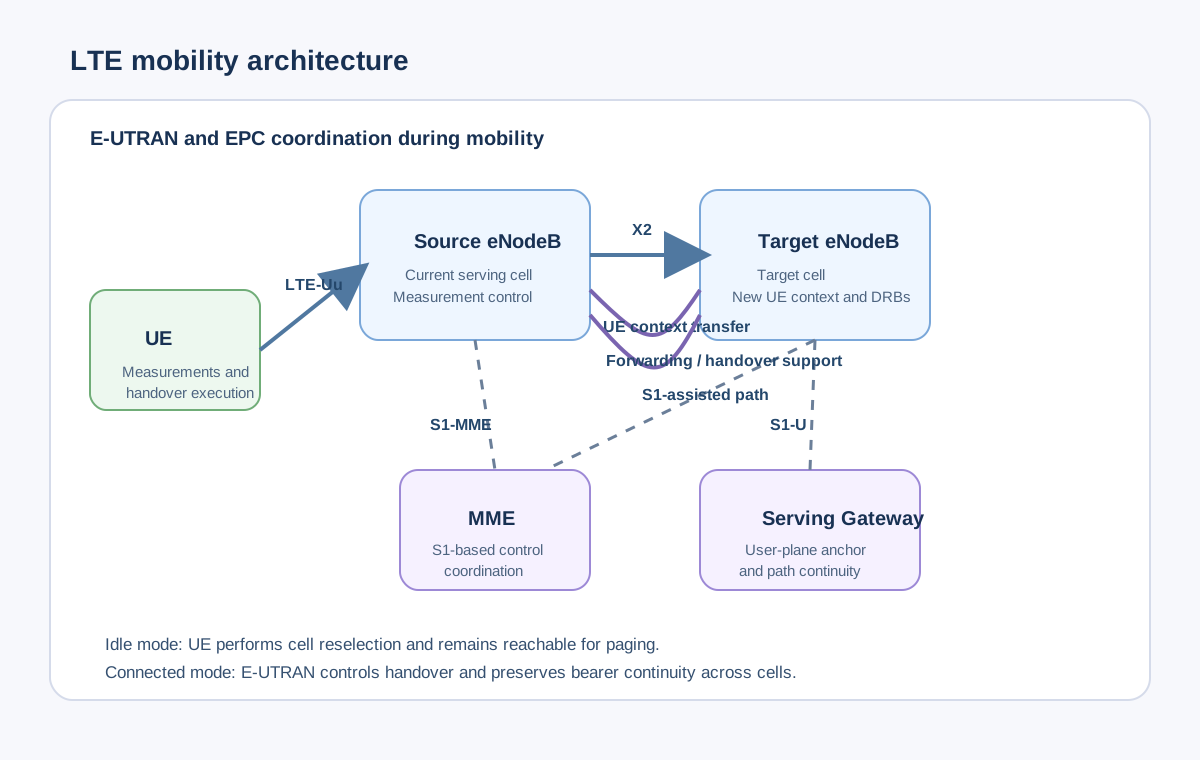
LTE mobility spans the radio side, the inter-eNB side, and the access-to-core side. The UE measures cells over the LTE-Uu interface, neighboring eNBs coordinate mobility over X2, and the EPC participates through S1-MME and S1-U when the mobility path cannot stay purely local.
| Interface or domain | Mobility role |
|---|---|
| LTE-Uu | Carries UE measurements, RRC mobility commands, and the new radio link after handover. |
| X2 | Direct eNB-to-eNB coordination for context transfer, forwarding control, and handover support. |
| S1-MME | Core-assisted control signaling when handover needs EPC coordination. |
| S1-U | User-plane anchoring toward the Serving Gateway during mobility continuity. |
Why mobility matters in LTE
Without mobility, LTE would only work well for stationary users. Real networks depend on mobility behavior for voice continuity, stable data sessions, and consistent user experience across changing radio conditions.
- keeps packet sessions usable while the UE moves
- preserves idle-state reachability for paging
- reduces packet loss and user-visible interruption
- supports load balancing and radio optimization between cells
- helps maintain QoS during movement and cell-edge conditions
Idle mode mobility: cell reselection
In RRC_IDLE, mobility is controlled by the UE. The UE performs cell selection and reselection, monitors paging, acquires system information, and measures neighboring cells without the network explicitly steering every movement decision.
This is why idle mobility is tightly connected to reachability. The UE must move to better or more suitable cells while still remaining pageable and aligned with the EPC mobility context.
- cell selection and reselection
- neighbor-cell measurements
- paging monitoring
- system information acquisition
- battery-efficient mobility without a persistent active radio connection
Connected mode mobility: handover
In RRC_CONNECTED, mobility is controlled by the network. The UE measures cells according to the configured measurement rules, reports those results to the eNB, and the E-UTRAN decides whether handover should be triggered.
Connected mobility is more demanding than idle mobility because service continuity depends on preserving UE context, bearer state, and user-plane continuity while the serving cell changes.
- network-triggered handover decisions
- measurement-based mobility control
- RRC mobility commands and reconfiguration
- context transfer between source and target eNBs
- user-plane continuity during the serving-cell change
Main LTE handover types
Both handover types aim to preserve service, but they use different architectural paths. X2 keeps more of the signaling local between eNBs, while S1 handover exposes EPC participation more clearly through the MME and Serving Gateway.
| Handover type | Uses | When it is typically used |
|---|---|---|
| X2 handover | X2 between eNBs | Preferred when neighboring eNBs have direct X2 connectivity. |
| S1 handover | S1-MME and EPC support | Used when X2 is unavailable or the move requires stronger core involvement. |
X2 handover
X2 handover is the direct eNB-to-eNB mobility path in LTE. It is generally faster because the source and target eNB coordinate directly over X2 for preparation, UE context transfer, forwarding control, cancellation handling, and source-context release.
This is usually the preferred connected-mode mobility path when neighboring eNBs have working X2 connectivity and the handover does not require a heavier EPC-centered procedure.
S1 handover
S1 handover is used when the move cannot rely on X2 alone. In this case, mobility signaling is coordinated through the EPC, especially the MME, over S1-MME.
S1 handover is usually chosen when direct X2 connectivity is missing, topology or inter-domain conditions require EPC assistance, or the move needs more centralized coordination than an X2 path can provide.
Measurement-based mobility decisions
LTE handover decisions are built on UE measurements. The eNB configures what the UE should measure and when it should report, and the UE sends Measurement Reports when the configured criteria are met.
In practical terms, mobility depends on the quality of both the measurement configuration and the neighbor-cell design. A good handover algorithm still fails if measurements are late, incomplete, or pointed at the wrong neighbors.
| Event | What it means |
|---|---|
| A1 | Serving cell becomes good. |
| A2 | Serving cell becomes worse than a threshold. |
| A3 | Neighbor becomes offset better than the serving cell. |
| A4 | Neighbor becomes better than a threshold. |
| A5 | Serving becomes worse while neighbor becomes better. |
UE context transfer during mobility
LTE mobility is not only about moving the radio link. It also requires moving or rebuilding the UE context so the target eNB can continue service correctly.
That context typically includes security state, UE capabilities, bearer context, mobility-related state, and the access-side configuration needed to keep service continuity intact after the cell change.
- security context
- UE capability information
- bearer context such as E-RAB and DRB association
- RRC configuration state
- handover-related identifiers and mobility state
User-plane continuity during mobility
A successful LTE handover must protect the user plane, not only the control path. That usually means a mix of source-side buffering, forwarding support, and path switching so the packet flow can resume quickly on the target side.
This is also why the Serving Gateway matters in mobility analysis. The S-GW stays on the user-plane anchor path while the radio side moves between eNBs.
- buffering at the source side
- forwarding support between source and target eNBs where needed
- path switching through the EPC
- re-establishment of the active user path on the target side
Mobility and bearer continuity
Mobility is tightly coupled with LTE bearer architecture. During handover, the network tries to keep the bearer identity and service path consistent while the serving cell changes. That is why radio bearers, E-RABs, and the wider EPS bearer model all matter during mobility.
In practice, the DRB side has to be recreated or transferred correctly, the S1 bearer path has to stay aligned, and the wider EPC anchor state has to remain consistent enough for service continuity.
Common mobility failure scenarios
These problems usually surface as dropped calls, interrupted sessions, higher latency, low throughput after handover, or repeated handover attempts. Good troubleshooting starts by separating the issue into measurement trigger, preparation, execution, and post-handover continuity phases.
- late, missing, or misleading measurement reports
- incorrect neighbor definitions or topology gaps
- X2 signaling or forwarding issues between eNBs
- S1 signaling delays or EPC-assisted handover problems
- UE context mismatch between source and target
- bearer or path-switch failures after the cell move
- radio-link failure during preparation or execution
Mobility optimization in LTE
Operators tune mobility behavior through measurement parameters, neighbor relation design, handover margins, load balancing policies, and SON features. The goal is to reduce handover failures and ping-pong behavior without making the network too sticky.
This is where architecture meets optimization practice: the interface design and procedure model stay the same, but the measurement and threshold choices decide how well the mobility system performs in the field.
Typical procedures or call flows using LTE mobility
- Cell reselection keeps idle UEs on suitable cells.
- Paging depends on the current idle mobility state and reachability context.
- Measurement reporting feeds the connected-mode mobility decision engine.
- X2 handover shows direct inter-eNB mobility.
- S1 handover shows EPC-assisted mobility.
Key takeaways
- LTE mobility is divided into idle-mode reselection and connected-mode handover.
- Idle mobility is UE controlled, while connected mobility for the RRC connection is controlled by the E-UTRAN.
- X2 handover is the preferred direct inter-eNB mobility path when available.
- S1 handover is used when the move needs EPC assistance through the MME and S1.
- Successful mobility depends on measurement quality, UE context transfer, bearer continuity, and stable user-plane anchoring.
- Understanding LTE mobility is essential for reading handover, paging, measurement, and post-move service issues correctly.
FAQ
What are the two types of mobility in LTE?
LTE mobility is split into idle mode mobility, where the UE performs cell reselection, and connected mode mobility, where the network performs handover.
What is X2 handover in LTE?
X2 handover is a direct handover between eNBs over the X2 interface. It is usually the faster mobility path when neighboring eNBs can coordinate directly.
What is S1 handover?
S1 handover is an EPC-assisted handover coordinated through the MME over the S1 control path, typically used when X2 is unavailable or insufficient.
Who controls mobility in LTE?
In RRC_IDLE, mobility is controlled by the UE. In RRC_CONNECTED, mobility for the RRC connection is controlled by the E-UTRAN.
What triggers handover in LTE?
Handover is typically triggered by measurement reports sent by the UE based on configured events such as A3 or A5, along with topology and policy conditions in the network.