X2 Interface in LTE Explained
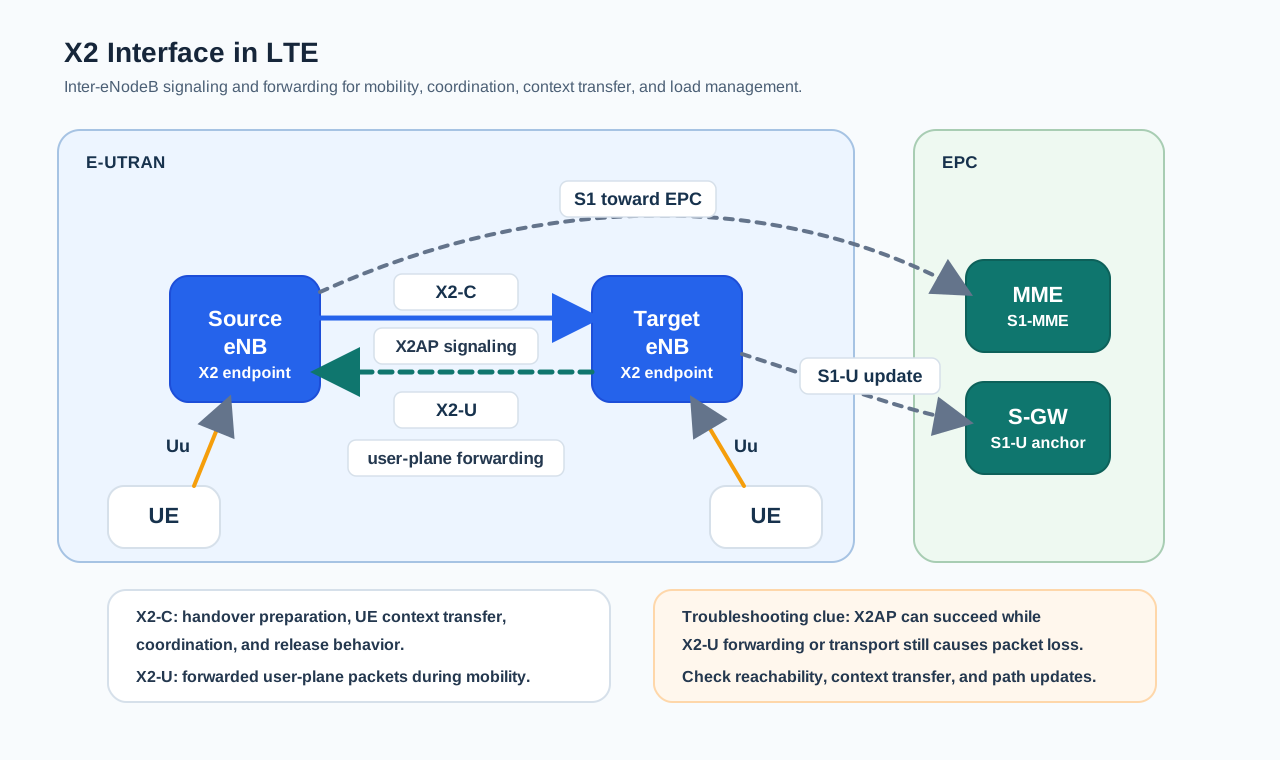
The X2 interface is the interface between eNodeBs (eNBs) inside the E-UTRAN. In LTE architecture, eNBs connect to the EPC through S1 and can be interconnected with each other through X2.
X2 is one of the main reasons LTE mobility can be fast and efficient. It lets neighboring eNBs exchange control signaling, transfer UE context, coordinate handovers, and support user-plane forwarding behavior without pushing every detail through the EPC.
X2 Interface Diagram
Quick facts
| Connects | eNodeB to eNodeB inside E-UTRAN |
|---|---|
| Main parts | X2-C for control plane and X2-U for user plane |
| Control protocol | X2AP on X2-C |
| Main use | Inter-eNB mobility, coordination, and context transfer |
| User-plane role | Forwarding user-plane packets between eNBs when needed |
| Operational focus | Handover preparation, context transfer, X2-U forwarding, and load coordination |
Contents
- X2 Interface Diagram
- X2 Interface in the LTE Architecture
- What the X2 Interface Is Used For
- X2-C and X2-U
- X2AP: The Main Signaling Protocol on X2-C
- Protocol Stack on X2-C
- X2-U and User-Plane Forwarding
- X2 and Inter-eNB Handover
- X2 and UE Context Transfer
- X2 and Load Management
- X2 as an Open Inter-eNB Interface
- X2 and S1: How They Differ
- Common Troubleshooting Angles for X2
- Related Pages
- Key takeaways
- FAQ
- References
X2 Interface in the LTE Architecture
At the architecture level, X2 complements S1. S1 connects E-UTRAN to the EPC, while X2 connects eNBs to each other inside the E-UTRAN.
This split is fundamental to LTE design. It allows inter-eNB coordination inside the RAN while preserving a clean access-to-core separation through S1.
| Interface | Connects | Main role |
|---|---|---|
| S1 | eNB and EPC | Access-to-core signaling and user-plane transport. |
| X2 | eNB and eNB | Inter-eNB mobility, coordination, context transfer, and forwarding support. |
What the X2 Interface Is Used For
The X2 interface is used for interconnection of E-UTRAN NodeB components. Its purpose includes multi-vendor eNB interconnection, continuation of E-UTRAN services offered through S1, and separation of radio-network functionality from transport-network functionality.
In practical LTE engineering, X2 is the direct coordination path between source and target eNBs. It is especially important when connected-mode mobility needs to happen quickly and the network wants to avoid routing every preparation detail through the EPC.
- Inter-eNB handover support
- UE context transfer
- Inter-eNB coordination
- Load management
- User-plane forwarding support
- Recovery and release procedures tied to inter-eNB mobility
X2-C and X2-U
The X2 interface has two main parts: X2-C for control-plane signaling and X2-U for user-plane forwarding. This split is essential for understanding how X2 works in real handover and coordination scenarios.
| Part | Plane | Main purpose |
|---|---|---|
| X2-C | Control plane | Inter-eNB signaling, handover preparation, context transfer, and coordination. |
| X2-U | User plane | Forwarding user-plane packets between eNBs when mobility requires it. |
X2AP: The Main Signaling Protocol on X2-C
The main control-plane signaling protocol on X2-C is the X2 Application Protocol (X2AP). X2AP provides the structured radio-network-layer procedures used between eNBs in E-UTRAN.
That means X2-C is not just a generic link between eNBs. It is a dedicated signaling interface used for handover-related signaling, load-management signaling, configuration and coordination procedures, and context-transfer-related actions between eNBs.
- Handover-related signaling
- Load-management signaling
- Configuration and coordination procedures
- Context-transfer-related actions between eNBs
Protocol Stack on X2-C
LTE separates radio-network functionality and transport-network functionality for X2. From an architecture and troubleshooting viewpoint, the key idea is that an X2-C problem may sit in X2AP itself, in the transport signaling layer, in IP reachability, or in the underlying transport network.
| Layer | Role on X2-C |
|---|---|
| X2AP | Radio-network-layer signaling between eNBs. |
| Transport signaling | Transport support for the X2 control plane. |
| IP | Network-layer reachability between eNBs. |
| Transport network | Underlying TNL connectivity and availability. |
X2-U and User-Plane Forwarding
X2-U is the user-plane side of X2. It is used for forwarding user-plane packets between eNBs, especially in mobility scenarios where the target eNB needs support while the user-plane path is being updated.
During mobility, user-plane traffic may need to be forwarded between eNBs so the handover can complete without excessive packet loss or service interruption. This is why a handover may look successful from the control-plane side but still show packet-loss or continuity issues if X2-U forwarding is broken or delayed.
X2 and Inter-eNB Handover
One of the most important uses of X2 is X2-based handover. The source eNB can coordinate directly with the target eNB for preparation, UE context transfer, forwarding behavior, and later cleanup.
This is why X2 handover is often faster and more efficient than S1-based fallback mobility. More of the mobility procedure remains inside E-UTRAN instead of routing all coordination through the EPC.
- Direct source-to-target eNB signaling
- UE context transfer
- User-plane forwarding support
- Release and cleanup actions after mobility
- Inter-eNB service continuity
X2 and UE Context Transfer
A major reason X2 matters is that it allows neighboring eNBs to exchange information needed to continue service for a UE during mobility. The target eNB needs enough UE-specific state to continue radio, bearer, and forwarding behavior after the serving cell changes.
Without reliable inter-eNB context transfer, handovers may fail, bearer continuity may break, user-plane forwarding may not align with target-cell state, and post-handover cleanup may become inconsistent.
X2 and Load Management
X2 is not only about mobility. X2AP also supports inter-eNB coordination functions beyond handover, including load-management-related signaling.
That broader coordination role matters because it makes X2 an operational interface for E-UTRAN optimization, not only a handover path.
- Balancing traffic between neighboring cells
- Sharing coordination information
- Improving radio-side resource usage
- Supporting optimization decisions inside E-UTRAN
X2 as an Open Inter-eNB Interface
One of the general principles for X2 is that the interface should be open and should facilitate interconnection of eNBs supplied by different manufacturers.
This interoperability goal is a major architectural advantage. It supports multi-vendor E-UTRAN deployments, allows inter-eNB coordination without assuming a single vendor stack, and improves practical deployment flexibility for operators.
X2 and S1: How They Differ
The S1 and X2 roles are easy to separate once the endpoints are clear. S1 connects the access network to the core. X2 connects the access network to itself.
A useful rule of thumb is: if the issue is between eNB and MME or S-GW, inspect S1. If the issue is between source and target eNB, inspect X2.
| Interface | Connects | Main role |
|---|---|---|
| S1 | eNB and EPC | Access-to-core signaling and user plane. |
| X2 | eNB and eNB | Inter-eNB mobility and coordination. |
Common Troubleshooting Angles for X2
X2 troubleshooting is usually about separating inter-eNB signaling, inter-eNB transport, and user-plane forwarding behavior. A handover can fail before preparation completes, or it can complete signaling while still losing packets because forwarding and path continuity are not healthy.
- X2 setup or inter-eNB connectivity issues
- X2AP signaling failures on the control plane
- Handover preparation failures between source and target eNB
- Context transfer problems
- X2-U forwarding failures during mobility
- Inter-vendor interoperability issues
- Load-management or coordination mismatches
- Transport-network problems under the X2 layer
Key takeaways
- The X2 interface is the main inter-eNB interface in LTE E-UTRAN.
- It is split into X2-C for control plane and X2-U for user plane.
- X2AP is the main signaling protocol on X2-C.
- X2 supports handover, UE context transfer, inter-eNB coordination, and load management.
- Understanding X2 is essential for diagnosing inter-eNB mobility and handover issues in LTE.
FAQ
What is the X2 interface in LTE?
The X2 interface is the interface between eNodeBs in LTE E-UTRAN. It is used for inter-eNB mobility and coordination.
What is the difference between X2-C and X2-U?
X2-C is the control-plane side used for signaling between eNBs, while X2-U is the user-plane side used for forwarding user-plane data packets between eNBs.
What protocol runs on X2-C?
The main control-plane signaling protocol on X2-C is X2AP.
Is X2 mainly used for handover?
Handover is one of the most important uses of X2, but X2 also supports inter-eNB coordination and load-management-related functions.
Is X2 an open interface?
Yes. X2 is designed as an open interface that supports interconnection of eNBs from different manufacturers.
Related pages
References
- 3GPP TS 36.401 E-UTRAN architecture, logical interfaces, and RNL/TNL separation.
- 3GPP TS 36.420 X2 general aspects and principles.
- 3GPP TS 36.423 X2 Application Protocol (X2AP) control-plane signaling procedures.
- 3GPP TS 36.300 E-UTRAN overall description, including X2-C and X2-U definitions.