LTE RRC Context Explained
In LTE, RRC context is the access-side control context maintained for a UE as part of the Radio Resource Control (RRC) function in the E-UTRAN. At the user level, LTE centers on two main RRC states: RRC_IDLE and RRC_CONNECTED.
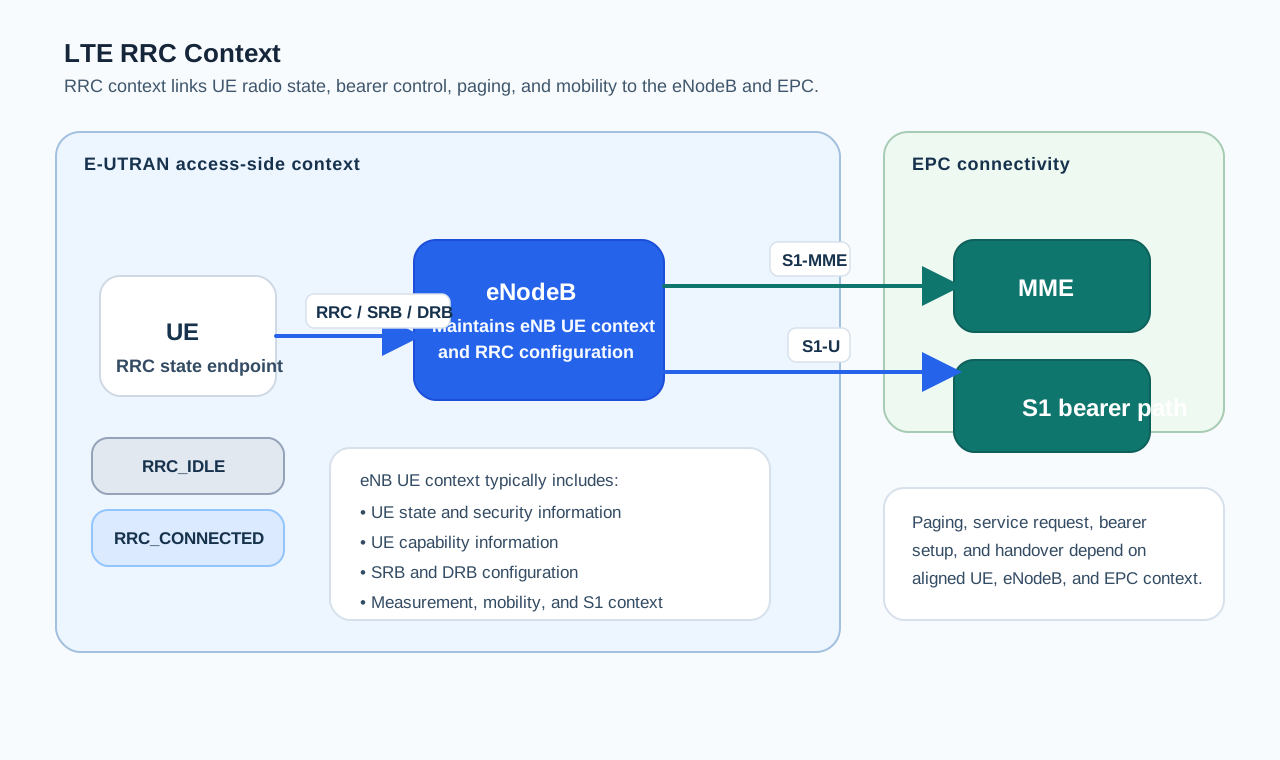
This context is what lets the eNodeB keep track of UE state, signaling bearers, data bearer configuration, measurements, security, and mobility information. It is the control-side bridge between the UE radio state and the wider LTE system behavior seen in paging, bearer setup, service request, and handover procedures.
Quick facts
| Main RRC states | RRC_IDLE and RRC_CONNECTED |
|---|---|
| Maintained in | UE and eNodeB access-side control context |
| eNB UE context includes | UE state, security, capability, and UE-associated logical S1 identities |
| Related bearers | SRBs for signaling and DRBs for user-plane realization |
| Why it matters | Paging, bearer control, mobility, and service continuity all depend on it |
| Linked core states | Interacts with ECM and EMM but is not the same thing |
Contents
- RRC context in the LTE architecture
- RRC_IDLE and RRC_CONNECTED
- What is an eNB UE context?
- RRC context and SRBs
- RRC context and DRBs
- RRC context and paging
- RRC context and mobility
- RRC context and ECM / EMM states
- What is stored in LTE RRC context?
- RRC context setup, modification, and release
- Common troubleshooting notes
- Related pages / next steps
- Key takeaways
- FAQ
RRC context in the LTE architecture
RRC context is the control-side glue between the UE radio behavior and the wider LTE network. It allows the eNB to maintain the UE active radio state, signaling bearers, measurement configuration, bearer state, mobility information, and access-side security and capability information.
| Context area | Why it matters |
|---|---|
| UE radio state | Defines whether the UE is idle or connected on the access side. |
| SRB / DRB configuration | Controls signaling paths and user-plane bearer realization. |
| Measurement and mobility state | Allows handover preparation, mobility control, and context continuity. |
| Security and capability information | Keeps the access side aligned with UE and EPC expectations. |
| S1-associated information | Connects the access-side UE context to EPC-facing control procedures. |
RRC_IDLE and RRC_CONNECTED
LTE defines two main RRC states. A UE is in RRC_CONNECTED when an RRC connection exists. Otherwise, it is in RRC_IDLE. This is a simple definition, but it has major architectural consequences for paging, mobility, bearer handling, and how much control context the network actively maintains.
| State | What it means in practice |
|---|---|
| RRC_IDLE | No RRC connection is established. The UE monitors paging, performs cell selection or reselection, and acquires system information. |
| RRC_CONNECTED | An RRC connection exists. The E-UTRAN knows the serving cell, the network can control mobility, and bearer and measurement configuration can be maintained. |
- RRC_IDLE: UE-controlled mobility, paging monitoring, neighboring-cell measurements, and system information acquisition
- RRC_CONNECTED: network-controlled handover, configured measurements, maintained radio bearers, and active access-side service state
What is an eNB UE context?
The eNB UE context is the block of information in an eNB associated with one UE and needed to maintain E-UTRAN service toward that active UE. This is one of the most important architecture definitions behind LTE RRC context because it shows that being connected means more than just being radio synchronized.
At minimum, the eNB UE context includes UE state information, security information, UE capability information, and the identities of the UE-associated logical S1 connection when those identities are established in the relevant eNB.
RRC context and SRBs
SRBs are a core part of LTE RRC context because they carry the access-side signaling used to establish, configure, and maintain the UE control state. Without SRBs, there is no bearer path for RRC signaling or transported NAS messages.
| SRB | Role in RRC context |
|---|---|
| SRB0 | Supports early RRC signaling using the CCCH. |
| SRB1 | Carries main RRC signaling and early transported NAS over DCCH. |
| SRB2 | Carries later NAS transport and lower-priority RRC signaling over DCCH. |
RRC context and DRBs
RRC context is not only about signaling state. It also includes the access-side control information needed to establish, modify, and release DRBs. Because a DRB is the radio-side data bearer for an associated EPS bearer, bearer handling problems often show up as RRC-context problems at the access side.
- DRB setup
- DRB modification
- DRB release
- Binding radio-side bearer behavior to E-RAB and EPS bearer expectations
RRC context and paging
Paging depends strongly on the difference between RRC_IDLE and RRC_CONNECTED. In idle state, the UE monitors the paging channel so the network can reach it when downlink activity arrives. The eNB then performs the access-side work needed to transmit the paging message.
That is why paging is one of the clearest examples of RRC context in action: the UE is not fully active on the access side, but enough state exists to let the network find it and bring it back into active signaling when needed.
RRC context and mobility
Mobility in LTE is deeply tied to RRC context. For a connected UE, mobility is controlled by the E-UTRAN, and handover depends on context transfer, bearer continuity, and eventual UE context release in the source eNB.
This means RRC context is not static. During mobility it may be transferred, updated, recreated in a target eNB, and finally released in the source eNB after handover completion.
- Context transfer from source eNB to target eNB
- Control of user-plane transport bearers during handover
- Handover cancellation when the move is aborted
- Source-eNB UE context release after successful mobility
RRC context and ECM / EMM states
RRC state is an access-side concept, while ECM and EMM are EPS-side concepts. They are not the same thing, but they interact closely in real procedures. For example, registration flows that move the UE into normal service often require the UE to be in an active access-side state while core-side state is updated.
This is why paging, attach, service request, and reactivation procedures often have to be read as combined access-side and core-side state transitions rather than as isolated protocol events.
What is stored in LTE RRC context?
The exact implementation is vendor specific, but from the architecture and signaling model the access-side context typically contains UE state, security-related information, UE capability information, UE-associated logical S1 identities, SRB and DRB configuration, measurement settings, mobility-related context, and bearer-related access parameters.
In practice, this is the information that lets the eNB keep the UE serviceable on the access side and coordinate correctly with the EPC during active procedures.
RRC context setup, modification, and release
RRC context begins to form when the UE moves into RRC_CONNECTED and the eNB completes the access-side setup needed for active service. It is then modified whenever bearer configuration, measurements, mobility preparation, security, or other service-related settings change.
It is eventually released when the UE leaves active access-side service, though related EPC-side state may remain depending on the overall procedure and core-network state.
- Setup: after transition to active connected service is completed
- Modification: during bearer changes, reconfiguration, mobility, and security updates
- Release: when active access-side service ends or when source context is removed after handover
Common troubleshooting notes
- Failure to establish RRC_CONNECTED
- SRB setup or SRB continuity problems
- DRB setup or modification failures
- Mismatch between bearer signaling and radio-side realization
- Paging behavior inconsistent with expected UE state
- Handover failures caused by context transfer issues
- Stale or partially released UE context in the eNB
- Security or capability-context mismatch
Key takeaways
- LTE RRC context is centered on the UE RRC state and the eNB UE context that maintains access-side service information.
- The two main LTE RRC states are RRC_IDLE and RRC_CONNECTED.
- SRBs carry signaling and are part of the RRC control context, while DRBs carry user traffic and are tied to bearer realization.
- The eNB UE context includes at least UE state, security information, UE capability information, and UE-associated logical S1 identities.
- RRC context is critical for paging, mobility, bearer handling, and service continuity in LTE.
FAQ
What is LTE RRC context?
LTE RRC context is the access-side control context maintained for a UE in the E-UTRAN, especially around RRC_CONNECTED, including UE state, security information, capability information, and related bearer and signaling state.
What is the difference between RRC_IDLE and RRC_CONNECTED?
A UE is in RRC_CONNECTED when an RRC connection exists; otherwise it is in RRC_IDLE. In idle, the UE monitors paging and performs cell reselection. In connected state, the network knows the serving cell and can control mobility.
What is an eNB UE context?
An eNB UE context is the block of information in the eNB associated with one UE and needed to maintain E-UTRAN services toward that active UE.
Are SRBs part of RRC context?
Yes. SRBs are central to RRC context because they carry the RRC and transported NAS signaling needed to establish and maintain the UE access-side control state.
How does RRC context relate to handover?
During handover, UE context is transferred, updated, or recreated in the target eNB, and the source eNB context is released after the move completes.