LTE Radio Bearers Explained
In LTE, a radio bearer is the logical bearer used on the access side between the UE and the eNodeB. LTE uses Signalling Radio Bearers (SRBs) for RRC and transported NAS signaling, and Data Radio Bearers (DRBs) for user-plane traffic.
This matters because the radio bearer is where EPC bearer intent becomes actual radio treatment. A DRB is the UE-to-eNB segment of the wider LTE bearer chain, and in standard LTE bearer handling there is a one-to-one relationship between the DRB, the associated E-RAB, and the associated EPS bearer when that bearer exists.
Quick facts
| Bearer types | SRB for signaling, DRB for user data |
|---|---|
| Access-side endpoints | UE and eNodeB |
| SRB purpose | RRC and transported NAS signaling |
| DRB purpose | User-plane packets for an associated EPS bearer |
| Key mapping | DRB ↔ E-RAB ↔ EPS bearer when the bearer exists |
| Configured through | RRC signaling and bearer-control procedures |
Contents
- Where radio bearers fit in LTE architecture
- Signalling Radio Bearers (SRBs)
- Data Radio Bearers (DRBs)
- SRB vs DRB
- Radio bearers, E-RABs, and EPS bearers
- Default bearers and dedicated bearers on the radio side
- Radio bearers and QoS in LTE
- Radio bearers and RRC
- Typical procedures and call flows using radio bearers
- Common troubleshooting notes
- Related pages / next steps
- Key takeaways
- FAQ
Where radio bearers fit in LTE architecture
A radio bearer is only one segment of the end-to-end LTE bearer model. On the radio side, the DRB carries packets between the UE and the eNodeB. On the access-to-core side, the S1 bearer carries the corresponding path between the eNB and the Serving Gateway. Together, those pieces form the E-RAB, which is the access-side realization of the wider EPS bearer.
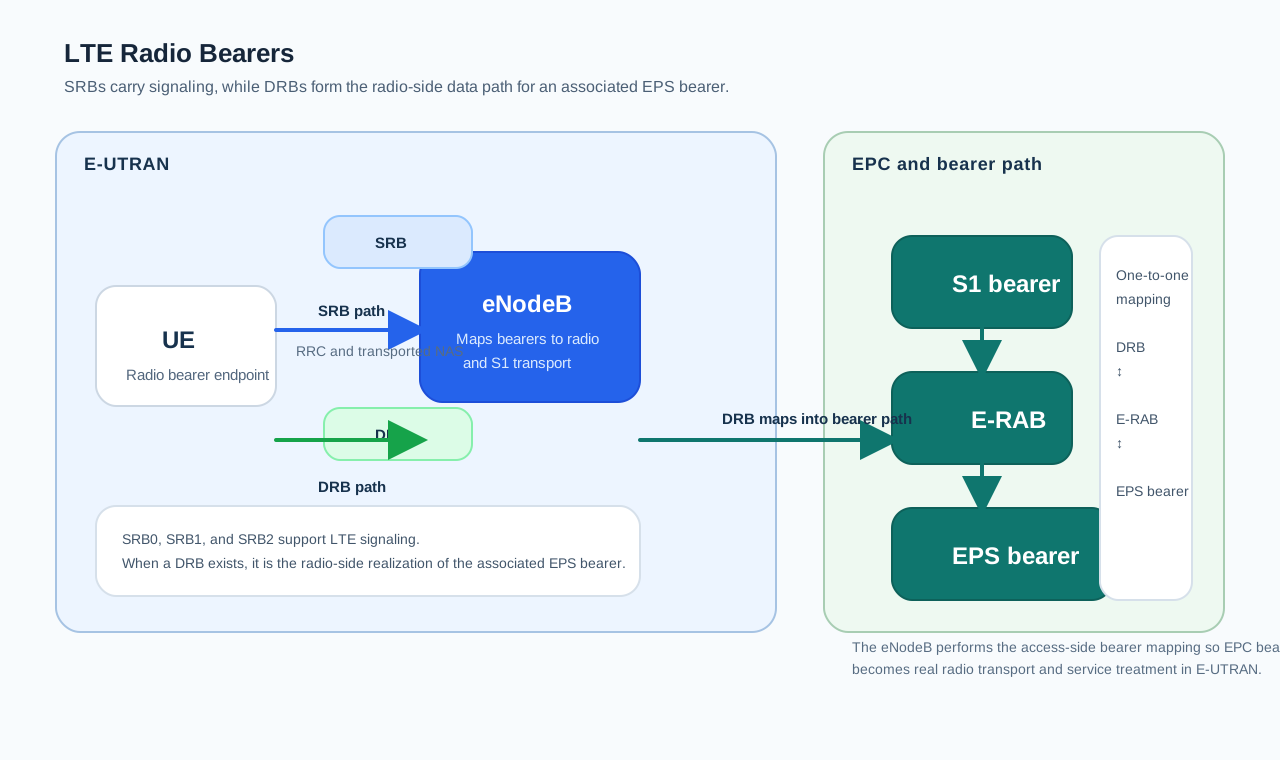
| Bearer segment | Scope in the architecture |
|---|---|
| SRB | Signaling bearer on the UE↔eNB side for RRC and transported NAS. |
| DRB | User-plane bearer on the UE↔eNB side for packets belonging to an associated EPS bearer. |
| S1 bearer | eNB↔Serving Gateway bearer for the E-RAB path toward the EPC. |
| E-RAB | Bearer path between the UE and EPC used to realize an associated EPS bearer through E-UTRAN and S1. |
| EPS bearer | End-to-end bearer concept used by the EPS for service and QoS handling. |
Signalling Radio Bearers (SRBs)
SRBs are used only for the transmission of RRC and transported NAS messages. They provide the control-side bearer framework that lets the UE create, maintain, and modify its LTE service state.
In practical terms, SRBs are the signaling foundation of LTE access. They carry the messages that establish the RRC connection, move NAS signaling toward the MME, and support reconfiguration, security, mobility, and bearer-control procedures.
| SRB | Typical role |
|---|---|
| SRB0 | Used for early RRC signaling on the CCCH. |
| SRB1 | Used for key RRC signaling and early transported NAS on the DCCH. |
| SRB2 | Used for later NAS transport and lower-priority RRC signaling on the DCCH. |
Data Radio Bearers (DRBs)
A DRB is the radio bearer used for user-plane data traffic. It is the access-side bearer that carries the packets of an associated EPS bearer between the UE and the eNodeB.
This is why DRBs matter so much in real networks: attach and signaling may succeed, but useful service only appears once the right radio-side data bearer exists and is aligned with the EPC bearer state.
- IP application traffic
- Internet and enterprise data traffic
- IMS media traffic in VoLTE deployments
- QoS-sensitive user-plane flows tied to bearer policy
SRB vs DRB
The short version is simple: SRBs carry control signaling, while DRBs carry user-plane traffic. That split is one of the reasons LTE can keep control behavior and service delivery aligned but distinct.
| Bearer type | Used for | Examples |
|---|---|---|
| SRB | Signaling | RRC setup, NAS transport, security, reconfiguration |
| DRB | User data | IP traffic, application traffic, VoLTE media |
Radio bearers, E-RABs, and EPS bearers
This mapping is the key architectural idea behind LTE bearer handling. The EPS bearer is the end-to-end bearer concept in the EPS. The E-RAB is the access realization of that bearer between the UE and the EPC. The DRB is the radio-side part of that path between the UE and the eNodeB.
In day-to-day engineering terms, the EPC decides and maintains bearer context, while the E-UTRAN turns that into access-side transport behavior. The eNB performs the mapping so the bearer identity and service treatment are realized correctly on the radio side.
| Concept | What it means in practice |
|---|---|
| EPS bearer | The end-to-end EPS service and QoS context. |
| E-RAB | The UE↔EPC bearer path used in E-UTRAN and S1. |
| DRB | The UE↔eNB segment that carries the packets of the associated EPS bearer. |
| S1 bearer | The eNB↔Serving Gateway segment used for the same E-RAB path. |
Default bearers and dedicated bearers on the radio side
A default bearer gives the UE its baseline IP connectivity for the lifetime of the PDN connection. A dedicated bearer can then be added for more specific treatment such as different QoS handling.
On the radio side, that means a default bearer is realized through the corresponding default DRB / E-RAB path, while a dedicated bearer is realized through a corresponding dedicated DRB / E-RAB path when it is established.
Radio bearers and QoS in LTE
Radio bearers are one of the main places where LTE service intent becomes actual scheduling and resource behavior. Because a DRB maps to the associated E-RAB and EPS bearer, the eNB can apply the right access-side treatment to the right traffic path.
That is why bearer identity, QoS policy, scheduling, and radio resource allocation all meet at the radio bearer level.
Radio bearers and RRC
Radio bearers are configured and controlled through RRC procedures. That includes SRB setup, DRB setup, modification, and release behavior during connection setup, reconfiguration, and later service changes.
This is also why radio bearer analysis is inseparable from RRC analysis: SRBs exist for control signaling, DRBs are created through control signaling, and bearer behavior depends on the current RRC configuration and state.
Typical procedures and call flows using radio bearers
- Attach: control signaling is established first, then the default bearer path is realized through the corresponding DRB and E-RAB.
- Service Request: the UE returns from idle and bearer usability is restored toward active service.
- Dedicated bearer establishment: additional QoS treatment is realized on the radio side through a new DRB / E-RAB path.
- Handover: bearer continuity depends on preserving the mapping and identity of the associated bearer across mobility.
Common troubleshooting notes
- SRB setup failure can break initial access, security progression, or later reconfiguration.
- DRB setup failure can leave the UE attached without usable packet service.
- E-RAB created but DRB missing is a classic access-side realization problem.
- Dedicated bearer partially created can leave QoS treatment inconsistent between EPC and E-UTRAN.
- Post-handover bearer issues often point to broken bearer continuity or incomplete context transfer.
- QoS mismatch can show up when core bearer intent and radio-side scheduling are not aligned.
Key takeaways
- LTE uses SRBs for signaling and DRBs for user data on the radio-access side.
- SRB0, SRB1, and SRB2 support RRC and transported NAS signaling.
- A DRB carries the packets of an associated EPS bearer between the UE and eNodeB.
- In LTE bearer handling, there is a practical one-to-one mapping between DRB, E-RAB, and EPS bearer when that bearer exists.
- Radio bearers are where EPC bearer intent, access-side QoS handling, and real radio transport behavior meet.
FAQ
What is a radio bearer in LTE?
A radio bearer is the bearer used on the LTE access side between the UE and the eNodeB. LTE uses SRBs for signaling and DRBs for user data.
What is the difference between SRB and DRB?
SRBs carry RRC and transported NAS signaling, while DRBs carry user-plane data traffic.
How many SRBs are there in LTE?
LTE defines SRB0, SRB1, and SRB2 for access-side signaling handling.
How does a radio bearer relate to an EPS bearer?
A DRB is the radio-side bearer that carries the packets of the associated EPS bearer between the UE and eNodeB. In standard bearer handling, the DRB, E-RAB, and EPS bearer map one-to-one when the bearer exists.
What is an E-RAB in LTE?
An E-RAB is the bearer path used between the UE and the EPC. It includes the radio-side realization through the DRB and the S1-side realization through the S1 bearer.