S1-U Interface in LTE Explained
The S1-U interface is the user-plane part of the LTE S1 interface between the eNodeB (eNB) in the E-UTRAN and the Serving Gateway (S-GW) in the EPC. In LTE architecture, S1 is split into S1-MME for the control plane and S1-U for the user plane.
S1-U is the EPC-facing data path from LTE radio access into the core user-plane path. It carries the S1 bearer segment between the eNB and the S-GW, using GTP-U over UDP/IP transport for LTE user traffic.
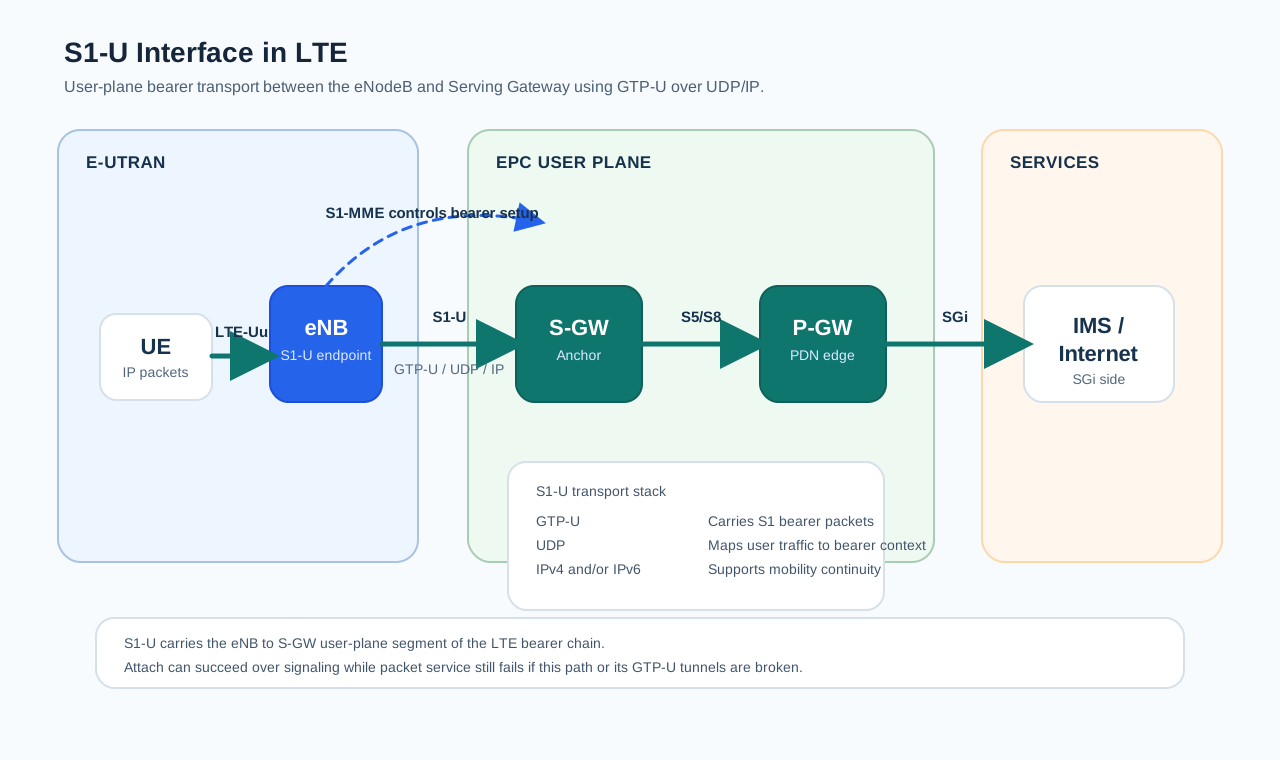
S1-U Interface Diagram
Quick facts
| Connects | eNodeB and Serving Gateway |
|---|---|
| Plane type | User plane |
| Main protocol | GTP-U over UDP/IP |
| Carries | User packets associated with E-RAB / EPS bearer handling |
| Bearer segment | S1 bearer between eNB and S-GW |
| Operational focus | No-data issues, bearer realization, packet loss, and handover user-plane continuity |
Contents
- S1-U Interface Diagram
- S1-U in the LTE Architecture
- What S1-U Is Used For
- S1-U Is the User Plane Part of S1
- S1-U and the LTE Bearer Model
- S1-U and E-RABs
- Protocol Stack on S1-U
- GTP-U on S1-U
- S1-U and the Serving Gateway
- S1-U and User Traffic Flow
- S1-U and Mobility
- S1-U and Default / Dedicated Bearers
- S1-U and VoLTE / IMS Reachability
- Common Troubleshooting Angles for S1-U
- Related Pages
- Key takeaways
- FAQ
- References
S1-U in the LTE Architecture
In LTE, the user-data path starts at the UE, crosses the LTE radio interface to the eNodeB, then leaves E-UTRAN over S1-U toward the S-GW. From there, traffic continues over S5/S8 toward the P-GW and then over SGi toward external packet networks, IMS, or Internet services.
This makes S1-U the access-side user-plane bridge between LTE radio transport and the EPC gateway path. It is where user packets leave the eNodeB and enter the S-GW path toward the rest of the EPC.
| Path segment | Role |
|---|---|
| UE ↔ eNB | LTE radio-side transport over LTE-Uu and radio bearers. |
| eNB ↔ S-GW | S1-U user-plane transport and S1 bearer segment. |
| S-GW ↔ P-GW | Core gateway bearer path over S5/S8. |
| P-GW ↔ external services | Packet-data-network access over SGi toward IMS or Internet services. |
What S1-U Is Used For
S1-U is the interface that turns successful LTE signaling into real packet service. Even if attach and NAS signaling complete correctly, no useful IP service can be delivered unless S1-U and the downstream EPC user-plane path also work properly.
- User data traffic between the UE and the EPC
- Bearer traffic associated with active LTE services
- Packet flows that correspond to E-RAB and EPS bearer handling
- Access-side user-plane continuity during mobility events
S1-U Is the User Plane Part of S1
A common confusion point in LTE is the distinction between S1-MME and S1-U. S1-MME carries the signaling needed for access and EPC control, while S1-U carries the actual packet data associated with LTE services.
| Interface | Connects | Plane | Main purpose |
|---|---|---|---|
| S1-MME | eNB and MME | Control plane | Signaling, NAS transport, and UE context control |
| S1-U | eNB and S-GW | User plane | User traffic transport |
S1-U and the LTE Bearer Model
The LTE bearer model is the key to understanding S1-U. An E-RAB transports packets of an EPS bearer between the UE and the EPC. A data radio bearer carries the UE-to-eNB segment, the S1 bearer carries the eNB-to-S-GW segment over S1-U, and the S5/S8 bearer continues the path between the S-GW and P-GW.
That means S1-U is where the S1 bearer lives in the bearer chain. It is essential to bearer realization because it connects the radio-side bearer path with the EPC gateway path.
| Bearer segment | Scope |
|---|---|
| Data Radio Bearer | UE to eNB bearer segment on the LTE radio side. |
| S1 bearer | eNB to S-GW bearer segment carried over S1-U. |
| S5/S8 bearer | S-GW to P-GW bearer segment inside the EPC. |
| EPS bearer | End-to-end EPS bearer context associated with the service path. |
S1-U and E-RABs
S1-U is tightly linked to E-RAB handling. When an E-RAB exists, the S1 bearer is the part of that E-RAB between the eNB and the S-GW. As a result, S1-U is where the access-side, core-facing bearer segment is actually carried.
This matters in troubleshooting because the control plane may indicate that a bearer exists while the actual user-plane path on S1-U is missing, inconsistent, or broken. Many LTE bearer problems are really S1-U realization problems.
Protocol Stack on S1-U
The main user-plane protocol on S1-U is GTP-U. S1-U data streams use GTP-U over UDP over IP, with the data link and physical transport underneath. This protocol layering matters because failures can happen at the tunnel layer, transport layer, or underlay network layer.
| Layer | Role on S1-U |
|---|---|
| GTP-U | Tunnels user-plane packets with bearer association. |
| UDP | Transport for GTP-U packets. |
| IPv4 and/or IPv6 | Network-layer connectivity between eNB and S-GW. |
| Data link layer | Underlying transport-network link behavior. |
| Physical layer | Physical transport for the S1-U network path. |
GTP-U on S1-U
GTP-U is the tunneling mechanism that lets the LTE EPC carry user-plane packets while preserving bearer association through the network. Because S1-U uses GTP-U, the eNB and S-GW can exchange user packets in a way that remains tied to the UE bearer context.
Operationally, S1-U traces are often read in terms of tunnel endpoints, bearer-related transport, user-plane continuity during mobility, and packet forwarding between eNB and S-GW.
S1-U and the Serving Gateway
The Serving Gateway is the EPC node on the far side of S1-U. It acts as the access-side user-plane anchor, supports packet routing and forwarding, contributes to local mobility anchoring for inter-eNB handover, and supports downlink buffering behavior for idle-mode service restoration.
Because S1-U terminates at the S-GW, it is one of the most important interfaces for understanding actual LTE data-service behavior.
S1-U and User Traffic Flow
A simplified LTE user-data path is UE → eNB → S1-U → S-GW → S5/S8 → P-GW → SGi → external packet network. S1-U is therefore the first EPC-facing user-plane hop after the radio side.
In practical LTE operations, S1-U carries Internet traffic, application traffic, IMS-related packet flows, and any other user-plane service data once bearers are active. If S1-U is unavailable or broken, the UE may still attach successfully from a signaling perspective, but real service traffic will fail.
S1-U and Mobility
S1-U is critical during LTE mobility. The S-GW is the local mobility anchor for inter-eNB handover, so the S1-U path is one of the key user-plane components that must be preserved, updated, or re-established during handover.
During handover, the source and target radio legs may change, but the user-plane path must remain continuous and S1-U endpoints must remain aligned with bearer state. That is why S1-U is often checked first when handover signaling succeeds but traffic continuity fails.
- Source and target radio legs may change during handover.
- The user-plane path must remain continuous.
- S1-U endpoints and forwarding behavior must match the active bearer state.
S1-U and Default / Dedicated Bearers
S1-U carries traffic for both the default bearer and dedicated bearers. The default bearer gives the UE baseline packet connectivity throughout the lifetime of the PDN connection, and dedicated bearers add service-specific treatment when required.
Once bearer setup is complete, the S1 bearer corresponding to that bearer path is carried over S1-U. This is why S1-U is central to QoS-relevant service delivery, whether the traffic is generic Internet data or service-specific traffic such as IMS media.
S1-U and VoLTE / IMS Reachability
IMS and VoLTE are service-layer topics, but the packet path still depends on S1-U. IMS-bound traffic traverses LTE radio access, S1-U, the S-GW, S5/S8, and the P-GW before reaching operator IP services.
SIP signaling, IMS service control, and policy control are separate architecture areas, but their packets still need a working LTE user-plane path. If S1-U is broken, VoLTE and IMS reachability can fail even when higher-layer service logic is otherwise correct.
Common Troubleshooting Angles for S1-U
S1-U troubleshooting is usually about separating signaling success from actual user-plane availability. The bearer may be established on the control side, but packet forwarding can still fail because the tunnel, transport path, endpoint mapping, or mobility update is wrong.
- Successful attach but no user data
- Intermittent user-plane loss after handover
- Missing or broken GTP-U tunnel behavior
- Incorrect bearer realization between eNB and S-GW
- Downlink buffering or service-reactivation mismatch
- S1-U transport reachability issues
- Packet loss between eNB and S-GW
- Mismatch between signaling-side bearer state and user-plane availability
Key takeaways
- S1-U is the LTE eNB-to-S-GW user-plane interface.
- It carries the S1 bearer, which transports packets of an E-RAB between the eNB and the Serving Gateway.
- The main protocol on S1-U is GTP-U over UDP/IP.
- S1-U is the first EPC-facing user-plane hop after LTE radio access.
- Understanding S1-U is essential for diagnosing no-data problems, bearer issues, and handover user-plane failures in LTE.
FAQ
What is S1-U in LTE?
S1-U is the user-plane part of the LTE S1 interface between the eNB and the Serving Gateway. It carries user data traffic between E-UTRAN and the EPC.
What protocol runs on S1-U?
The main user-plane protocol on S1-U is GTP-U, carried over UDP/IP.
What is the difference between S1-MME and S1-U?
S1-MME is the control-plane side of S1 toward the MME, while S1-U is the user-plane side toward the S-GW.
How does S1-U relate to bearers?
S1-U carries the S1 bearer, which transports packets of an E-RAB between the eNB and the Serving Gateway.
Why is S1-U important for handover?
Because the S-GW is the local mobility anchor for inter-eNB handover, and S1-U is the access-side EPC user-plane path that must remain continuous or be updated correctly during mobility.
Related pages
References
- 3GPP TS 36.410 S1 general aspects and principles.
- 3GPP TS 23.401 EPS architecture and mobility behavior for E-UTRAN access.
- 3GPP TS 36.300 E-UTRAN overall description, bearer model, and S1 bearer relationship.
- 3GPP TS 29.281 GTP-U protocol specification for EPS user-plane interfaces including S1-U.
- 3GPP TS 36.414 S1 data transport and GTP-U over UDP/IP stack.