PDN Gateway (P-GW) in LTE Explained
The PDN Gateway (P-GW) is the gateway that connects the LTE network to external packet data networks (PDNs) such as the Internet, IMS, or enterprise networks. In LTE architecture, the P-GW is responsible for IP address allocation, policy and charging enforcement, bearer-aware packet treatment, and connectivity to external IP networks.
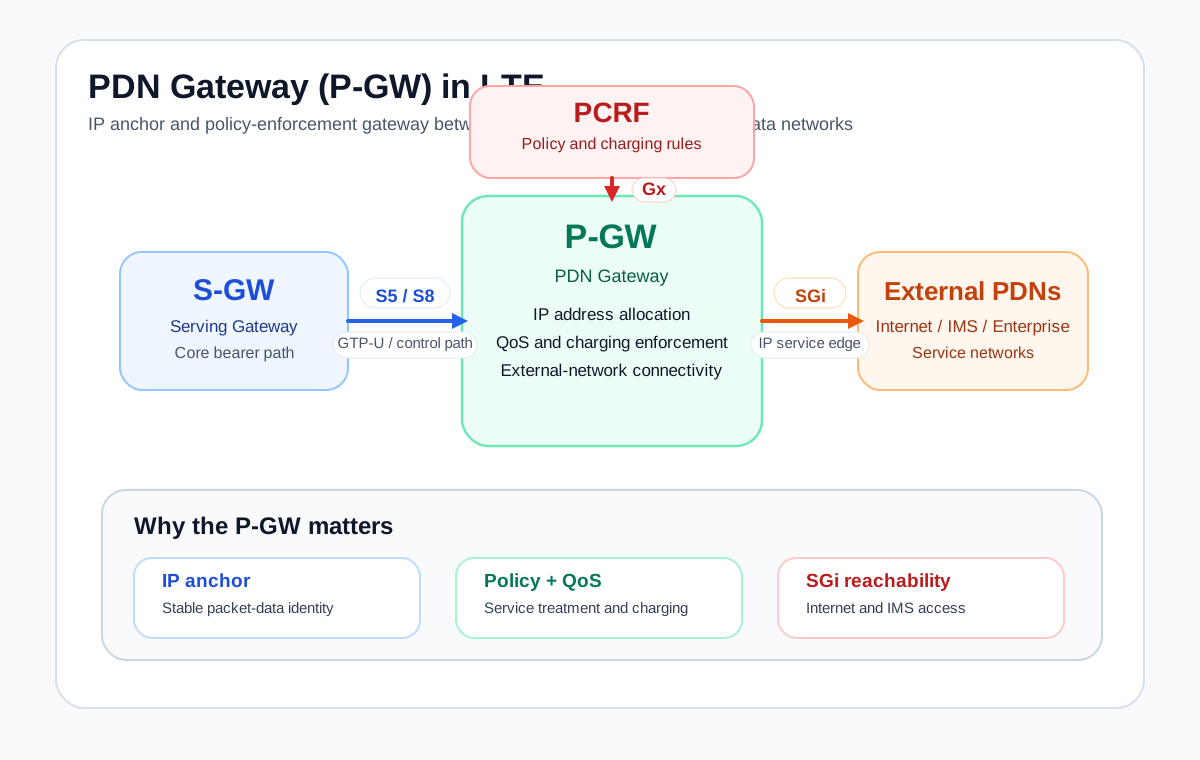
Architecturally, the P-GW sits on the far side of the S-GW. It faces the EPC over S5/S8, reaches external packet networks over SGi, and works with the PCRF over Gx for policy and charging control. That makes the P-GW the EPC node where LTE packet service meets the outside world.
P-GW in LTE architecture
Quick facts
| Node type | External-connectivity and IP-anchor gateway in the EPC |
|---|---|
| Main role | PDN connectivity, IP allocation, policy and charging enforcement |
| Core-side interface | S5/S8 toward the S-GW |
| Service-side interface | SGi toward external packet networks and IMS |
| Policy interface | Gx toward the PCRF |
| Key architectural theme | IP anchor and service-policy enforcement point |
Contents
- P-GW in LTE architecture
- Where the P-GW fits in LTE architecture
- Main functions of the P-GW
- IP address allocation and PDN connectivity
- Connectivity to external networks
- Policy and QoS enforcement
- Charging and accounting
- Interfaces used
- Protocols used
- P-GW and LTE bearers
- The P-GW as the IP anchor
- P-GW versus S-GW
- Typical procedures or call flows using it
- Common troubleshooting notes
- Related pages / next steps
- Key takeaways
- FAQ
Where the P-GW fits in LTE architecture
The P-GW sits at the edge of the EPC, between LTE core bearers and external packet networks. On the EPC side it receives traffic from the S-GW over S5/S8. On the service side it reaches the public Internet, IMS, and enterprise networks over SGi.
That makes the P-GW the boundary point where EPC bearer handling becomes real IP service delivery. It is also the point where policy, charging, and QoS enforcement become visible to actual traffic flows.
| Architecture relationship | Why it matters |
|---|---|
| S-GW side | Receives the LTE core bearer path over S5/S8. |
| External-network side | Connects LTE users to Internet, IMS, and enterprise PDNs over SGi. |
| PCRF side | Enforces policy and charging rules received over Gx. |
| UE service continuity | Acts as the IP anchor for the UE across most LTE mobility events. |
Main functions of the P-GW
This is why the P-GW is one of the most service-visible nodes in LTE. Radio access and bearer creation can succeed, but if the P-GW does not allocate the right IP context or enforce the right policy, the user still does not get the expected service.
- IP address allocation for the UE when a PDN connection is established
- Connectivity to external networks such as Internet, IMS, and enterprise PDNs
- Policy and QoS enforcement using rules from the PCRF
- Charging and accounting support for operator billing and usage control
- Bearer-aware packet treatment and mapping toward external IP flows
- Traffic filtering and service enforcement at the EPC boundary
IP address allocation and PDN connectivity
One of the most important P-GW functions is assigning the UE an IP address when a PDN connection is established. In practical terms, this makes the P-GW the node that turns LTE registration and bearer setup into usable packet-data service for the application layer.
Each PDN connection is tied to its own service context, and the P-GW is where that connectivity becomes anchored. This is why APN selection, PDN type, and IP allocation are central parts of LTE packet service behavior.
Connectivity to external networks
The P-GW provides connectivity to public Internet, IMS, and enterprise or private networks. This happens over SGi, which is the service-facing side of the LTE packet core.
From an engineering point of view, this means the P-GW is where EPC packet handling meets the outside world. Even when radio access, S1 bearers, and S5/S8 transport all look healthy, a problem beyond or at SGi can still prevent the user from reaching the expected service.
Policy and QoS enforcement
The P-GW is the EPC node that enforces policy and charging rules and applies service treatment to bearer traffic. This includes QoS-aware behavior, traffic treatment, and service-control decisions that come from the PCRF over Gx.
This is why the P-GW matters so much for user experience. Bearers are not only about getting traffic from one side of the network to the other. They are also about ensuring the right service gets the right treatment, priority, and policy behavior once it reaches the EPC edge.
| Policy area | P-GW role |
|---|---|
| QoS enforcement | Applies bearer-related service treatment and traffic behavior. |
| Charging rules | Applies policy-linked charging and usage treatment. |
| Traffic filtering | Allows or restricts flows according to configured policy behavior. |
| Service awareness | Aligns bearer traffic with operator service rules and external-network expectations. |
Charging and accounting
The P-GW is a major charging point in LTE architecture. It supports usage accounting, billing-related behavior, and service-aware charging rules that are tied to bearers, traffic types, and subscriber policy.
This makes the P-GW important not only for packet delivery but also for commercial service behavior. A user may have working bearer connectivity, but charging-policy mismatch can still affect whether the expected service is allowed or shaped correctly.
Interfaces used
| Interface | Connects | Purpose |
|---|---|---|
| S5/S8 | S-GW ↔ P-GW | Bearer path and control coordination between LTE EPC gateway roles. |
| SGi | P-GW ↔ external packet networks | Service-side IP connectivity toward Internet, IMS, and enterprise PDNs. |
| Gx | P-GW ↔ PCRF | Policy and charging rule exchange for bearer and service enforcement. |
Protocols used
This protocol mix is one reason P-GW troubleshooting spans multiple layers. Some issues are in EPC tunnel handling, while others are really policy, charging, or SGi-side routing problems.
| Protocol family | Where it appears around the P-GW |
|---|---|
| GTP-U | Used on S5/S8 for user-plane traffic between the S-GW and P-GW. |
| GTPv2-C | Used for control coordination associated with the S5/S8 bearer path. |
| Diameter | Used on Gx toward the PCRF for policy and charging control. |
| IP transport | Used on SGi toward external networks rather than GTP tunneling. |
P-GW and LTE bearers
The P-GW is the far-end anchor for EPS bearer behavior inside the EPC. It maps bearer traffic toward external IP flows, applies policy, and keeps the service treatment aligned with the bearer’s intended QoS and charging behavior.
This applies to both default bearers and dedicated bearers. The default bearer provides baseline packet connectivity, while dedicated bearers are added for more specific service treatment such as VoLTE-related traffic handling.
The P-GW as the IP anchor
One of the clearest ways to understand the P-GW is as the IP anchor for the UE. The radio path and even the serving eNodeB may change, and the S-GW may handle local mobility anchoring, but the P-GW is the stable EPC-side anchor for the UE’s packet-data service identity.
This is why many LTE mobility scenarios can preserve application continuity without changing the UE’s external-service perspective. The access side changes, but the packet-data anchor remains consistent.
P-GW versus S-GW
This comparison is useful because the two gateways often appear together in LTE traces, but they do different jobs. The S-GW keeps the access-side path stable, while the P-GW keeps the external service identity and policy behavior stable.
| Feature | S-GW | P-GW |
|---|---|---|
| Primary role | Local mobility and access-side user-plane anchor | IP anchor and external-network gateway |
| Main interfaces | S1-U, S11, S5/S8 | S5/S8, SGi, Gx |
| Focus | Packet forwarding and mobility continuity | IP connectivity, policy, QoS, charging |
| Mobility view | Local mobility anchor | Session and service continuity anchor |
Typical procedures or call flows using it
- Attach uses the P-GW as part of initial PDN connectivity creation.
- APN / PDN connectivity setup is one of the clearest procedure views of P-GW session creation.
- Default EPS bearer establishment depends on the P-GW for usable packet-data service.
- Dedicated EPS bearer establishment shows how the P-GW participates in service-specific bearer treatment.
Common troubleshooting notes
- the UE receives an IP address but still cannot reach the Internet or IMS
- QoS behavior is wrong even though bearer setup succeeded
- PCRF policy does not line up with observed traffic treatment
- charging or accounting behavior is missing or inconsistent
- SGi-side routing or external-service reachability is broken
- S5/S8 tunnel behavior is healthy enough for setup but unstable for real traffic
- traffic filtering or policy enforcement blocks expected application flows
Key takeaways
- The P-GW connects LTE to external IP networks and services.
- It is the UE’s main IP anchor in the EPC.
- It is responsible for IP allocation, QoS enforcement, policy, and charging.
- Its main interfaces are S5/S8, SGi, and Gx.
- It is essential for end-to-end packet connectivity and service delivery beyond the LTE core.
FAQ
What is the P-GW in LTE?
The P-GW is the gateway that connects LTE to external packet data networks and provides IP connectivity for the UE.
What does the P-GW do in LTE?
It handles IP address allocation, QoS and policy enforcement, charging support, and connectivity to external networks over SGi.
What interface connects the P-GW to the Internet?
The SGi interface connects the P-GW to external packet data networks such as the Internet, IMS, and enterprise systems.
What is the difference between S-GW and P-GW?
The S-GW is the local mobility and access-side user-plane anchor, while the P-GW is the IP anchor and service-policy gateway toward external networks.
Does the P-GW change during LTE mobility?
Typically the P-GW remains the same, acting as the stable IP anchor while access-side mobility happens around it.