Serving Gateway (S-GW) in LTE Explained
The Serving Gateway (S-GW) is one of the main user-plane nodes in the LTE Evolved Packet Core (EPC). It is the EPC gateway that terminates the interface toward the E-UTRAN, and for each UE associated with the EPS there is a single Serving GW at a given point in time. Its main functions include local mobility anchoring for inter-eNodeB handover, mobility anchoring for inter-3GPP mobility, idle-mode downlink packet buffering, packet routing and forwarding, and transport-level packet marking.
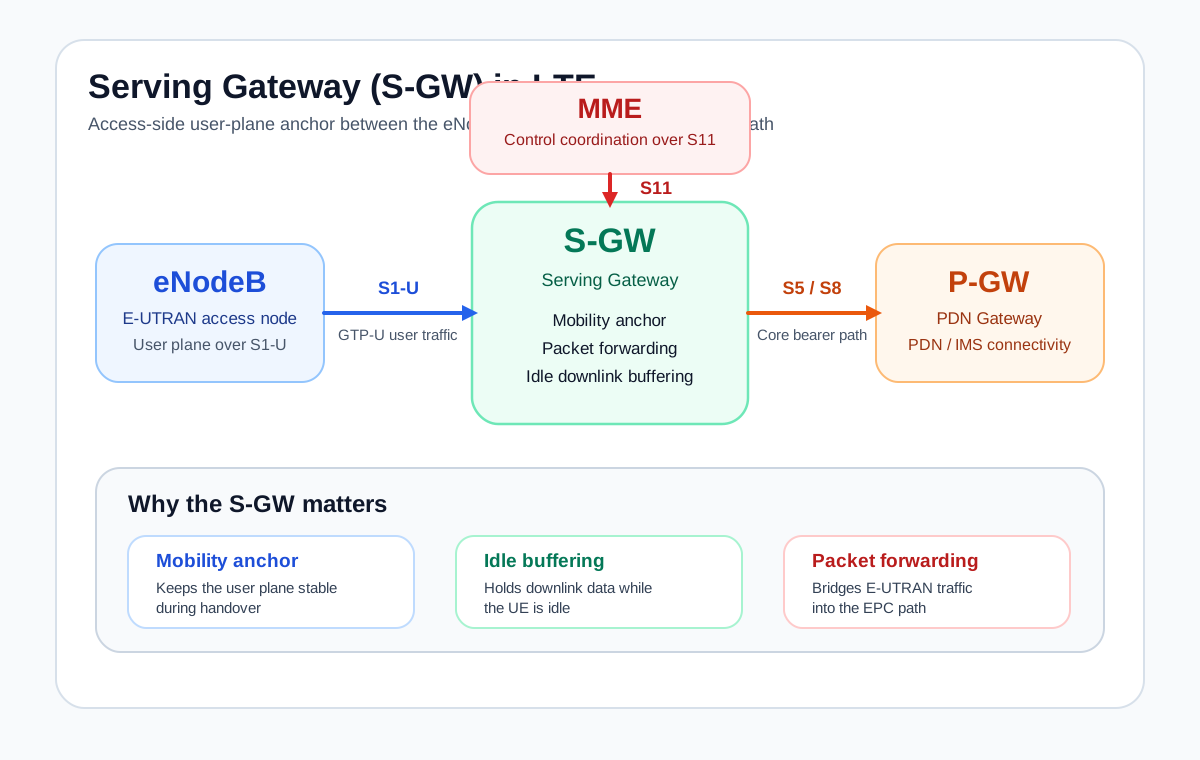
Architecturally, the S-GW sits between the eNodeB and the P-GW. On the access side it faces the eNB over S1-U and the MME over S11; on the core side it connects toward the P-GW over S5/S8. That makes the S-GW the access-side user-plane anchor inside the EPC.
S-GW in LTE architecture
Quick facts
| Node type | Main EPC user-plane gateway toward E-UTRAN |
|---|---|
| Plane focus | User plane with control coordination on S11 |
| Access-side interface | S1-U toward the eNodeB |
| Core-side interface | S5/S8 toward the P-GW |
| Control coordination | S11 toward the MME |
| Key roles | Mobility anchor, packet forwarding, idle buffering, bearer continuity |
Contents
- S-GW in LTE architecture
- Where the S-GW fits in LTE architecture
- Main functions of the S-GW
- The S-GW as a mobility anchor
- Idle-mode downlink buffering and service restoration
- Interfaces used
- Protocols used
- S-GW and the LTE bearer path
- Typical procedures or call flows using it
- Control plane and user plane around the S-GW
- Common troubleshooting notes
- Related pages / next steps
- Key takeaways
- FAQ
Where the S-GW fits in LTE architecture
The S-GW is the user-plane transition point between LTE access and the deeper EPC packet path. Traffic arrives from the eNodeB over S1-U, continues toward the P-GW over S5/S8, and is coordinated from the control plane by the MME over S11.
That placement makes the S-GW the EPC node that keeps the access-side packet path stable while radio conditions, serving cells, and even some mobility scenarios change around it.
| Architecture relationship | Why it matters |
|---|---|
| E-UTRAN side | Terminates the EPC-facing user-plane interface toward the eNodeB over S1-U. |
| MME side | Receives bearer and session control coordination from the MME over S11. |
| P-GW side | Forwards and anchors the packet path toward the P-GW over S5/S8. |
| Mobility role | Acts as the local mobility anchor for inter-eNodeB handover and supports inter-3GPP mobility anchoring. |
Main functions of the S-GW
Taken together, these functions show that the S-GW is much more than a simple tunnel endpoint. It is the EPC node that keeps the access-side user plane usable while control-plane procedures and mobility events happen around it.
- Local mobility anchor for inter-eNodeB handover
- Mobility anchoring for inter-3GPP mobility cases
- Idle-mode downlink packet buffering for UE reachability and later service restoration
- Packet routing and forwarding between E-UTRAN and the deeper EPC path
- Transport-level packet marking in uplink and downlink
- Accounting and charging support tied to user-plane behavior
The S-GW as a mobility anchor
One of the most important S-GW roles is acting as the local mobility anchor point for inter-eNodeB handover. This means the radio side can change while the EPC user-plane anchor remains stable enough to preserve continuity across the move.
That is why the S-GW matters so much in mobility analysis. The handover procedure may look RAN-heavy on the surface, but the user-plane continuity behind it still depends on the S-GW staying aligned with the changing access path.
Idle-mode downlink buffering and service restoration
The S-GW supports idle-mode downlink packet buffering and is tied to network-triggered service restoration behavior. If downlink traffic arrives while the UE is idle, the S-GW can hold packets while the network works to make the UE reachable again.
This is why paging, service request, and S-GW behavior are closely related in practice. Even if the UE is idle on the radio side, the EPC still needs somewhere to preserve the packet path long enough for service to resume cleanly.
Interfaces used
| Interface | Connects | Purpose |
|---|---|---|
| S1-U | eNodeB ↔ S-GW | User-plane traffic between E-UTRAN and the EPC access-side gateway. |
| S11 | MME ↔ S-GW | GTP-C control coordination for session and bearer management. |
| S5/S8 | S-GW ↔ P-GW | Core user-plane path and gateway-to-gateway bearer continuity. |
Protocols used
This is why S-GW troubleshooting often has two layers: control behavior on S11 and user-plane behavior on S1-U or S5/S8. A UE may register successfully through the MME but still fail to pass real traffic if the user-plane path around the S-GW is broken.
| Protocol family | Where it is used around the S-GW |
|---|---|
| GTPv2-C | Used on S11 for bearer and session control between the MME and the S-GW. |
| GTP-U | Used on S1-U and S5/S8 for user-plane transport through the S-GW path. |
S-GW and the LTE bearer path
The S-GW sits directly in the LTE bearer chain. The eNB ↔ S-GW user-plane segment runs over S1-U, while the S-GW ↔ P-GW segment continues over S5/S8. That makes the S-GW the central user-plane handoff point between the access side and the packet-data gateway.
From a bearer perspective, the S-GW is where access-side service continuity and EPC-side gateway continuity meet. This is why it is such a critical point for packet forwarding, QoS-sensitive traffic handling, and handover-related path switching.
Typical procedures or call flows using it
These procedures make the S-GW visible in very different ways. In attach it looks like part of bearer creation. In service request it looks like idle-to-active continuity support. In handover it looks like the user-plane anchor that prevents packet service from collapsing when the serving eNodeB changes.
- Attach uses S-GW coordination as part of default bearer creation.
- Service Request depends on S-GW buffering and bearer reuse after idle mode.
- X2 handover keeps user-plane continuity while the radio anchor changes.
- S1 handover exposes EPC coordination more directly while still depending on the S-GW user-plane anchor.
Control plane and user plane around the S-GW
The S-GW is primarily a user-plane-oriented EPC node, but it still participates in control coordination through S11 with the MME. This is a useful example of the LTE architecture split: the MME handles control logic, the S-GW anchors the access-side user plane, and the P-GW provides connectivity toward packet data networks.
Understanding that separation helps explain why attach, service request, bearer setup, and handover always have both signaling and packet-path dimensions.
Common troubleshooting notes
- attach succeeds but user-plane traffic never becomes usable
- S11 bearer-control coordination between MME and S-GW fails or stalls
- S1-U tunnel issues prevent traffic between the eNodeB and the S-GW
- S5/S8 problems break connectivity toward the P-GW
- handover causes packet loss because the user-plane path was not updated cleanly
- idle-mode buffering or service restoration behaves inconsistently
- packet forwarding or marking behavior is wrong even though control signaling looks healthy
Key takeaways
- The S-GW is the EPC gateway that terminates the interface toward the E-UTRAN.
- It is the local mobility anchor for inter-eNodeB handover and also supports inter-3GPP mobility anchoring.
- It supports idle-mode downlink buffering and helps service restoration when the UE returns from idle.
- Its main interfaces are S1-U, S11, and S5/S8.
- It is central to LTE packet forwarding, bearer continuity, and mobility-related user-plane stability.
FAQ
What is the S-GW in LTE?
The Serving Gateway (S-GW) is the EPC gateway that terminates the interface toward the E-UTRAN and acts as the access-side user-plane anchor in LTE.
What are the main functions of the S-GW?
The S-GW handles local mobility anchoring for inter-eNodeB handover, inter-3GPP mobility anchoring, idle-mode downlink buffering, packet routing and forwarding, and transport-level packet marking.
Which interfaces connect to the S-GW?
The main S-GW interfaces are S1-U toward the eNodeB, S11 toward the MME, and S5/S8 toward the P-GW.
Is the S-GW control plane or user plane?
The S-GW is primarily a user-plane-oriented EPC node, but it still participates in control coordination with the MME over S11.
Why is the S-GW important for handover?
Because it acts as the local mobility anchor for inter-eNodeB handover, helping preserve packet continuity while the radio-side serving node changes.