PCRF in LTE Explained
The Policy and Charging Rules Function (PCRF) is the LTE/EPC function that makes policy and charging control (PCC) decisions for packet services. In the EPC architecture, the PCRF works with the gateway-side enforcement function to decide how traffic should be treated, which QoS behavior should apply, and which charging rules should be enforced for a subscriber or service flow.
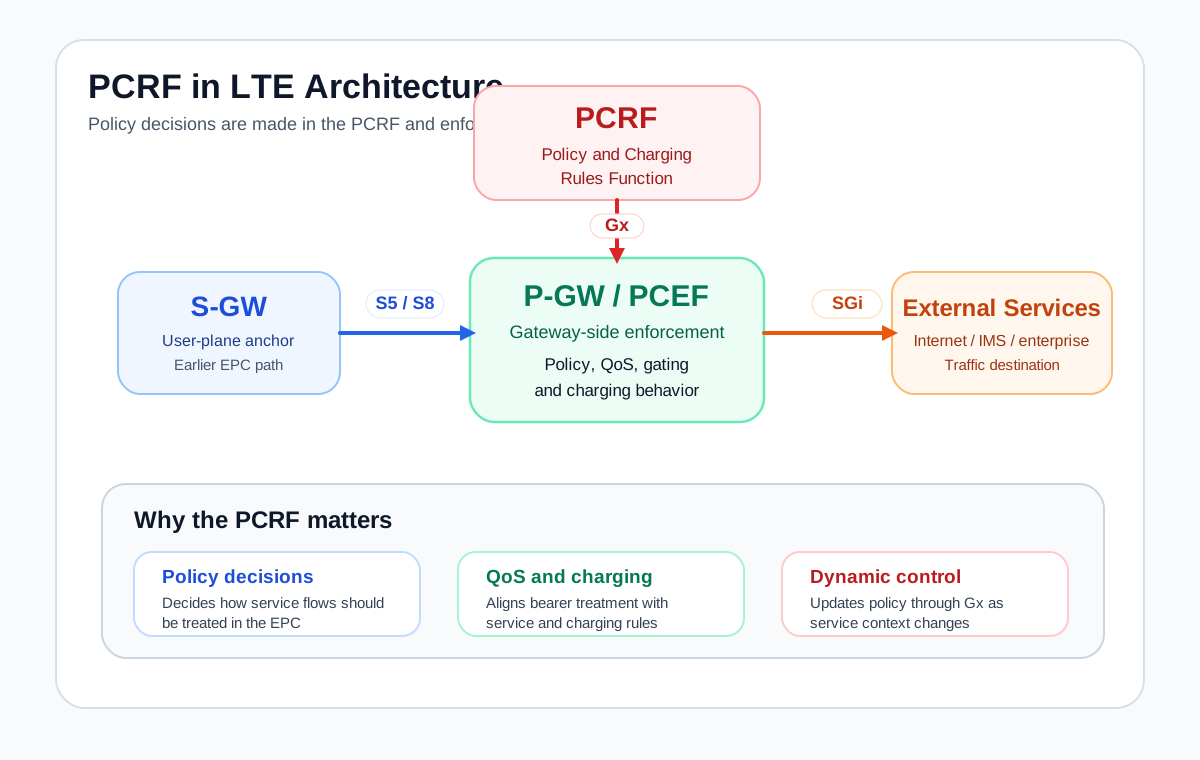
From an architecture point of view, the PCRF is not in the user-plane packet path itself. Instead, it supplies dynamic policy and charging decisions to the enforcement side of the packet core, typically associated with the P-GW / PCEF over Gx. That is why the PCRF is best understood as a decision node rather than a forwarding node.
PCRF in LTE architecture
Quick facts
| Node type | Policy and charging control decision function in the EPC |
|---|---|
| Main interface | Gx toward the P-GW / PCEF |
| Primary scope | PCC decisions for QoS, gating, and charging behavior |
| Main architectural split | PCRF decides, PCEF enforces |
| Key service impact | Flow treatment, QoS behavior, and charging control |
| Roaming relevance | Home and visited policy roles may both appear in roaming scenarios |
Contents
- PCRF in LTE architecture
- Where the PCRF fits in LTE architecture
- What the PCRF does in LTE
- PCRF and PCC architecture
- PCRF and the Gx interface
- PCRF and the PCEF
- PCRF and QoS control
- PCRF and charging control
- PCRF and bearer or service control
- Dynamic policy control
- PCRF and roaming
- PCRF and service-aware policy
- Typical procedures or call flows using it
- Common troubleshooting notes
- Related pages / next steps
- Key takeaways
- FAQ
Where the PCRF fits in LTE architecture
The PCRF sits in the EPC as a policy-decision function rather than a bearer anchor or packet-forwarding node. It communicates with the gateway-side enforcement function over Gx, while the actual user-plane traffic continues through the S-GW and P-GW path.
This means PCRF behavior is often visible indirectly. Engineers do not usually see packets “through” the PCRF. Instead, they see the effects of PCRF decisions in P-GW or PCEF policy enforcement, QoS treatment, bearer behavior, and charging outcomes.
| Architecture relationship | Why it matters |
|---|---|
| P-GW / PCEF side | The PCRF provides PCC rules to the gateway-side enforcement function over Gx. |
| User plane | The PCRF is not in the user-plane packet path. |
| QoS and charging domain | It makes policy decisions that affect flow treatment, gating, QoS, and charging behavior. |
| Service awareness | It becomes especially important when service-specific traffic treatment is required. |
What the PCRF does in LTE
This makes the PCRF one of the key decision nodes in the EPC. The packet gateway enforces behavior in the traffic path, but the PCRF is what decides what that behavior should be.
- makes policy control decisions for packet services
- makes charging control decisions for service flows
- supplies PCC rules to the enforcement side of the EPC
- influences QoS treatment, gating, and service-aware behavior
- supports dynamic control when traffic-plane or service events matter
PCRF and PCC architecture
The PCRF is central to the Policy and Charging Control (PCC) architecture. PCC is the framework that ties together subscriber and service policy, QoS behavior, bearer treatment, charging decisions, and packet-flow handling in LTE.
Without PCC, the EPC could still forward packets, but it would have much weaker control over which flows are allowed, how they are prioritized, and which charging rules apply. This is why the PCRF matters most in differentiated-service environments rather than in a pure best-effort packet core.
| PCC area | Why the PCRF matters |
|---|---|
| Policy control | Decides how a service or subscriber flow should be treated. |
| Flow-based charging | Defines charging-related behavior tied to packet flows and services. |
| QoS control | Influences how bearer treatment aligns with service expectations. |
| Gating / flow handling | Determines whether traffic should be allowed, limited, or controlled. |
PCRF and the Gx interface
The Gx reference point is the main interface associated with the PCRF in LTE EPC. It connects the PCRF to the PCEF and is used to provision and remove PCC rules, as well as to return traffic-plane events from the enforcement side back to policy control.
That is why Gx is so important architecturally. It is the mechanism that turns PCRF decisions into enforceable gateway behavior and allows the gateway to feed relevant events back into the policy-control loop.
PCRF and the PCEF
The PCEF (Policy and Charging Enforcement Function) is the enforcement point that applies PCRF decisions in the gateway node providing IP access to the PDN. In practical LTE architecture, this maps to the P-GW role in the common EPC model.
This relationship is one of decision and enforcement: the PCRF decides the PCC behavior, and the PCEF enforces it in the packet path. That distinction is essential when troubleshooting because a visible traffic problem can appear at the P-GW even when the root cause is really a PCRF decision issue.
PCRF and QoS control
One of the most important PCRF functions is QoS control. The PCRF helps decide how service flows should be treated in terms of policy and QoS behavior, and those decisions are then reflected in gateway enforcement and bearer treatment.
In practical LTE terms, that means the PCRF can influence which bearer treatment applies, whether certain traffic should be admitted or gated, and how service-specific behavior is reflected in the EPC packet path.
PCRF and charging control
Charging control is the other major side of PCC. The PCRF participates in charging behavior by supplying charging-related rule decisions that affect how service flows are handled and monetized in the packet core.
This matters because charging in LTE is not only a back-office concern. It is tied to flow identity, policy decisions, service differentiation, and in some cases whether a dedicated service treatment is even justified.
PCRF and bearer or service control
The PCRF is not the bearer anchor, but it strongly influences how bearers are used and enforced. In the LTE EPC model, the MME handles control-plane mobility and bearer coordination, the S-GW anchors the access-side user plane, the P-GW / PCEF enforces policy and charging behavior, and the PCRF supplies the policy decisions.
That is why PCRF issues often show up as wrong QoS treatment, application-specific policy mismatch, service flows not being allowed, or charging inconsistencies rather than as obvious low-level transport failures.
Dynamic policy control
A useful way to think about the PCRF is that it is not only a static provisioning node. PCRF control through Gx is dynamic, which means policy behavior can react to service context, traffic-plane events, and deployment-specific application inputs.
This is one reason LTE EPC can support richer service models than a purely static bearer configuration approach. The packet core can adapt policy and charging behavior as the service context changes.
PCRF and roaming
In roaming scenarios, the PCRF role can become more complex because home and visited policy roles may both appear. For architecture reading, the key idea is simple: policy decisions are not always entirely local, but PCRF-style policy control remains central to PCC behavior across roaming-aware deployments.
That is enough context for most LTE EPC readers before going deeper into full roaming PCC variants.
PCRF and service-aware policy
The PCRF becomes especially important in service-aware cases such as VoLTE and other differentiated packet services. Those services often need specific QoS behavior, precise policy rules, and charging treatment that differs from generic Internet traffic.
This is why policy control is not just an abstract EPC concept. It directly affects whether the user experiences the expected service quality and treatment for the application being used.
Typical procedures or call flows using it
- Attach is where baseline EPC service and policy context come together.
- Default EPS bearer establishment shows the baseline bearer path affected by later policy enforcement.
- Dedicated EPS bearer establishment is often where differentiated service treatment becomes visible.
- APN / PDN connectivity setup is useful when policy or service-profile behavior needs to be traced at session creation time.
Common troubleshooting notes
- Gx connectivity problems between the PCRF and the PCEF
- missing or incorrect PCC rule provisioning
- wrong QoS control behavior even though bearer setup succeeded
- wrong charging behavior or missing charging treatment
- service flows not getting the expected policy treatment
- mismatch between subscriber or service policy and gateway enforcement
- roaming-related policy mismatch between home and visited domains
Key takeaways
- The PCRF is the LTE or EPC function that makes policy and charging control decisions.
- PCC includes two main areas: flow-based charging and policy control.
- The Gx reference point connects the PCRF to the PCEF for rule provisioning and event feedback.
- The PCRF is central to QoS control, charging behavior, gating, and service-aware policy enforcement.
- Understanding the PCRF is essential for diagnosing LTE QoS, policy, and charging-enforcement problems.
FAQ
What is the PCRF in LTE?
The PCRF is the Policy and Charging Rules Function in LTE or EPC. It makes policy and charging control decisions for packet services.
What interface does the PCRF use in LTE?
The PCRF mainly uses the Gx reference point toward the PCEF, typically associated with the P-GW in common LTE architecture.
Is the PCRF in the user plane?
No. The PCRF is a policy decision function, not a user-plane forwarding node. Enforcement happens at the PCEF or packet gateway side.
What does the PCRF control?
The PCRF controls policy and charging behavior, including QoS control, gating-related behavior, service treatment, and flow-based charging decisions.
What is the difference between PCRF and P-GW?
The PCRF makes policy and charging decisions, while the P-GW / PCEF enforces those decisions in the packet-data path.