LTE Network Architecture Overview
LTE architecture is part of the Evolved Packet System (EPS) and is built around two major domains: E-UTRAN for radio access and EPC for core-network control and packet connectivity.
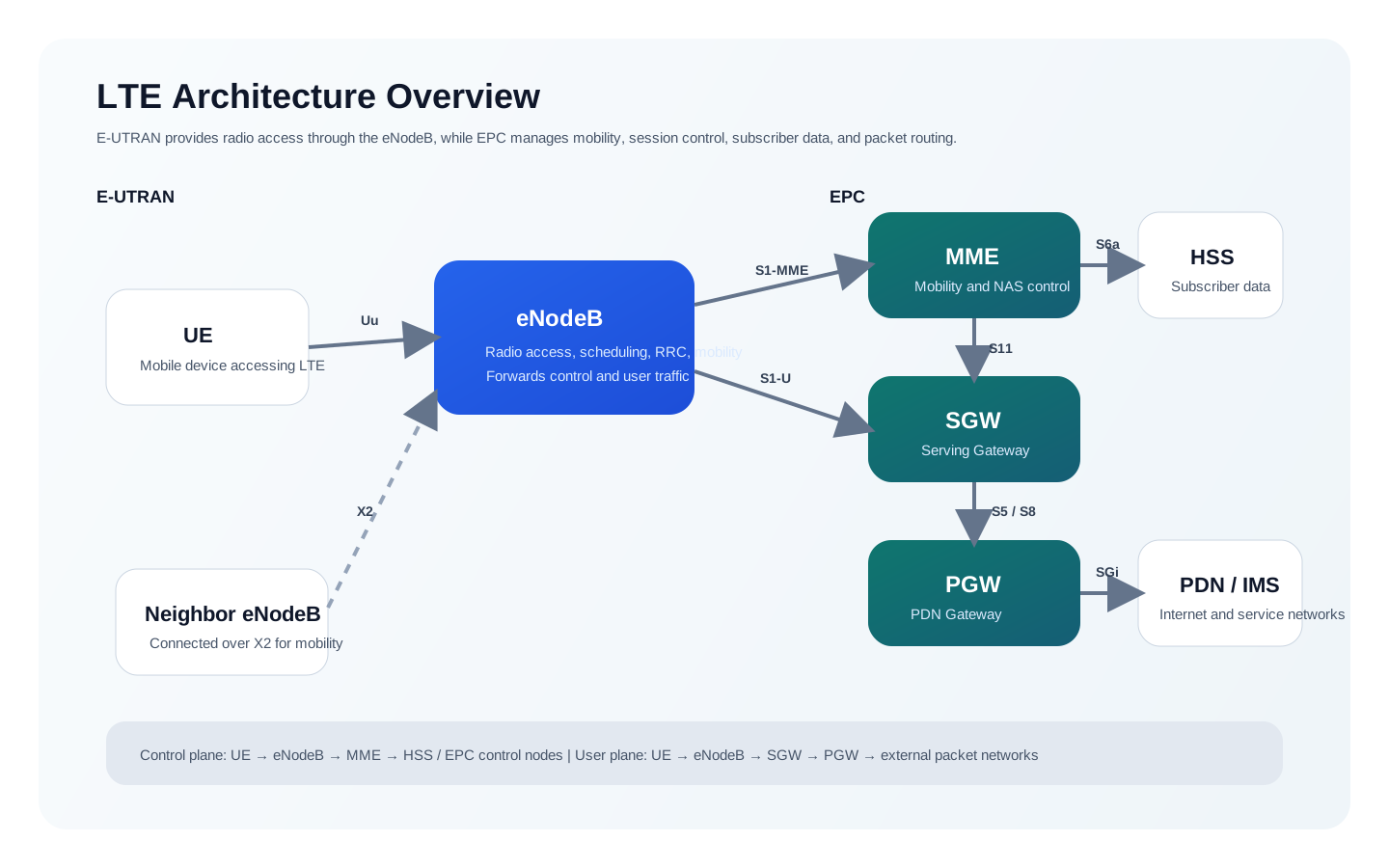
In the LTE system model, the E-UTRAN consists of eNBs that provide the LTE user plane (PDCP/RLC/MAC/PHY) and control plane (RRC) toward the UE. eNBs interconnect over X2 and connect to the EPC over S1, with S1-MME toward MME and S1-U toward Serving Gateway. The architecture is designed as a flat, packet-switched, all-IP system with clear control and user-plane separation.
Quick facts
| Parent system | Evolved Packet System (EPS) |
|---|---|
| Main domains | E-UTRAN and EPC |
| Access node | eNB (eNodeB) |
| Core entities | MME, S-GW, P-GW, HSS, PCRF |
| Main interfaces | LTE-Uu, S1-MME, S1-U, X2, S11, S5/S8, S6a, SGi |
| Architecture model | Flat, all-IP, packet-switched with bearer-based service delivery |
Contents
- LTE architecture from a system view
- Main architectural principles
- E-UTRAN overview
- EPC overview
- LTE interfaces and what they mean architecturally
- Control plane and user plane
- EPS bearer architecture
- UE state model in LTE architecture
- Mobility architecture
- Security architecture
- Deployment variants and architectural extensions
- End-to-end architectural view of LTE attach
- LTE architecture and IMS or voice services
- Related messages
- Related procedures
- Key takeaways
- FAQ
LTE architecture from a system view
From a system perspective, LTE combines radio access over LTE-Uu, mobility and session control in the EPC, bearer-based packet transport, QoS-aware service delivery, and security across access and core procedures.
In non-roaming deployments the core path is typically UE to E-UTRAN to MME, S-GW, P-GW, HSS, PCRF, and operator IP services. In roaming scenarios, the model extends with home and visited PLMN roles and interfaces such as S8.
Main architectural principles
| Principle | What it means in LTE |
|---|---|
| Flat radio architecture | LTE removes the RNC from the access side. The eNB terminates radio protocols and connects directly to EPC over S1. |
| Control and user-plane split | Signaling (RRC, NAS, S1-AP, core control) is separated from traffic transport (PDCP/RLC/MAC/PHY and GTP-U). |
| Bearer-based delivery | Services are carried through EPS bearers, linking QoS, routing, radio transport, and EPC control. |
| Standardized interfaces | Clear interface definitions (S1-MME, S1-U, X2, S11, S5/S8, S6a, SGi) support scale and multi-vendor deployment. |
E-UTRAN overview
The E-UTRAN consists of eNBs, which provide LTE radio user-plane and RRC control-plane functions toward the UE. eNBs interconnect over X2 and connect to the EPC over S1.
The eNB functional scope includes radio resource management, radio bearer control, admission control, mobility control, dynamic scheduling, user-data stream handling, and routing user-plane data toward the Serving Gateway.
EPC overview
| Node | Main architectural role |
|---|---|
| MME | Control-plane node for NAS signaling, mobility management, and security control. |
| Serving Gateway (S-GW) | User-plane anchor for inter-eNB handover and inter-3GPP mobility; supports downlink buffering and service request initiation. |
| PDN Gateway (P-GW) | Connectivity to packet data networks and policy/QoS anchoring toward external services. |
| HSS | Subscriber, authentication, and subscription data. |
| PCRF | Policy and charging control architecture function. |
LTE interfaces and what they mean architecturally
| Interface | Connects | Architectural purpose |
|---|---|---|
| LTE-Uu | UE and eNB | LTE radio access. |
| S1-MME | eNB and MME | Control-plane signaling. |
| S1-U | eNB and S-GW | User-plane transport. |
| X2 | eNB and eNB | Inter-eNB mobility and coordination. |
| S11 | MME and S-GW | Session and bearer control. |
| S5/S8 | S-GW and P-GW | User-plane and related bearer transport. |
| S6a | MME and HSS | Authentication and subscription data. |
| SGi | P-GW and operator IP services / PDNs | External service connectivity. |
Control plane and user plane
| Plane | Main elements | Architectural focus |
|---|---|---|
| Control plane | RRC, NAS, S1-AP and EPC control signaling | Authentication, mobility, attach, TAU, paging, and bearer-control signaling. |
| User plane | PDCP / RLC / MAC / PHY and GTP-U over S1-U and S5/S8 | End-to-end packet forwarding from UE toward packet data networks. |
EPS bearer architecture
The bearer model is a central deep topic in LTE architecture. An EPS bearer is the architectural transport construct used to carry packet flows through LTE, linking QoS policy, radio admission, EPC session control, and traffic treatment.
In this model, a radio bearer carries EPS-bearer packets between UE and eNB, an S1 bearer carries them between eNB and S-GW, and an E-RAB is the concatenation of the corresponding radio bearer and S1 bearer. The path then continues across S5/S8 between S-GW and P-GW.
| Bearer type | Architectural meaning |
|---|---|
| Default bearer | Provides UE connectivity throughout the lifetime of the PDN connection and is Non-GBR. |
| Dedicated bearer | May be GBR or Non-GBR depending on service requirements and policy decisions. |
UE state model in LTE architecture
| State model | Architectural meaning |
|---|---|
| EMM | Distinguishes EMM-REGISTERED and EMM-DEREGISTERED behavior on the mobility-management side. |
| ECM | Distinguishes ECM-CONNECTED and ECM-IDLE signaling-connection behavior between UE and MME. |
| RRC | Distinguishes RRC_IDLE and RRC_CONNECTED behavior on the radio side, shaping paging, measurement, and mobility procedures. |
Mobility architecture
LTE mobility is distributed across access and core layers. eNBs coordinate directly over X2 for efficient handover behavior, while MME and S-GW provide core-assisted mobility control and anchoring functions.
S1-flex style deployments support multi-to-multi relationships between E-UTRAN nodes and EPC nodes, which matters for scaling and shared-network designs.
Security architecture
LTE security is architectural as well as procedural. The MME hosts NAS signaling security and AS security control, while the access side implements user-plane and radio-side protection behavior under core-controlled security context.
At a high level, LTE security spans subscriber authentication, NAS protection between UE and MME, AS security coordination, and access-side user-plane protection.
Deployment variants and architectural extensions
- Home eNB and HeNB Gateway deployments can use control-plane concentration for S1-MME and flexible user-plane handling for S1-U.
- Single-gateway deployment options exist while still allowing S5 use when S-GW and P-GW are not collocated.
- Roaming architecture extends the non-roaming model with home and visited PLMN roles and S8-based traffic options.
End-to-end architectural view of LTE attach
- UE enters LTE over LTE-Uu.
- eNB handles radio access and forwards NAS over S1-MME.
- MME performs mobility and security-related control functions.
- MME consults HSS over S6a.
- MME coordinates bearer and session creation with S-GW over S11.
- S-GW and P-GW establish user-plane path over S5/S8.
- Data flows over S1-U and onward over SGi to operator or external IP services.
LTE architecture and IMS or voice services
The EPS architecture model includes operator IP services such as IMS on the P-GW side, making VoLTE an architectural extension of LTE rather than a separate transport system.
This is why many real deployments treat LTE as the access and transport architecture for IMS-based voice and emergency service support.
Key takeaways
- LTE architecture is part of EPS and built from E-UTRAN + EPC.
- The eNB is a powerful access node that terminates LTE radio protocols and connects directly to EPC over S1.
- The MME, S-GW, P-GW, HSS, and PCRF define control, mobility, connectivity, subscription, and policy roles in the core.
- The bearer model is central: radio bearer, S1 bearer, E-RAB, and EPS bearer together explain traffic transport and QoS behavior.
- LTE architecture is best understood through its interfaces, state models, mobility model, security split, and end-to-end procedures such as attach and service request.
FAQ
What are the two main domains in LTE architecture?
LTE architecture is built around E-UTRAN for radio access and EPC for core-network control and packet connectivity.
Why is LTE considered a flat architecture?
Because eNB handles major radio-control functions and connects directly to the EPC without an RNC layer in the access network.
What is the architectural role of eNB?
The eNB provides LTE user-plane and RRC control-plane functions, handles radio resource and mobility control, and routes user-plane traffic toward S-GW.
What is an EPS bearer in LTE?
An EPS bearer is the end-to-end packet transport construct in LTE. It spans radio bearer, S1 bearer, and EPC bearer segments, with E-RAB representing the radio-plus-S1 portion.
What is the difference between default and dedicated bearer?
A default bearer provides connectivity for the lifetime of the PDN connection and is Non-GBR, while a dedicated bearer can be GBR or Non-GBR based on service and policy needs.