What is PDU Session Release Complete in simple terms?
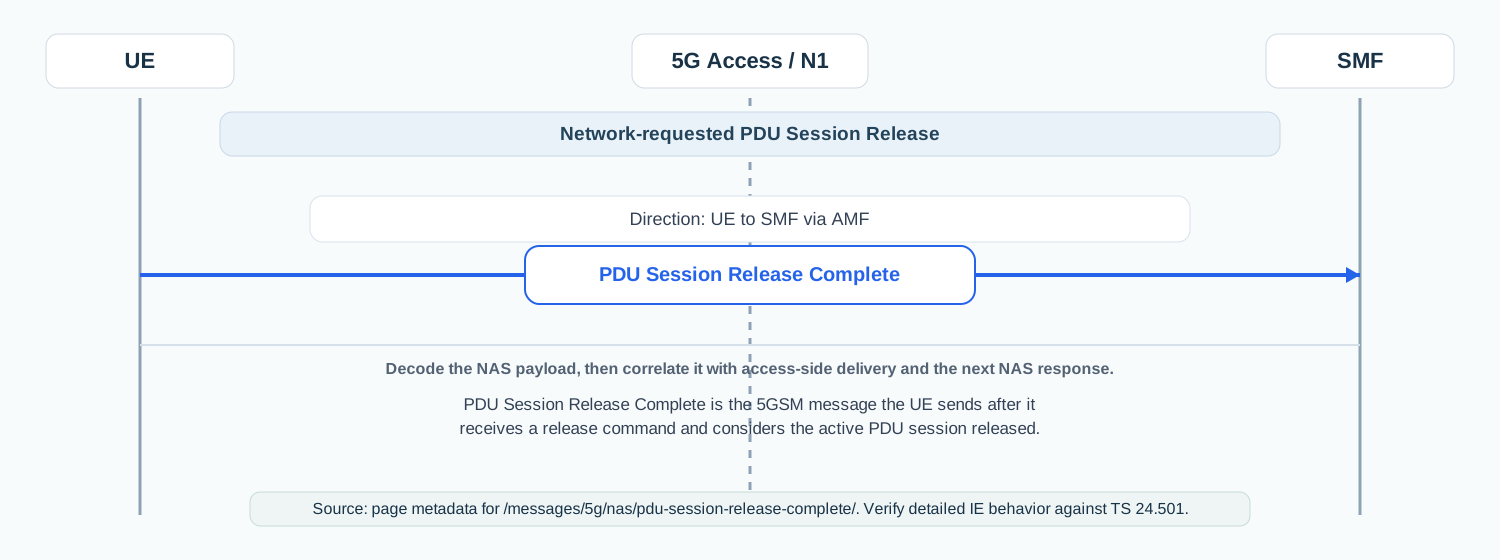
PDU Session Release Complete is the 5GSM message the UE sends after it receives a release command and considers the active PDU session released.
Confirms that the UE accepted the network's release instruction so the SMF can finish the release procedure and clear the session state.
Why this message matters
PDU Session Release Complete is the UE's confirmation that the PDU session has been released.
Where this message appears in the call flow
Network-requested PDU Session Release
PDU Session Release Complete in context: UE to SMF via AMF. Use the diagram to place the NAS message in the surrounding procedure before inspecting individual fields.
Call flow position: UE acknowledgement that the release command was received and the session is now considered released.
Typical state: The UE has received the release command and is telling the network the release is complete.
Preconditions:
A release command was received.
The UE has accepted the release instruction.
Next likely message: The session becomes inactive and any new service requires a fresh establishment request
UE-requested PDU Session Release
Call flow position: UE completion step after the network accepted the release request and sent the release command.
Typical state: The UE is completing the release procedure after the network's downlink instruction.
Preconditions:
The UE previously sent PDU Session Release Request.
The network responded with PDU Session Release Command.
Start with PDU Session ID to confirm which session the UE is acknowledging as released.
Check PTI to correlate the completion with the right release transaction.
A minimal completion message is normal because the UE often just confirms the session is released.
Important Information Elements
IE
Presence
Description
PDU Session ID
Mandatory
Identifies the PDU session that is now considered released.
PTI
Mandatory
Correlates the completion with the release transaction when one exists.
Extended protocol configuration options
Optional
May carry additional protocol data from the UE back to the SMF during release completion.
Detailed field explanation
PDU Session ID
Identifies the PDU session that is now considered released.
Presence: Mandatory
In practice: In practice, compare this field with the original request and with any later release-dependent optional fields so you can see whether the network accepted the same service model the UE asked for.
PTI
Correlates the completion with the release transaction when one exists.
Presence: Mandatory
In practice: In practice, compare this field with the original request and with any later release-dependent optional fields so you can see whether the network accepted the same service model the UE asked for.
Extended protocol configuration options
May carry additional protocol data from the UE back to the SMF during release completion.
Presence: Optional
In practice: This is where DNS and other operational configuration can hide. When the session is accepted but applications still fail, EPCO is often one of the first optional fields worth validating.
What to check in logs and traces
Confirm the completion follows a visible PDU Session Release Command.
Verify `PDU Session ID` and `PTI` first so the completion matches the right release procedure.
Check whether `T3592` stopped on the network side after the completion arrived.
If the release was UE-requested, verify that `T3582` also stopped on the UE side.
Correlate the completion with the session state transition to inactive.
Common Issues and Troubleshooting
The UE does not send release complete.
Likely cause: The UE may not have received the release command, or the release command may not have been accepted.
What to inspect: Check the release command, the downlink NAS path, and the UE state machine.
Next step: Confirm whether the issue is transport, sequencing, or command parsing.
The network still shows the session as pending release.
Likely cause: The completion may have been lost, delayed, or not correlated with the correct PTI.
What to inspect: Check T3592, PTI correlation, and SMF logs.
Next step: Validate that the UE sent the completion and that the SMF received it in time.
The session remains active after completion.
Likely cause: The network may not have processed the completion correctly, or another procedure may still be holding the session context.
What to inspect: Check SMF release handling and any concurrent modification or reactivation procedure.
Next step: Confirm the session state transition in the core network.
FAQ
What does PDU Session Release Complete do?
It confirms that the UE accepted the release command and considers the PDU session released.
Who sends PDU Session Release Complete?
The UE sends it to the SMF via the AMF.
When is PDU Session Release Complete sent?
It is sent after the UE receives a PDU Session Release Command.
What are the important IEs in PDU Session Release Complete?
Start with PDU Session ID and PTI, then inspect any Extended Protocol Configuration Options field.
What happens after PDU Session Release Complete?
The network stops waiting for the release procedure and the session becomes inactive.
Is ASN.1 used for PDU Session Release Complete?
No. It is a 5GSM NAS message defined by structured information elements in 3GPP TS 24.501.
Can this message carry configuration data?
Yes. It can include extended protocol configuration options.
What timer is related to this message?
T3592 is the main network-side timer that should stop when the completion is received.
Decode this message with the 3GPP Decoder, inspect the related message database, or open the matching call flow to see where this signaling step fits in the full procedure.