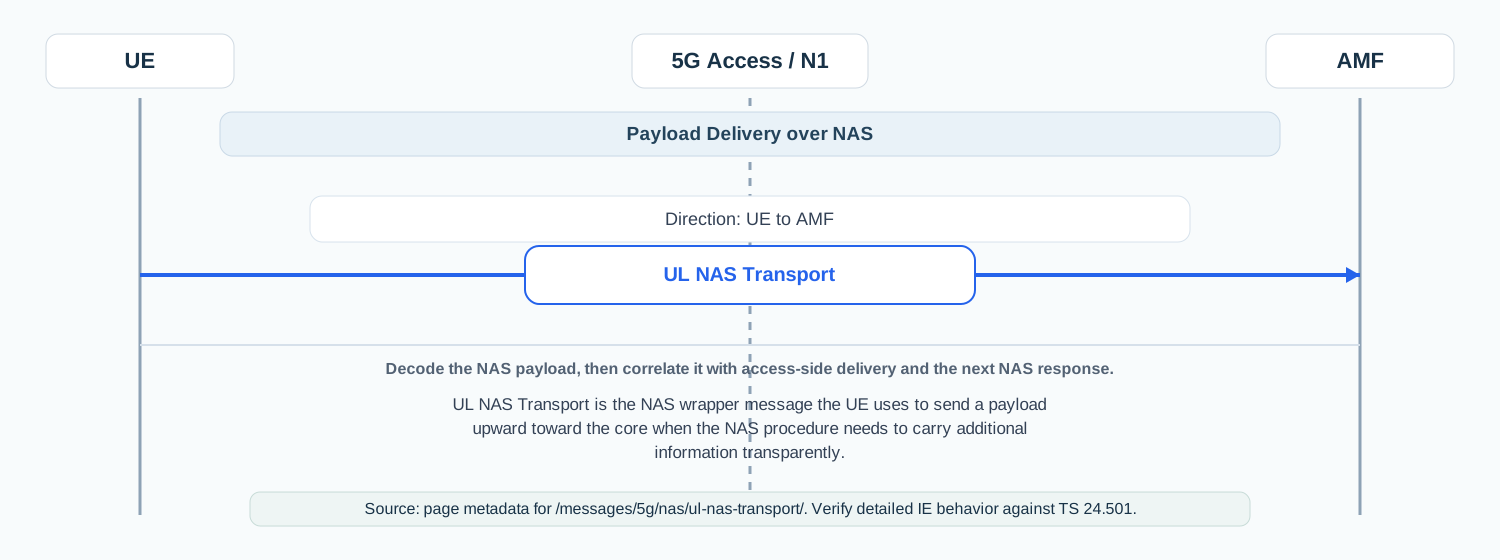
UL NAS Transport is the NAS wrapper message the UE uses to send a payload upward toward the core when the NAS procedure needs to carry additional information transparently.
Message Fact Sheet
Protocol
nas
Network
5g
Spec
3GPP TS 24.501
Spec Section
8.2.29
Direction
UE to AMF
Message Type
5GMM signaling
Full message name
5G NAS - UL NAS Transport
Protocol
NAS
Technology
5G
Direction
UE to AMF
Interface
N1
Signaling bearer / channel
NAS signaling / Dedicated NAS message, commonly transported via UL Information Transfer on the access side
Typical trigger
Sent when the UE needs to forward a payload through NAS transport handling rather than through a standalone top-level 5GMM message.
Main purpose
Transports a contained NAS or application-related payload from the UE to the network without defining a standalone new top-level procedure for every use case.
Main specification
3GPP TS 24.501, 8.2.29
Release added
Release 15
Procedures where used
Payload delivery over NAS, Protected 5GMM signaling, Core-facing transport of embedded information
What is UL NAS Transport in simple terms?
UL NAS Transport is the NAS wrapper message the UE uses to send a payload upward toward the core when the NAS procedure needs to carry additional information transparently.
Transports a contained NAS or application-related payload from the UE to the network without defining a standalone new top-level procedure for every use case.
Why this message matters
UL NAS Transport is the UE using NAS as a wrapper to send another piece of information up to the network.
Where this message appears in the call flow
Payload Delivery over NAS
UL NAS Transport in context: UE to AMF. Use the diagram to place the NAS message in the surrounding procedure before inspecting individual fields.
Call flow position: UE-to-network transport step used when an inner payload must be delivered through NAS signaling.
Typical state: The UE already has a valid NAS relationship and is using UL NAS Transport as a wrapper rather than starting a new standalone outer procedure.
Preconditions:
A valid NAS transport path exists.
The UE has payload content that is defined to be carried using UL NAS Transport.
Next likely message: DL NAS Transport or procedure-specific network handling
Protected 5GMM Signaling
Call flow position: Supplementary UE uplink transport step inside a broader mobility-management or session-related interaction.
Typical state: The outer NAS exchange is stable, but the message meaning depends mainly on the transported payload.
Preconditions:
NAS security and connectivity context already exist, depending on the scenario.
Next likely message: Payload-specific response or transport continuation
Next message(s):DL NAS Transport, Procedure-specific core response, 5GMM Status
Message direction and transport
Sender and receiver: UE to AMF
Interface: N1
Domain: Core-side mobility management signaling with access-side NAS transport dependency
Signaling bearer: NAS signaling
Logical channel: Dedicated NAS message, commonly transported via UL Information Transfer on the access side
Transport / encapsulation: NAS 5GS message carried end-to-end between UE and AMF
Security context: Often appears in an already established NAS security context, so engineers should inspect both the outer transport wrapper and the inner payload meaning.
Message Structure Overview
UL NAS Transport is primarily a wrapper message, so its operational value comes from correlating the outer message with the embedded payload container.
In troubleshooting, engineers usually inspect the payload container type first and then decode the transported inner content.
ASN.1 Message Syntax for 5G NAS - UL NAS Transport
This message is not typically analyzed as ASN.1 on the wire. It is usually read as a NAS or protocol field structure instead.
UL NAS Transport follows NAS 24.501 IE structure and is not an ASN.1 message.
5G NAS - UL NAS Transport - Example Dump
UL NAS Transport
  Extended Protocol Discriminator: 5G Mobility Management
  Security Header Type: Integrity protected and ciphered
  Message Type: UL NAS Transport
  Payload Container Type: N1 SM information
  Payload Container: 2e0101c1ff...
  PDU Session ID: 10
How to read this dump
The outer message tells you that this is a transport wrapper; the payload container type tells you what to decode next.
In real troubleshooting, the inner payload usually matters more than the presence of the wrapper itself.
Important Information Elements
IE
Presence
Description
Payload container type
Mandatory
Tells you what kind of embedded content the message is carrying and therefore how the inner payload should be interpreted.
Payload container
Mandatory
Carries the actual transported content, which often matters more than the outer UL NAS Transport wrapper.
PDU Session ID
Optional
May be present when the transported payload is related to a specific session context.
Additional information
Optional
Scenario-dependent container extensions that refine how the payload should be handled.
Detailed field explanation
Payload container type
Tells you what kind of embedded content the message is carrying and therefore how the inner payload should be interpreted.
Presence: Mandatory
In practice: In practice, compare this field with the original request and with any later release-dependent optional fields so you can see whether the network accepted the same service model the UE asked for.
Payload container
Carries the actual transported content, which often matters more than the outer UL NAS Transport wrapper.
Presence: Mandatory
In practice: In practice, compare this field with the original request and with any later release-dependent optional fields so you can see whether the network accepted the same service model the UE asked for.
PDU Session ID
May be present when the transported payload is related to a specific session context.
Presence: Optional
In practice: In practice, compare this field with the original request and with any later release-dependent optional fields so you can see whether the network accepted the same service model the UE asked for.
Additional information
Scenario-dependent container extensions that refine how the payload should be handled.
Presence: Optional
In practice: In practice, compare this field with the original request and with any later release-dependent optional fields so you can see whether the network accepted the same service model the UE asked for.
What to check in logs and traces
Check the payload container type first.
Correlate the wrapper with the inner payload meaning and any related PDU Session ID.
Verify whether the NAS protection state matches the procedure stage.
Look for the matching downlink or core-side response that corresponds to the transported payload.
Common Issues and Troubleshooting
UL NAS Transport appears, but the expected procedure does not progress.
Likely cause: The wrapper may be correct while the embedded payload is malformed, unsupported, or not accepted by the network.
What to inspect: Decode the payload container type and the inner payload before concluding that the NAS transport itself failed.
Next step: Correlate with the matching DL NAS Transport or later core response to see whether the inner request was understood.
The message is present, but analysts cannot tell what it really means.
Likely cause: UL NAS Transport is a transport wrapper, so reading only the outer message hides the real procedure semantics.
What to inspect: Focus on the payload container type, the payload container contents, and any session identifiers.
Next step: Map the inner payload to its actual procedure instead of treating UL NAS Transport as the whole story.
FAQ
What does UL NAS Transport do in 5G?
It carries an embedded payload from the UE toward the network using NAS transport handling.
Is UL NAS Transport itself the main procedure?
Usually no. It is often a wrapper, and the real procedure meaning comes from the transported payload.
What should engineers inspect first?
Start with the payload container type and then decode the inner payload.
Decode this message with the 3GPP Decoder, inspect the related message database, or open the matching call flow to see where this signaling step fits in the full procedure.