5G Expansion Release
3GPP Release 17
3GPP Release 17 is a major 5G expansion release that builds on the initial 5G foundation and introduces broader device support, satellite-related evolution, sidelink enhancements, positioning improvements, power saving, and deeper system capabilities. This page explains the main feature areas, protocol impact, and the best next topics to study.
Quick facts
| Release | Rel-17 |
|---|---|
| Status | Frozen |
| Start date | 2018-06-15 |
| End date | SA#96, 2022-06-10 |
| Position in roadmap | Advanced 5G expansion release before 5G-Advanced branding |
| Editorial framing | Bridge between foundational 5G and Release 18 5G-Advanced |
What is Release 17?
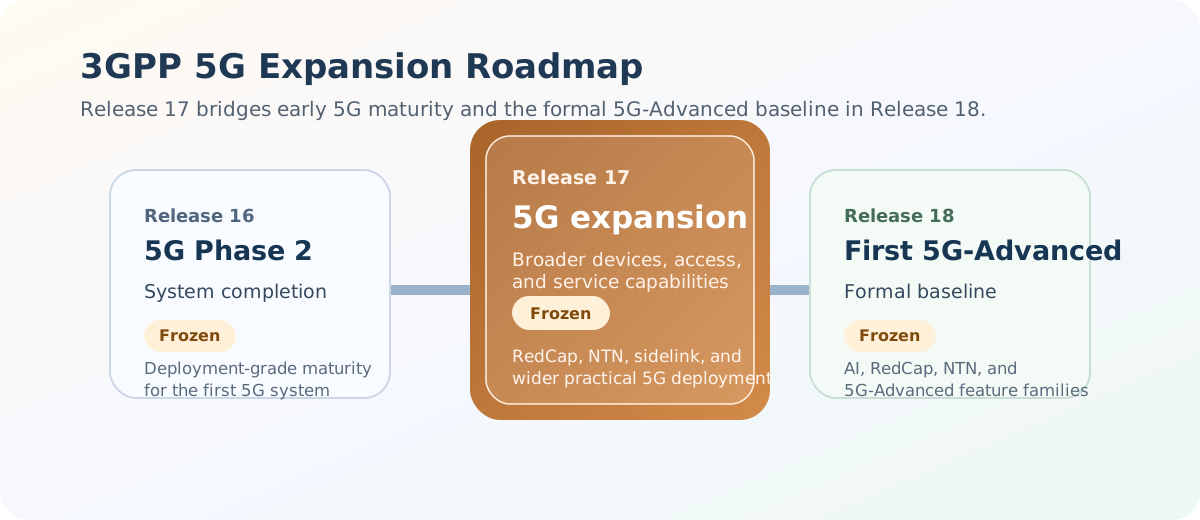
Release 17 sits in the 3GPP roadmap as the expansion release that follows the first-wave 5G baseline created in Release 15 and extended in Release 16. It does not yet carry formal 5G-Advanced branding, but it is where 5G becomes broader, more diverse, and more practical across devices, radio features, access scenarios, and operational use cases.
The reason Release 17 matters is that it widens practical 5G scope before Release 18 formalizes the 5G-Advanced era. Official 3GPP highlights show Release 17 bringing together RedCap, NTN, sidelink, power saving, positioning, edge computing, ATSSS, RAN slicing, and broader automation-oriented work rather than focusing on only one part of the system.
For engineers, Release 17 is the bridge page you read before Release 18. It helps explain how 5G moved from first-generation architecture and procedures into a wider set of real deployment models, device classes, and service capabilities.
Key Features in Release 17
5G expansion beyond the first baseline
Release 17 takes early 5G beyond the initial baseline and broadens what the system can support in more practical and diverse deployment scenarios.
RedCap and lower-complexity NR devices
Reduced-capability NR devices become a visible standards topic, widening 5G toward simpler, lower-cost, and more deployment-flexible device classes.
NTN and satellite-related evolution
Release 17 makes NTN a clear 5G standards theme with both NR over NTN and IoT over NTN included among the official highlights.
Sidelink and direct communication enhancements
Sidelink grows as a more prominent part of the radio story, pointing to broader direct-communication use cases and deeper radio behavior.
Coverage, positioning, and power saving
Coverage enhancement, positioning improvement, and UE power saving make Rel-17 more commercially relevant than a purely feature-list release.
RAN slicing and non-public networks
RAN slicing, non-public networks, and broader operational support show 5G becoming more practical for enterprise and specialized environments.
Edge computing, ATSSS, and service evolution
The core and service side evolves with ATSSS, edge-computing support in 5GC, and richer traffic-handling and service options.
Network automation for 5G Phase 2
Release 17 also matters operationally because automation, deployment readiness, and service management become more visible parts of the story.
Release 17 by technical domain
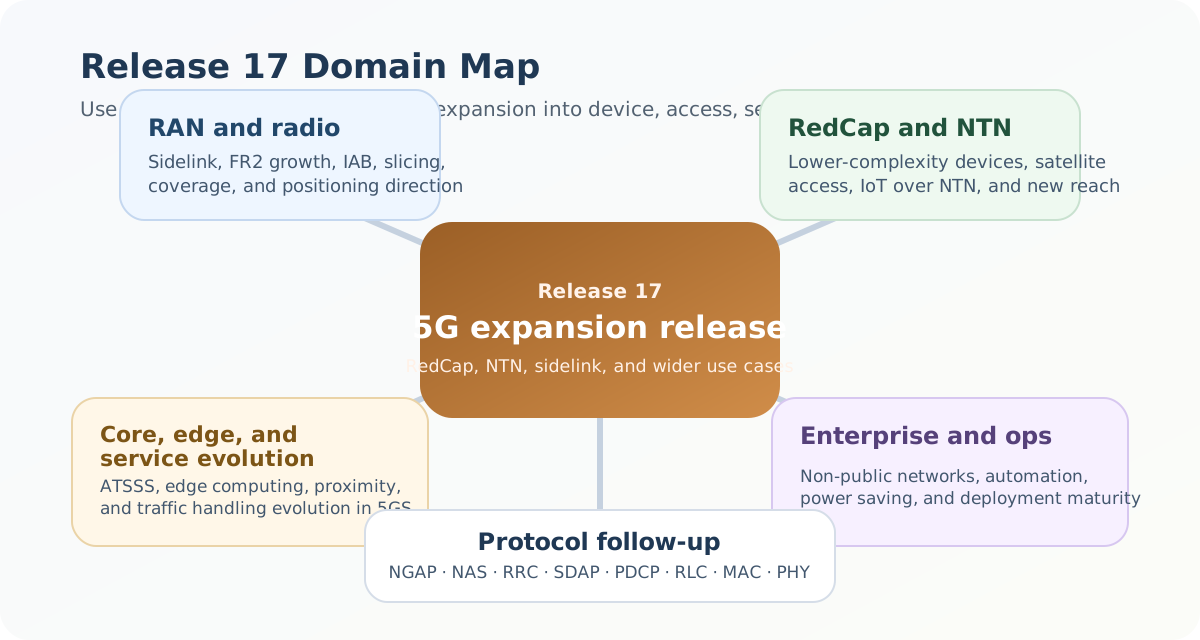
RAN and radio evolution
Release 17 is a strong radio evolution release. Official highlights include sidelink enhancements, NR operation extended to 71 GHz, further MIMO enhancements, IAB enhancements, enhancement of RAN slicing for NR, and RF requirement evolution for both FR1 and FR2.
That makes Release 17 important for readers moving from high-level release context into PHY, MAC, RRC, mobility, measurements, and RAN deployment questions. It is one of the points where 5G radio behavior starts to feel much broader than the original baseline story.
Reduced-capability and device evolution
Reduced-capability NR devices are one of the most important Release 17 signals because they show 5G widening toward simpler and more flexible device classes. This is a major part of why Rel-17 feels like a practical expansion release rather than just a technical refresh.
In practice, this matters to engineers working with lower-complexity 5G endpoints, broader deployment economics, and device portfolios that do not need full flagship NR capability.
NTN, IoT, and expanded access scenarios
Release 17 is the point where satellite-related support becomes a clearly visible part of the 5G standards story. Official highlights explicitly list NR over NTN and IoT over NTN, making the release a key bridge into wider coverage models and non-terrestrial access scenarios.
That means Release 17 should be part of the reading path for anyone trying to understand how 5G started to move beyond purely terrestrial assumptions and into broader access continuity questions.
Coverage, positioning, and power saving
Coverage enhancements, positioning enhancements, and UE power saving enhancements are all explicit Release 17 highlights. Together, they make the release more useful to commercial networks because they connect standards work to real device behavior, radio performance, and user experience.
This is also one of the best examples of Release 17 becoming more practical: the release is not only about enabling new ideas, but about making 5G behave better in real deployments.
Core network and service evolution
On the system side, Release 17 highlights include support for edge computing in 5GC, proximity-based services in 5GS, and access traffic steering, switching and splitting. These show that the release expands service and traffic-handling capability rather than leaving the core story behind the radio story.
For site navigation, that means Release 17 should naturally lead readers into 5GC, SBA, NAS, NGAP, and service-oriented reading when questions move from feature names into architecture and procedure implications.
Enterprise, automation, and deployment evolution
Official Release 17 highlights also include enhanced support of non-public networks, support for uncrewed aerial systems, and network automation for 5G Phase 2. These are important because they move the release beyond consumer-radio feature talk and into enterprise, industrial, and operational use cases.
This makes Rel-17 useful for operators, planners, and implementers who need to understand how 5G became more commercially flexible before the 5G-Advanced era started.
Major Release 17 feature areas
Sidelink enhancements
Reduced-capability NR devices
NR over NTN
IoT over NTN
NR operation up to 71 GHz
MIMO enhancements
UE power saving
IAB enhancements
RAN slicing enhancements
Coverage and positioning enhancements
ATSSS
Edge computing in 5GC
Non-public networks
Network automation for 5G Phase 2
Protocol and signaling impact
This section is intentionally navigational rather than exhaustive. Use it to jump from Release 17 feature families into the protocol, message, and troubleshooting areas that are most likely to surface real impact.
NGAP
Release 17 broadens the feature and procedure context around NGAP, especially where new deployment models, slicing, mobility, and service evolution affect N2 signaling expectations.
NAS
NAS becomes more interesting in Rel-17 when new services, access models, device classes, and system behavior change how engineers read registration, mobility, and session handling.
RRC
RRC is a key follow-up layer for Release 17 because radio behavior expands around capability handling, measurements, positioning, power saving, sidelink, NTN, and reduced-capability device support.
SDAP
SDAP matters when Release 17 service growth and ATSSS-related thinking change how engineers interpret user-plane treatment and QoS-flow handling.
PDCP
PDCP is a useful follow-up area when Release 17 radio and service changes affect delivery behavior, duplication, user-plane handling, or traffic continuity assumptions.
RLC
RLC becomes part of the detailed follow-up path when Rel-17 radio evolution changes expectations around segmentation, reassembly, buffering, or reliability handling.
MAC
MAC is important when Release 17 changes touch scheduling, control signaling, radio-resource handling, power behavior, sidelink, or broader radio coordination below RRC.
PHY
PHY is central to Release 17 because many headline items sit in radio evolution, higher-frequency operation, coverage, positioning, and broader performance behavior.
Network slicing procedures
Release 17 expands the operational and procedural context around slicing, making slice-aware procedure reading more important across access, service, and control-plane work.
Positioning and power-related procedures
Positioning and power-saving enhancements make Release 17 especially relevant when engineers need to connect feature language to practical behavior and troubleshooting outcomes.
What changed compared with Release 16?
| Area | Release 16 | Release 17 direction |
|---|---|---|
| Roadmap role | 5G Phase 2 expansion | Broader 5G expansion before formal 5G-Advanced |
| Device evolution | Broader system maturity | Reduced-capability NR devices become a visible new direction |
| NTN scope | Earlier groundwork | NR over NTN and IoT over NTN become explicit release highlights |
| Radio enhancement | Strong phase-2 radio growth | Sidelink, higher-frequency operation, IAB, slicing, and broader radio expansion |
| Automation and operations | Industrial and operational maturity | More visible automation, NPN, and deployment-oriented flexibility |
| Service evolution | Broader 5GC maturity | ATSSS, edge computing, proximity services, and wider traffic-handling evolution |
What should you study in Release 17?
For beginners
- Review Release 15 and Release 16 first if you still need baseline 5G architecture and procedure context.
- Learn the core 5G architecture and protocol stack before reading detailed work-item language.
- Use Release 17 as the page that explains how 5G became broader and more practical.
For intermediate engineers
- Focus on RedCap, NTN, sidelink, positioning, power saving, and service evolution.
- Connect radio features to protocol and signaling behavior through the linked protocol pages.
- Study ATSSS and edge-computing relevance before moving into Release 18.
For advanced engineers
- Map Release 17 feature families into likely protocol and implementation implications.
- Compare Release 17 with Release 18 to see how expansion turns into 5G-Advanced baseline work.
- Connect enterprise and deployment themes to troubleshooting, optimization, and operations workflows.
Related specs and official references
Release 17 FAQs
What is 3GPP Release 17?
Release 17 is the major 5G expansion release that broadens practical 5G scope beyond the earlier baseline established in Releases 15 and 16.
Is Release 17 complete?
As checked on April 23, 2026, the 3GPP portal listed Release 17 as Frozen.
What are the main features of Release 17?
Release 17 highlights include sidelink enhancements, reduced-capability NR devices, NR over NTN, IoT over NTN, NR operation extended to 71 GHz, UE power saving, IAB enhancement, RAN slicing, coverage and positioning enhancements, ATSSS, edge computing in 5GC, and network automation for 5G Phase 2.
Did Release 17 introduce NTN and RedCap?
Yes. The official Release 17 highlights list includes both reduced-capability NR devices and NR over NTN, along with IoT over NTN.
How is Release 17 different from Release 16?
Release 16 expanded 5G Phase 2 capabilities, while Release 17 broadens 5G into new device classes, satellite-related support, expanded radio behavior, and deeper operational features.
How is Release 17 different from Release 18?
Release 17 is the major 5G expansion release before formal 5G-Advanced branding, while Release 18 becomes the first official 5G-Advanced release.
Does Release 17 affect NGAP, NAS, and RRC?
Yes. Release 17 changes the feature and procedure context in which NGAP, NAS, and RRC are interpreted and extended.