PDU Session Resource Modify Request is the AMF-to-NG-RAN NGAP message used to request modification of one or more already established PDU session resources for a UE.
Message Fact Sheet
Protocol
ngap
Network
5g
Spec
3GPP TS 38.413
Spec Section
Clause 8.2.3, clause 9.2.1.5, and clause 9.2.1.6 (Release 18 baseline)
AMF or SMF determines that one or more existing PDU session resources need modification, such as QoS-flow updates, transport changes, NAS delivery, or other session-level adjustment.
Main purpose
Requests modification of existing PDU session resources for an already identified UE, carrying per-session modification instructions that can affect QoS flow handling, transport and user-plane information, NAS forwarding, and bearer-related behavior at NG-RAN.
What is PDU Session Resource Modify Request in simple terms?
PDU Session Resource Modify Request is the AMF-to-NG-RAN NGAP message used to request modification of one or more already established PDU session resources for a UE.
Requests modification of existing PDU session resources for an already identified UE, carrying per-session modification instructions that can affect QoS flow handling, transport and user-plane information, NAS forwarding, and bearer-related behavior at NG-RAN.
Why this message matters
PDU Session Resource Modify Request is the AMF telling the NG-RAN to change already existing session resources for a UE, session by session, instead of creating new ones or removing them entirely.
Where this message appears in the call flow
Modification of existing PDU session resources
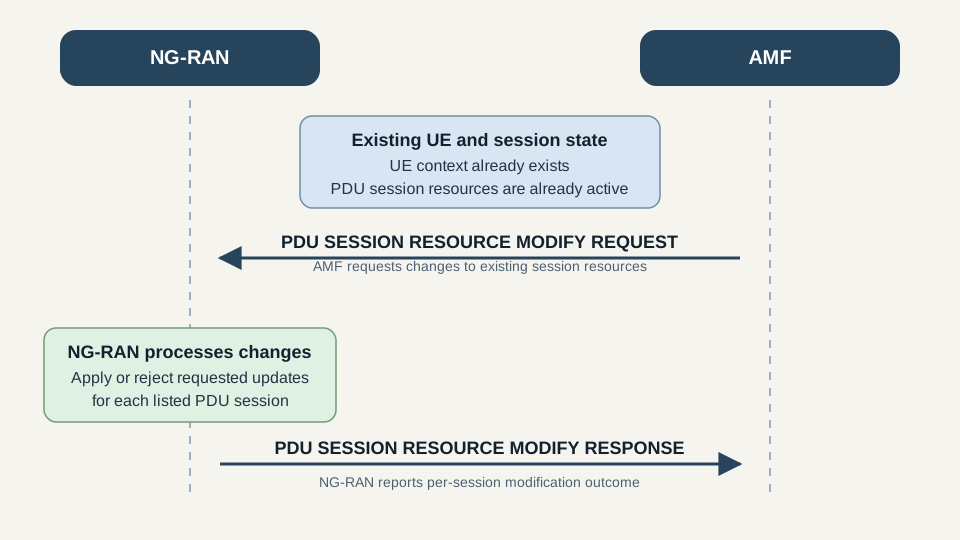
Existing-session branch: the UE context and session resources already exist, and the AMF asks NG-RAN to modify them rather than create or release them.
Call flow position: The UE context already exists, one or more PDU session resources are already active, and the AMF now asks NG-RAN to modify those established resources instead of creating or releasing them.
Typical state: The session exists and remains active, but its bearer, QoS, NAS, or transport-related handling needs adjustment.
Preconditions:
AMF UE NGAP ID and RAN UE NGAP ID already map to a live UE-associated NGAP context.
At least one PDU session resource already exists at NG-RAN.
AMF has per-session modification data ready in the modify request transfer.
Next likely message: PDU Session Resource Modify Response
Per-session QoS or transport update
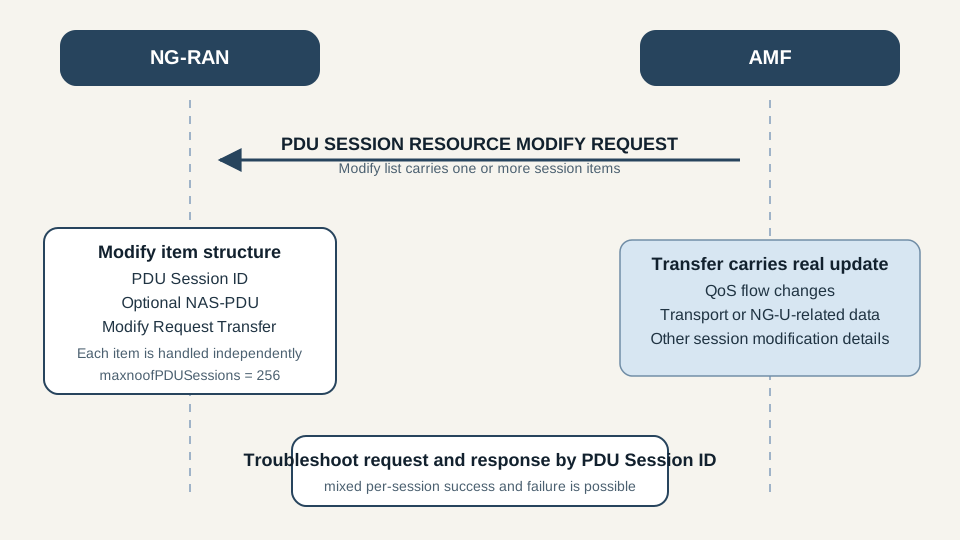
Per-session branch: each listed PDU session item carries its own modify request transfer so NG-RAN can process the update session by session.
Call flow position: The request is used when session-specific QoS flow handling, NG-U-related information, or other per-session resource parameters need to change while the session stays established.
Typical state: NG-RAN must process session items individually and decide whether each requested modification can be applied.
Preconditions:
The affected PDU session IDs are already valid in the active UE context.
Each listed session item carries a PDU Session Resource Modify Request Transfer container.
Next likely message: PDU Session Resource Modify Response with per-session success or failure outcome
NAS-assisted session modification
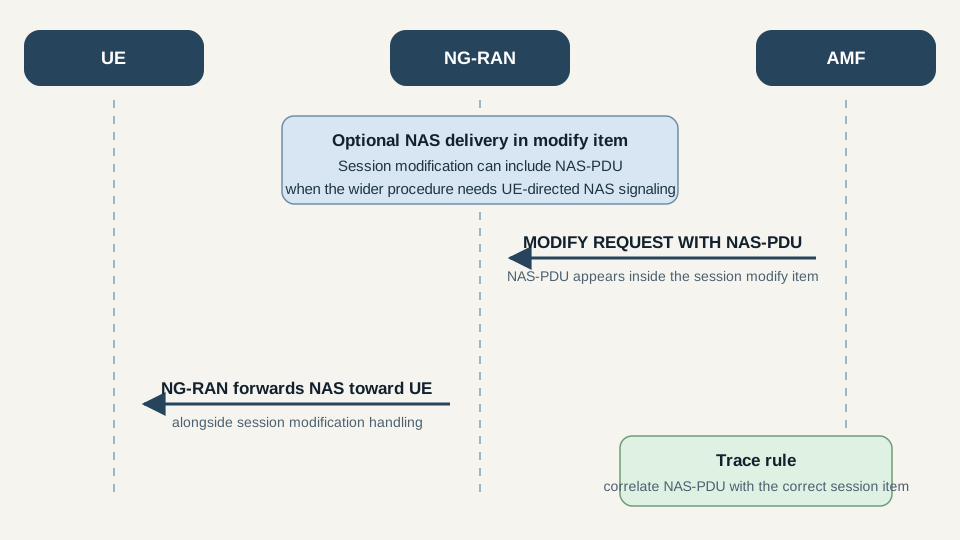
NAS branch: a modify item can include NAS-PDU when the session modification also needs NG-RAN to forward NAS signaling toward the UE.
Call flow position: The request can also carry NAS-PDU inside session-specific modify items when the wider procedure needs NAS delivery toward the UE as part of the modification branch.
Typical state: The modification branch spans both NGAP session-resource handling and UE-directed NAS delivery.
Preconditions:
The relevant PDU session modify item includes NAS-PDU.
NG-RAN is expected to forward that NAS signaling toward the UE as part of the modification handling.
Next likely message: PDU Session Resource Modify Response after NG-RAN processes both resource changes and any related NAS forwarding
Call flow position
Previous message(s): Existing UE context and active PDU session resources, AMF or SMF session modification decision
Transport / encapsulation: NGAP over SCTP/IP between AMF and NG-RAN
Security context: The message assumes an active UE-associated NGAP context already exists. It modifies existing session resources rather than creating a fresh security or context baseline.
Message Structure Overview
PDU Session Resource Modify Request is an AMF-to-NG-RAN initiatingMessage in the NGAP PDU Session Management family.
It is used to modify already established PDU session resources, not to set up new ones and not to release them completely.
AMF UE NGAP ID and RAN UE NGAP ID anchor the request to the existing UE-associated NGAP context.
The operational center of gravity is PDU Session Resource Modify List Mod Req because each item represents one PDU session resource to modify.
Inside each modify item, PDU Session ID identifies the session, NAS-PDU may be present when needed, and PDU Session Resource Modify Request Transfer carries the session-specific modification details.
The Release 18 list bound is maxnoofPDUSessions = 256.
ASN.1 for 5G NGAP - PDU Session Resource Modify Request
PDUSessionResourceModifyRequest ::= SEQUENCE {
  protocolIEs ProtocolIE-Container { {PDUSessionResourceModifyRequest-IEs} },
  ...
}

PDUSessionResourceModifyRequest-IEs NGAP-PROTOCOL-IES ::= {
  { ID id-AMF-UE-NGAP-ID                     CRITICALITY reject TYPE AMF-UE-NGAP-ID                     PRESENCE mandatory } |
  { ID id-RAN-UE-NGAP-ID                     CRITICALITY reject TYPE RAN-UE-NGAP-ID                     PRESENCE mandatory } |
  { ID id-RANPagingPriority                  CRITICALITY ignore TYPE RANPagingPriority                  PRESENCE optional  } |
  { ID id-PDUSessionResourceModifyListModReq CRITICALITY reject TYPE PDUSessionResourceModifyListModReq PRESENCE mandatory },
  ...
}

PDUSessionResourceModifyItemModReq ::= SEQUENCE {
  pduSessionID PDU Session ID,
  nAS-PDU NAS-PDU OPTIONAL,
  pduSessionResourceModifyRequestTransfer OCTET STRING,
  ...
}
How to read this ASN.1
Decode the UE identity pair first, then enumerate the PDU Session Resource Modify List Mod Req item by item. The real session-specific meaning sits inside each PDU Session Resource Modify Request Transfer, so the top-level message name alone never tells the full story.
Treat this as a teaching example based on the spec structure, not as a captured network trace.
The message modifies existing session resources, so the listed PDU Session IDs should already exist at NG-RAN.
Read the request and later response together item by item, because mixed per-session outcome is entirely possible.
If NAS-PDU appears in a modify item, correlate it with the wider session modification branch instead of assuming the transfer container alone explains the UE-visible behavior.
Important Information Elements
IE
Presence
Description
Message Type
Mandatory
Identifies the NGAP PDU as PDU SESSION RESOURCE MODIFY REQUEST.
AMF UE NGAP ID
Mandatory
Mandatory AMF-side UE identifier used to correlate the request with the correct existing UE context.
RAN UE NGAP ID
Mandatory
Mandatory NG-RAN-side UE identifier used to bind the requested changes to the correct radio-side UE context.
RAN Paging Priority
Optional
Optional paging-priority-related context associated with the request.
PDU Session Resource Modify List Mod Req
Mandatory
Mandatory list of one or more PDU session resource modify items. Each item identifies the target PDU Session ID and carries optional NAS-PDU plus PDU Session Resource Modify Request Transfer.
Detailed field explanation
Message Type
Identifies the NGAP PDU as PDU SESSION RESOURCE MODIFY REQUEST.
Presence: Mandatory
In practice: In practice, compare this field with the original request and with any later release-dependent optional fields so you can see whether the network accepted the same service model the UE asked for.
AMF UE NGAP ID
Mandatory AMF-side UE identifier used to correlate the request with the correct existing UE context.
Presence: Mandatory
In practice: In practice, compare this field with the original request and with any later release-dependent optional fields so you can see whether the network accepted the same service model the UE asked for.
RAN UE NGAP ID
Mandatory NG-RAN-side UE identifier used to bind the requested changes to the correct radio-side UE context.
Presence: Mandatory
In practice: In practice, compare this field with the original request and with any later release-dependent optional fields so you can see whether the network accepted the same service model the UE asked for.
RAN Paging Priority
Optional paging-priority-related context associated with the request.
Presence: Optional
In practice: In practice, compare this field with the original request and with any later release-dependent optional fields so you can see whether the network accepted the same service model the UE asked for.
PDU Session Resource Modify List Mod Req
Mandatory list of one or more PDU session resource modify items. Each item identifies the target PDU Session ID and carries optional NAS-PDU plus PDU Session Resource Modify Request Transfer.
Presence: Mandatory
In practice: In practice, compare this field with the original request and with any later release-dependent optional fields so you can see whether the network accepted the same service model the UE asked for.
What to check in logs and traces
Confirm AMF UE NGAP ID and RAN UE NGAP ID match the active UE-associated NGAP context.
List every PDU Session ID inside PDU Session Resource Modify List Mod Req.
Verify each modify item carries the expected PDU Session Resource Modify Request Transfer.
Check whether NAS-PDU is present only for the session items where UE-directed NAS delivery is expected.
Correlate the request with PDU Session Resource Modify Response item by item using PDU Session ID.
Separate modify behavior from setup or release behavior before diagnosing bearer-state mismatches.
Common Issues and Troubleshooting
The wrong PDU session appears to change after the request.
Likely cause: The PDU Session ID mapping may be wrong, or engineers may be correlating the request to the wrong session item.
What to inspect: Read every PDU Session ID in the modify list and compare it with the active session inventory for the same AMF UE NGAP ID and RAN UE NGAP ID.
Next step: Fix session-ID correlation before treating the issue as a transfer-container decoding problem.
The request is present, but NG-RAN does not apply the expected update.
Likely cause: The PDU Session Resource Modify Request Transfer may be missing, malformed, or semantically inconsistent with the existing session state.
What to inspect: Decode the modify request transfer and compare it with the later per-session outcome reported in the response.
Next step: Treat this as a per-session transfer-content issue rather than a generic top-level message failure.
QoS behavior looks wrong after the modification.
Likely cause: Requested QoS flow changes may not match the existing bearer realization, or only some per-session updates may have succeeded.
What to inspect: Follow the request item, the modify transfer, and the response item together for the affected PDU Session ID.
Next step: Debug the session-level QoS realization path instead of assuming all session items behaved the same way.
NAS signaling was expected during modification, but the UE never appears to receive it.
Likely cause: NAS-PDU may be absent from the intended modify item, or NG-RAN may not have forwarded it as expected.
What to inspect: Verify NAS-PDU presence in the correct PDU session modify item and correlate it with the UE-facing NAS branch.
Next step: Resolve the NAS delivery path separately from the bearer modification path if necessary.
Some sessions succeed in the response while others fail.
Likely cause: NG-RAN processed the request item by item, and only a subset of requested session modifications could be applied.
What to inspect: Compare request and response by PDU Session ID rather than reading the whole modify procedure as one binary success or failure.
Next step: Fix the failing items specifically instead of repeating successful modifications unnecessarily.
LTE / 5G / Variant Comparison
Compared with PDU Session Resource Setup Request
Setup Request creates new PDU session resources. PDU Session Resource Modify Request changes already established session resources without creating a new session resource baseline.
Compared with PDU Session Resource Release Command
Release Command removes existing PDU session resources. PDU Session Resource Modify Request keeps the session active while changing its handling or parameters.
Compared with PDU Session Resource Modify Response
Modify Request carries the AMF instruction set. Modify Response reports which requested per-session modifications NG-RAN accepted or failed.
FAQ
What is PDU Session Resource Modify Request in NGAP?
It is the AMF-to-NG-RAN message used to request changes to already established PDU session resources for a UE.
Who sends PDU Session Resource Modify Request?
The AMF sends PDU Session Resource Modify Request to the NG-RAN node.
When is this message used?
It is used when one or more existing PDU session resources need modification, such as QoS, bearer, transport, or related session-level handling changes.
What is PDU Session Resource Modify List?
It is the mandatory list of PDU sessions to modify, with one item per targeted PDU Session ID.
What does PDU Session Resource Modify Request Transfer contain?
It carries the per-session modification details, such as QoS flow updates, transport information, or other 5GC-driven session modification parameters.
Can this message carry NAS-PDU?
Yes. NAS-PDU may be included inside a PDU session modify item when the wider procedure needs NAS delivery toward the UE.
What is the response to this message?
The response is PDU Session Resource Modify Response.
What is the difference between Modify Request and Setup Request?
Setup Request creates new session resources, while Modify Request changes resources that already exist.
Can multiple PDU sessions be modified in one message?
Yes. The modify list can contain multiple session items, up to the Release 18 maximum of 256 PDU sessions.
How do you troubleshoot a failed PDU session modification?
Correlate the request and response by PDU Session ID, inspect the modify request transfer for the failing item, and separate per-session failure from overall message delivery.
Decode this message with the 3GPP Decoder, inspect the related message database, or open the matching call flow to see where this signaling step fits in the full procedure.