PDU Session Resource Setup Response is the NGAP message the NG-RAN sends to AMF to report which requested PDU session resources were successfully established and which failed.
NG-RAN completed processing of PDU Session Resource Setup Request and needs to tell AMF which requested session resources were successfully realized and which failed.
Main purpose
Confirms the outcome of requested PDU session bearer realization at NG-RAN, including admitted session items, failed items, and diagnostics AMF can use for continuation or retry decisions.
What is PDU Session Resource Setup Response in simple terms?
PDU Session Resource Setup Response is the NGAP message the NG-RAN sends to AMF to report which requested PDU session resources were successfully established and which failed.
Confirms the outcome of requested PDU session bearer realization at NG-RAN, including admitted session items, failed items, and diagnostics AMF can use for continuation or retry decisions.
Why this message matters
PDU Session Resource Setup Response tells the AMF which requested session resources the gNB actually established and which ones failed.
Where this message appears in the call flow
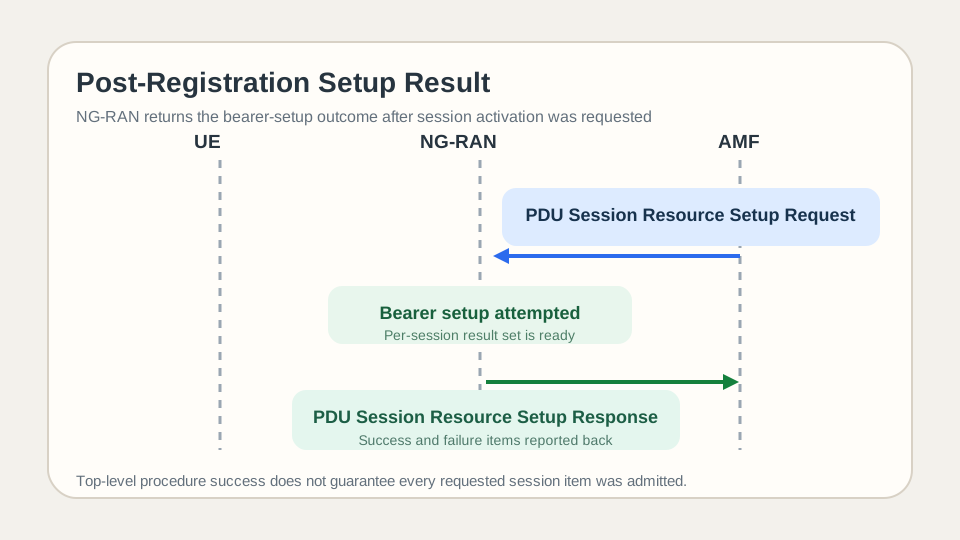
Post-registration PDU session activation result
Post-registration result branch: NG-RAN reports which requested session resources are now ready for service.
Call flow position: NG-RAN returns the bearer-setup outcome after AMF requested session resource realization on a live UE context.
Typical state: The UE context remains present, and AMF is now learning which requested user-plane resources are actually usable.
Preconditions:
PDU Session Resource Setup Request was received and processed.
AMF UE NGAP ID and RAN UE NGAP ID mapping remains valid.
Next likely message: Service continuation for admitted sessions or retry for failed ones
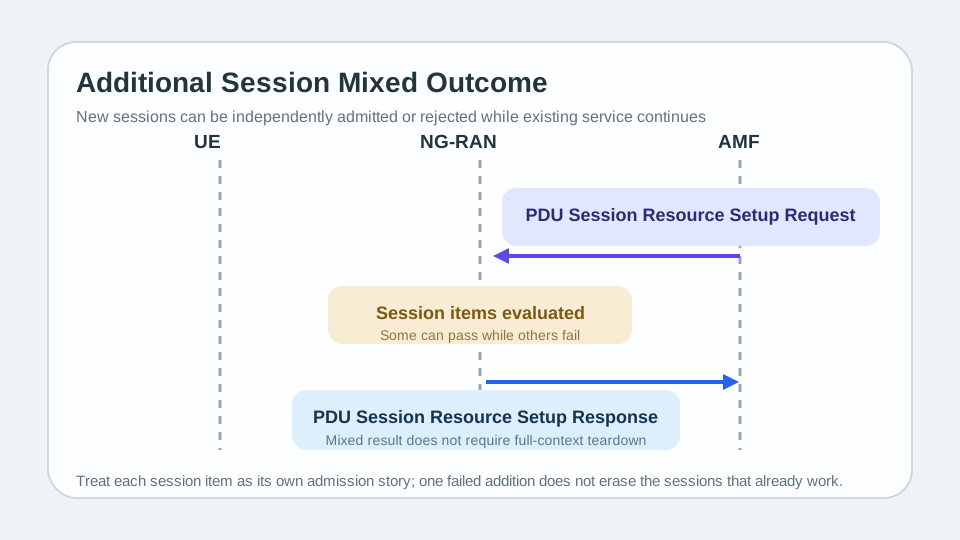
Additional session setup result on established UE
Additional-session result branch: existing service can continue while new session items are individually admitted or rejected.
Call flow position: Response branch for later session additions where some new PDU sessions may succeed while others fail.
Typical state: Existing service can continue while AMF decides what to do about any failed new session items.
Preconditions:
One or more additional PDU sessions were requested.
NG-RAN completed admission and bearer realization attempts for each item.
Next likely message: Continue admitted sessions, retry failures, or adjust policy
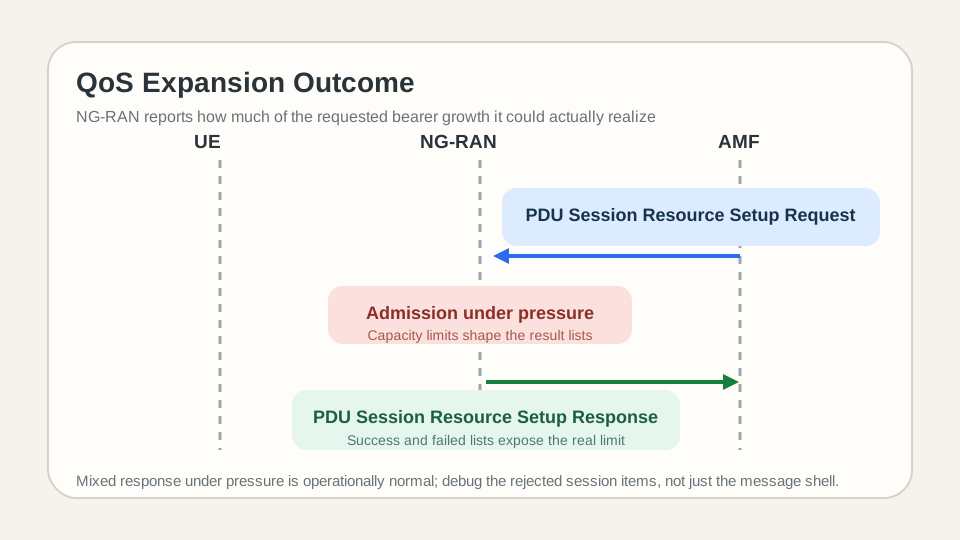
QoS or capacity-driven bearer expansion outcome
QoS expansion result branch: success and failure lists reveal how much of the requested bearer growth NG-RAN could realize.
Call flow position: NG-RAN reports how successfully the requested resource expansion was realized under current radio and transport constraints.
Typical state: AMF can distinguish full success, mixed success, and severe admission pressure by reading the setup and failed lists together.
Preconditions:
Session-resource setup request carried one or more bearer realization items.
NG-RAN evaluated the request against live resource conditions.
Next likely message: Targeted retry, partial continuation, or cleanup branch
Transport / encapsulation: NGAP over SCTP/IP between NG-RAN and AMF
Security context: The response reports the result of requested bearer setup on an already established UE context; it does not create the security baseline itself.
Message Structure Overview
PDU Session Resource Setup Response is the NG-RAN-to-AMF successfulOutcome message for the dedicated session-resource setup procedure.
AMF UE NGAP ID and RAN UE NGAP ID are the mandatory correlation anchors.
The practical value is in comparing the success and failure lists item-by-item against the original request list.
ASN.1 for 5G NGAP - PDU Session Resource Setup Response
PDUSessionResourceSetupResponse ::= SEQUENCE {
  protocolIEs ProtocolIE-Container { {PDUSessionResourceSetupResponse-IEs} },
  ...
}

PDUSessionResourceSetupResponse-IEs NGAP-PROTOCOL-IES ::= {
  { ID id-AMF-UE-NGAP-ID                      CRITICALITY reject TYPE AMF-UE-NGAP-ID                      PRESENCE mandatory } |
  { ID id-RAN-UE-NGAP-ID                      CRITICALITY reject TYPE RAN-UE-NGAP-ID                      PRESENCE mandatory } |
  { ID id-PDUSessionResourceSetupListSURes    CRITICALITY ignore TYPE PDUSessionResourceSetupListSURes    PRESENCE optional  } |
  { ID id-PDUSessionResourceFailedToSetupListSURes CRITICALITY ignore TYPE PDUSessionResourceFailedToSetupListSURes PRESENCE optional } |
  { ID id-CriticalityDiagnostics              CRITICALITY ignore TYPE CriticalityDiagnostics              PRESENCE optional  },
  ...
}
How to read this ASN.1
Decode the UE identity pair first, then inspect success and failure lists together. This message is best treated as a per-session result set rather than a simple yes/no response.
A valid response can contain only success items, only failed items, or a mixture of both depending on actual admission results.
The presence of a top-level successfulOutcome does not mean every requested session item succeeded.
Treat the failed list as a normal operational output under constrained conditions, not automatically as a protocol anomaly.
Important Information Elements
IE
Presence
Description
AMF UE NGAP ID
Mandatory
Mandatory AMF-side UE identifier used to correlate the response with the original request and the correct UE context.
RAN UE NGAP ID
Mandatory
Mandatory NG-RAN-side UE identifier used to bind the reported session-resource outcome to the correct radio-side context.
PDU Session Resource Setup List SURes
Optional
Optional list of PDU session resource items that were successfully established, including response transfer payloads.
PDU Session Resource Failed To Setup List SURes
Optional
Optional list of PDU session resource items that failed setup, along with the relevant failure transfer details.
Criticality Diagnostics
Optional
Optional diagnostics that can help explain unusual decode or processing context around the response.
Detailed field explanation
AMF UE NGAP ID
Mandatory AMF-side UE identifier used to correlate the response with the original request and the correct UE context.
Presence: Mandatory
In practice: In practice, compare this field with the original request and with any later release-dependent optional fields so you can see whether the network accepted the same service model the UE asked for.
RAN UE NGAP ID
Mandatory NG-RAN-side UE identifier used to bind the reported session-resource outcome to the correct radio-side context.
Presence: Mandatory
In practice: In practice, compare this field with the original request and with any later release-dependent optional fields so you can see whether the network accepted the same service model the UE asked for.
PDU Session Resource Setup List SURes
Optional list of PDU session resource items that were successfully established, including response transfer payloads.
Presence: Optional
In practice: In practice, compare this field with the original request and with any later release-dependent optional fields so you can see whether the network accepted the same service model the UE asked for.
PDU Session Resource Failed To Setup List SURes
Optional list of PDU session resource items that failed setup, along with the relevant failure transfer details.
Presence: Optional
In practice: In practice, compare this field with the original request and with any later release-dependent optional fields so you can see whether the network accepted the same service model the UE asked for.
Criticality Diagnostics
Optional diagnostics that can help explain unusual decode or processing context around the response.
Presence: Optional
In practice: In practice, compare this field with the original request and with any later release-dependent optional fields so you can see whether the network accepted the same service model the UE asked for.
What to check in logs and traces
Match AMF UE NGAP ID and RAN UE NGAP ID with the original PDU Session Resource Setup Request.
Compare every requested session item against the success and failure lists in the response.
Inspect failure transfer details for rejected items before deciding on retry strategy.
Confirm AMF continuation logic matches the mixed outcome profile instead of assuming all-or-nothing success.
If user-plane problems persist despite success items, validate the response transfer payloads and downstream realization.
Common Issues and Troubleshooting
PDU Session Resource Setup Response is present, but some sessions still do not work.
Likely cause: The response may report mixed outcome, or the supposedly successful session transfer details may still be inconsistent with downstream realization.
What to inspect: Compare request items with both success and failed lists, then inspect response transfer content for sessions marked successful.
Next step: Debug the affected session item directly instead of treating the whole procedure as either fully good or fully bad.
AMF continues as if everything succeeded, but capacity pressure was visible.
Likely cause: Mixed outcome may have been ignored at application level, with failed session items hidden inside the response details.
What to inspect: Read the failed list carefully and confirm AMF logic handles partial success explicitly.
Next step: Retry or defer only the failed session items rather than destabilizing already admitted sessions.
Repeated setup-response cycles oscillate between different failed session items.
Likely cause: The live resource state is unstable, so different sessions lose the admission contest on different attempts.
What to inspect: Track which session IDs move between success and failure across retries and correlate with radio or transport load.
Next step: Stabilize the admission environment or reduce simultaneous setup scope before retrying again.
LTE / 5G / Variant Comparison
Compared with PDU Session Resource Setup Request
Request carries the AMF bearer-setup ask. Response reports which requested session-resource items NG-RAN actually established or failed.
Compared with Initial Context Setup Response
Initial Context Setup Response can include session outcomes during broader context activation. PDU Session Resource Setup Response is the dedicated later session-resource outcome message.
Compared with UE Context Release Command
PDU Session Resource Setup Response reports usable session-resource outcomes on a still-live UE context. UE Context Release Command abandons the context entirely when continuation is no longer appropriate.
FAQ
What is PDU Session Resource Setup Response in 5G NGAP?
It is the NG-RAN-to-AMF message reporting the outcome of requested PDU session resource setup for one or more session items.
Can this response include both successful and failed session items?
Yes. Mixed outcome is normal, and both the success list and the failed list can be present in the same response.
What are the mandatory fields in this response?
AMF UE NGAP ID and RAN UE NGAP ID are mandatory; the success and failed session lists are optional depending on the result.
Why is this response important even when NGAP shows successfulOutcome?
Because successfulOutcome only means the procedure completed at message level. Individual session items may still have failed and must be read from the response lists.
Decode this message with the 3GPP Decoder, inspect the related message database, or open the matching call flow to see where this signaling step fits in the full procedure.