Handover Required is the NGAP message the source NG-RAN sends to the AMF to request preparation of resources at the target during AMF-mediated mobility procedures.
The source NG-RAN decides a handover must be prepared through AMF-mediated signaling because the UE should move to another target node or RAT and the procedure must continue over NGAP.
Main purpose
Requests the AMF to begin target-side preparation after the source NG-RAN has decided the UE should move to another target through the NGAP handover preparation path.
Handover Required is the NGAP message the source NG-RAN sends to the AMF to request preparation of resources at the target during AMF-mediated mobility procedures.
Requests the AMF to begin target-side preparation after the source NG-RAN has decided the UE should move to another target through the NGAP handover preparation path.
Why this message matters
Handover Required is the source gNB telling the AMF to start preparing a target for handover and carrying the mobility context the AMF needs to forward.
Where this message appears in the call flow
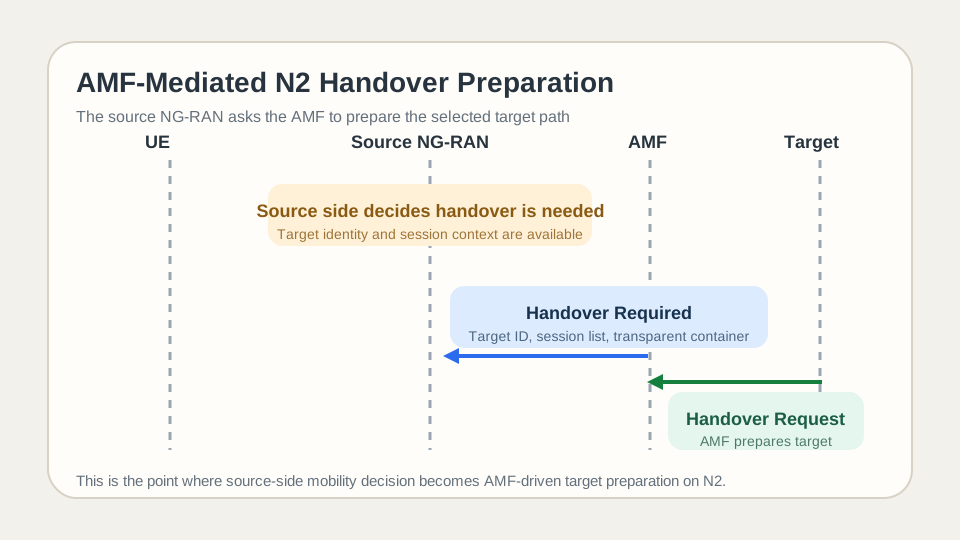
AMF-mediated N2 handover preparation
N2 preparation branch: source NG-RAN requests AMF to prepare the chosen target path.
Call flow position: The source NG-RAN has chosen a target that must be prepared through the AMF, so Handover Required starts the NGAP preparation leg toward that target path.
Typical state: The UE is still anchored on the source side while AMF has not yet contacted the target node with Handover Request.
Preconditions:
A UE-associated NGAP context already exists between source NG-RAN and AMF.
Source NG-RAN has determined that handover preparation should continue through the AMF.
Target identification and per-session handover context are available.
Next likely message: Handover Request from AMF toward the selected target
Inter-RAT mobility preparation
Fallback branch: preparation moves onto NGAP signaling when the source side uses the AMF-mediated path.
Call flow position: The message starts preparation when the target is in another supported access path and AMF must bridge the mobility context between source and target systems.
Typical state: Source NG-RAN is packaging the target identity, cause, and transparent mobility container so AMF can continue the interworking branch.
Preconditions:
The source node has selected an inter-RAT or otherwise AMF-mediated mobility target.
Source to Target Transparent Container is available for the target preparation exchange.
Next likely message: Handover Request or another AMF-mediated target preparation message
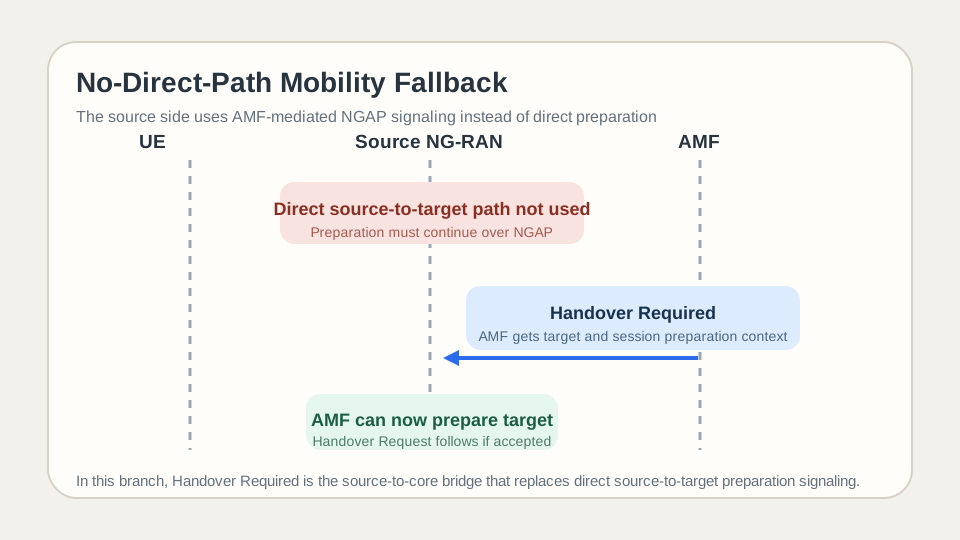
No-direct-Xn mobility fallback
Fallback branch: preparation moves onto NGAP signaling when the source side uses the AMF-mediated path.
Call flow position: The handover must be prepared through core signaling instead of a direct source-to-target exchange path.
Typical state: The source node still serves the UE, but preparation has moved onto N2 control signaling so AMF can coordinate the next hop.
Preconditions:
A direct source-to-target preparation path is not being used for this handover branch.
Source NG-RAN can provide the mandatory mobility context and per-session transfer information.
Next likely message: AMF target preparation signaling followed by Handover Command if preparation succeeds
Call flow position
Previous message(s): Measurement-driven mobility decision at the source NG-RAN, Source-side handover preparation evaluation
Transport / encapsulation: NGAP over SCTP/IP between source NG-RAN and AMF
Security context: The message runs on an existing UE-associated NGAP context. It does not establish new NAS or AS security by itself; it packages mobility context so the AMF can drive target preparation.
Message Structure Overview
Handover Required is the source NG-RAN initiatingMessage used to start NGAP handover preparation toward the AMF.
AMF UE NGAP ID and RAN UE NGAP ID anchor the message to the existing UE-associated NGAP context.
Handover Type, Cause, and Target ID explain what kind of mobility is needed and which target AMF should prepare.
PDU Session Resource List is session-granular and each item carries Handover Required Transfer from section 9.3.4.14.
Source to Target Transparent Container is mandatory, which is why this message should be read as a mobility-context package, not as a simple trigger flag.
Read the message in three layers: first the UE identity pair, then the handover intent fields, then the session-by-session items plus the mandatory transparent container. Section 9.3.4.14 defines Handover Required Transfer as transparent to the AMF, so AMF routes the information rather than decoding radio-specific inner semantics.
The top-level message is source NG-RAN to AMF, but the per-session Handover Required Transfer remains transparent to the AMF according to section 9.3.4.14.
The fetched Release 18-compatible message table shows AMF UE NGAP ID, RAN UE NGAP ID, Handover Type, Cause, Target ID, PDU Session Resource List, and Source to Target Transparent Container as mandatory.
Direct Forwarding Path Availability appears as optional in both the main message table and the Handover Required Transfer definition.
Important Information Elements
IE
Presence
Description
AMF UE NGAP ID
Mandatory
Mandatory AMF-side UE identifier that keeps the handover preparation tied to the correct UE-associated NGAP context.
RAN UE NGAP ID
Mandatory
Mandatory source NG-RAN UE identifier used together with the AMF UE NGAP ID to correlate the correct access-side UE context.
Handover Type
Mandatory
Mandatory mobility type indicator that tells AMF which broad handover branch is being prepared.
Cause
Mandatory
Mandatory reason the source NG-RAN is requesting handover preparation, which helps AMF interpret the mobility condition and follow-on handling.
Target ID
Mandatory
Mandatory target identity that tells AMF where the source side wants the next preparation leg to go.
Direct Forwarding Path Availability
Optional
Optional indication related to forwarding-path availability in the handover context. Release 18 keeps it optional both in the top-level message and in Handover Required Transfer handling.
PDU Session Resource List
Mandatory
Mandatory list of per-session handover items. Each item contains a PDU Session ID and a Handover Required Transfer, and the message is incomplete without this session-level preparation data.
Source to Target Transparent Container
Mandatory
Mandatory container carrying source-provided target-preparation information that AMF forwards without interpreting its inner radio-specific content.
Detailed field explanation
AMF UE NGAP ID
Mandatory AMF-side UE identifier that keeps the handover preparation tied to the correct UE-associated NGAP context.
Presence: Mandatory
In practice: In practice, compare this field with the original request and with any later release-dependent optional fields so you can see whether the network accepted the same service model the UE asked for.
RAN UE NGAP ID
Mandatory source NG-RAN UE identifier used together with the AMF UE NGAP ID to correlate the correct access-side UE context.
Presence: Mandatory
In practice: In practice, compare this field with the original request and with any later release-dependent optional fields so you can see whether the network accepted the same service model the UE asked for.
Handover Type
Mandatory mobility type indicator that tells AMF which broad handover branch is being prepared.
Presence: Mandatory
In practice: In practice, compare this field with the original request and with any later release-dependent optional fields so you can see whether the network accepted the same service model the UE asked for.
Cause
Mandatory reason the source NG-RAN is requesting handover preparation, which helps AMF interpret the mobility condition and follow-on handling.
Presence: Mandatory
In practice: In practice, compare this field with the original request and with any later release-dependent optional fields so you can see whether the network accepted the same service model the UE asked for.
Target ID
Mandatory target identity that tells AMF where the source side wants the next preparation leg to go.
Presence: Mandatory
In practice: In practice, compare this field with the original request and with any later release-dependent optional fields so you can see whether the network accepted the same service model the UE asked for.
Direct Forwarding Path Availability
Optional indication related to forwarding-path availability in the handover context. Release 18 keeps it optional both in the top-level message and in Handover Required Transfer handling.
Presence: Optional
In practice: In practice, compare this field with the original request and with any later release-dependent optional fields so you can see whether the network accepted the same service model the UE asked for.
PDU Session Resource List
Mandatory list of per-session handover items. Each item contains a PDU Session ID and a Handover Required Transfer, and the message is incomplete without this session-level preparation data.
Presence: Mandatory
In practice: In practice, compare this field with the original request and with any later release-dependent optional fields so you can see whether the network accepted the same service model the UE asked for.
Source to Target Transparent Container
Mandatory container carrying source-provided target-preparation information that AMF forwards without interpreting its inner radio-specific content.
Presence: Mandatory
In practice: In practice, compare this field with the original request and with any later release-dependent optional fields so you can see whether the network accepted the same service model the UE asked for.
What to check in logs and traces
Confirm AMF UE NGAP ID and RAN UE NGAP ID match the live source-side UE context.
Read Handover Type, Cause, and Target ID before looking at later target-preparation messages.
Enumerate every PDU Session Resource Item and note which session IDs are being prepared for mobility.
Treat Handover Required Transfer and Source to Target Transparent Container as opaque payloads unless you are decoding the relevant target-facing radio container separately.
Check whether Direct Forwarding Path Availability is present when user-plane forwarding behavior matters in the handover branch.
Common Issues and Troubleshooting
Handover Required appears in the trace, but AMF prepares the wrong target or no target at all.
Likely cause: Target ID may not match the intended target branch, or AMF may not be able to continue with the source-provided preparation context.
What to inspect: Validate Target ID, Handover Type, and the timing against the following target-preparation signaling from the AMF.
Next step: Fix target-selection or target-reachability interpretation before analyzing later handover failure symptoms.
Only some sessions continue correctly after handover preparation.
Likely cause: The PDU Session Resource List may be incomplete or a session-specific Handover Required Transfer may not line up with the sessions expected to move.
What to inspect: Compare the full session list in Handover Required against the sessions that later appear in the target-preparation and execution branch.
Next step: Resolve the session-granularity mismatch before blaming the entire handover procedure.
Forwarding behavior is unclear during the mobility branch.
Likely cause: Direct Forwarding Path Availability may be absent or may not match the expected forwarding design for the scenario.
What to inspect: Check whether the optional forwarding indication is present at top level and remember that section 9.3.4.14 also treats forwarding-related information as optional inside the transfer.
Next step: Correlate forwarding expectations with later user-plane handling instead of assuming direct forwarding was available.
LTE / 5G / Variant Comparison
Compared with Handover Command
Handover Required starts target preparation from the source side. Handover Command is the later execution-stage instruction delivered after target preparation succeeds.
Compared with UE Context Modification Request
UE Context Modification Request changes parts of an existing UE-associated context. Handover Required begins a mobility preparation branch that can move the UE to another target.
Compared with UE Context Release Command
Handover Required tries to preserve service through target preparation. UE Context Release Command explicitly tears down the current UE-associated NG connection.
FAQ
What is Handover Required in 5G NGAP?
It is the source NG-RAN to AMF message used to request preparation of resources at the target during handover preparation.
What are the key fields in Handover Required?
The core fields are AMF UE NGAP ID, RAN UE NGAP ID, Handover Type, Cause, Target ID, PDU Session Resource List, and Source to Target Transparent Container. Direct Forwarding Path Availability is optional.
Why does Handover Required matter so much in trace analysis?
Because it is where the source side commits to the AMF-mediated handover path and packages the target identity plus session-level preparation context that drives the next signaling steps.
Does the AMF fully decode Handover Required Transfer?
Section 9.3.4.14 states that Handover Required Transfer is transparent to the AMF, so the AMF mainly forwards or uses the container operationally rather than interpreting radio-specific inner details.
Decode this message with the 3GPP Decoder, inspect the related message database, or open the matching call flow to see where this signaling step fits in the full procedure.