5G PDU Session Release Procedure Call Flow
5G PDU Session Release is the controlled teardown of an active PDU session so the UE and network can remove data connectivity and free related resources.
The key engineering question is not only whether a release command appeared, but whether the right session disappeared completely across UE, SMF, and UPF.
Introduction
This page explains the end-to-end teardown path for an existing 5G data session, including both UE-initiated and network-initiated release behavior.
For practical troubleshooting, the strongest checks are the target session ID, the release cause, the PFCP cleanup on the UPF side, and the absence of traffic after release.
What Is PDU Session Release in Simple Terms?
- What starts the procedure: The UE or network decides an active session should be removed.
- What the UE and network want to achieve: Delete the correct session cleanly without leaving stale context behind.
- What success looks like: The selected session is removed and related data-plane resources disappear.
- What failure means: The wrong session is touched, cleanup is partial, or residual traffic remains.
Why this procedure matters
Release problems cause subtle outages because the session may appear gone in one layer but still exist in another. A structured teardown analysis avoids chasing ghost sessions.
Quick Fact Sheet
| Procedure name | 5G PDU Session Release Procedure |
|---|---|
| Domain | 5G NR + 5GC session teardown and resource cleanup |
| Main trigger | UE or network decides an active PDU session should be removed |
| Start state | UE has an active PDU session with working user-plane state |
| End state | The selected session is deleted and related resources are released |
| Main nodes | UE, gNB, AMF, SMF, UPF |
| Main protocols | NAS, NGAP, PFCP |
| Main success outcome | The targeted session is removed cleanly and no residual user-plane state remains |
| Main failure outcome | The release is partial, stale context remains, or the wrong session is removed |
| Most important messages | PDU Session Release Request, PDU Session Release Command, PDU Session Release Complete |
| Main specs | TS 23.502, TS 24.501, TS 23.501, TS 29.244 |
Preconditions
- A valid active PDU session exists before release begins.
- The network can correlate the release action to the intended session context.
- SMF and UPF can remove the session state successfully.
- The UE can process release signaling and remove the session locally.
Nodes and Interfaces
Nodes involved
| Node | Role in this procedure |
|---|---|
| UE | Requests release or confirms network-initiated release for the selected PDU session. |
| gNB | Relays control signaling and tears down access-side handling tied to the session. |
| AMF | Provides the signaling anchor between UE and SMF during session removal. |
| SMF | Owns the decision to release the session and coordinates removal of session context. |
| UPF | Deletes forwarding and enforcement rules associated with the session. |
Interfaces used
| Interface | Path | Role |
|---|---|---|
| NR-Uu | UE <-> gNB | Carries the release-related signaling while the access path still exists. |
| N1 | UE <-> AMF | Carries release request, command, and completion confirmation. |
| N2 | gNB <-> AMF | Keeps access-side state aligned with session removal. |
| N11 | AMF <-> SMF | Coordinates teardown of the selected PDU session context. |
| N4 / N3 | SMF <-> UPF and gNB <-> UPF | Remove forwarding state and stop user-plane transport for the session. |
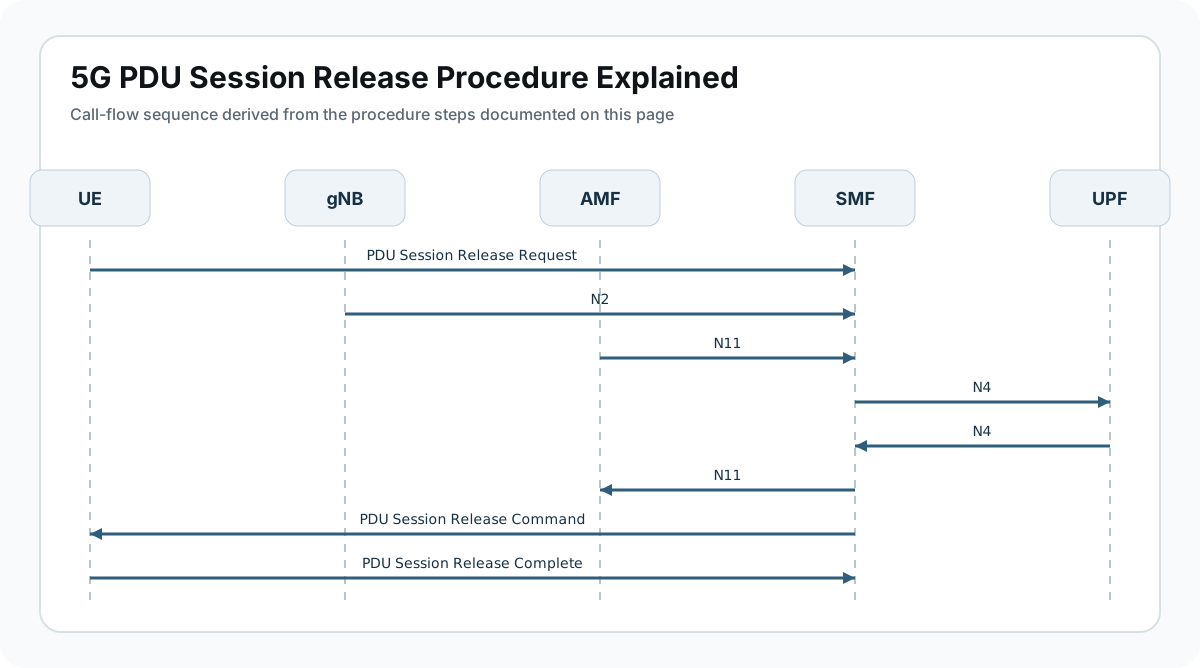
End-to-End Call Flow
UE                gNB                AMF                SMF                UPF
|                  |                  |                  |                  |
|-- Release Request ----------------->|----------------->|----------------->|
|                  |                  |                  |-- delete rules -->|
|                  |                  |                  |<-- cleanup done --|
|<-- Release Command -----------------|<-----------------|                  |
|-- Release Complete ---------------->|----------------->|----------------->|
|==== no user-plane traffic should remain on released session ==========>|
Major Phases
| Phase | What happens |
|---|---|
| 1. Release need appears | The UE or network determines the session is no longer required or no longer allowed. |
| 2. Release signaling | The selected session is identified and a release exchange begins. |
| 3. Core teardown | The SMF and UPF remove session, forwarding, and QoS state. |
| 4. UE confirmation | The UE confirms the session has been removed from its local context. |
| 5. Post-release validation | Logs and traffic confirm the session is actually gone and resources are cleanly freed. |
Step-by-Step Breakdown
The session selected for removal is identified
Sender -> receiver: UE or network policy logic
Message(s): Release trigger and target session identification
Purpose: Make sure the correct active session is being removed.
State or context change: The network correlates release intent with a specific PDU Session ID.
Note: Always prove which session is being released before interpreting the rest of the trace.
Release signaling starts
Sender -> receiver: UE -> AMF -> SMF or SMF -> UE via AMF
Message(s): PDU Session Release Request or PDU Session Release Command
Purpose: Initiate controlled removal of the selected session.
State or context change: The session moves from active service toward explicit teardown.
Note: UE-initiated and network-initiated releases share most of the teardown logic after the trigger.
The SMF removes core session state
Sender -> receiver: AMF <-> SMF <-> UPF
Message(s): Session release handling and PFCP deletion
Purpose: Delete the user-plane and policy context for the session.
State or context change: The session stops being a valid transport path in the core.
Note: Stale UPF rules after a clean NAS release are a common operational trap.
The UE confirms removal
Sender -> receiver: UE -> AMF -> SMF
Message(s): PDU Session Release Complete
Purpose: Tell the network that the UE removed the session locally.
State or context change: The release becomes complete from both UE and network viewpoints.
Note: Without Complete, you may have a half-finished release that leaves confusing traces later.
Residual traffic and state are checked
Sender -> receiver: UE, gNB, UPF, service monitoring
Message(s): Post-release traffic and context observation
Purpose: Prove the session is fully gone and not silently lingering.
State or context change: The network returns to a clean post-release state.
Note: Residual user-plane traffic usually means incomplete cleanup, not a mysterious new failure.
Important Messages in This Flow
| Message | Protocol | Direction | Purpose in this procedure | What to inspect briefly |
|---|---|---|---|---|
| PDU Session Release Request | NAS | UE -> SMF via AMF | Starts a UE-initiated release of the selected session. | Inspect the session ID and release reason first. |
| PDU Session Release Command | NAS | SMF -> UE via AMF | Instructs the UE to remove the session. | Useful for network-initiated release and cleanup validation. |
| PDU Session Release Complete | NAS | UE -> SMF via AMF | Confirms the UE removed the session locally. | Use it to confirm the teardown reached the UE side fully. |
| PFCP session deletion | PFCP | SMF <-> UPF | Deletes forwarding and QoS enforcement state in the UPF. | Critical for catching stale N3/N4 context after release. |
Important Parameters to Inspect
| Parameter | What it is | Where it appears | Why it matters | Common issues |
|---|---|---|---|---|
| PDU Session ID | Identifier of the session being removed. | Request, Command, and Complete | Keeps the teardown tied to the correct active session. | Wrong ID creates severe correlation errors. |
| Release cause | Reason for session teardown. | Request or network decision path | Helps explain whether the release is user-driven, policy-driven, or failure-driven. | Missing cause hides the real story. |
| PFCP rule deletion state | UPF cleanup related to the released session. | N4 teardown | Proves whether data forwarding was actually removed. | Residual rules cause phantom traffic. |
| UE local session state | Whether the UE still believes the session exists. | After Command and Complete | Important when the network looks clean but the UE does not. | Creates confusing retry or reuse behavior. |
| Traffic after release | Any packets still crossing the old path. | Post-release monitoring | Best final proof that the session is really gone. | Residual packets mean incomplete cleanup. |
Success Criteria
- The correct PDU session is selected for release.
- The UE and network both remove session state cleanly.
- PFCP deletion removes forwarding and enforcement state in the UPF.
- No residual traffic or stale session behavior remains afterward.
Common Failures and Troubleshooting
| Symptom | Likely cause | Where to inspect | Relevant message(s) | Relevant interface(s) | Likely next step |
|---|---|---|---|---|---|
| Wrong session is released | The release was correlated to the wrong PDU Session ID. | Session ID in Request, Command, and all related context. | Release Request or Command | N1, N11 | Always start here when the service impact looks larger than expected. |
| Release signaling completes but UPF state remains | NAS teardown succeeded but user-plane cleanup was partial. | PFCP deletion state and residual traffic. | Release Complete | N4, N3 | This is a classic stale-context problem. |
| UE never confirms release | The command reached the UE poorly or local cleanup failed. | Command delivery, NAS integrity, and UE behavior. | Release Command, Release Complete | N1, radio | Separate command-delivery issues from core cleanup issues. |
| Application still sends traffic after release | Another session exists, or cleanup is incomplete, or the application is mis-correlated. | PDU Session ID, post-release traffic path, and application binding. | Post-release traffic | N3, service layer | Do not assume all post-release traffic belongs to the released session. |
What to Check in Logs and Traces
- Validate the PDU Session ID before anything else.
- Use the release cause to understand why the teardown happened.
- Inspect PFCP deletion to confirm UPF cleanup really occurred.
- Check for residual N3 traffic after release to catch stale context.
- If the UE still behaves as if the session exists, compare Release Command and Release Complete handling closely.
Related Pages
Related sub-procedures
- 5G PDU Session Establishment
- 5G PDU Session Modification
- 5G Network Requested PDU Session
- 5G Session Reactivation after Idle/Inactive Return
Related message reference pages
Related troubleshooting pages
Notes
The release is only finished when residual state is gone. Message completion without UPF cleanup is still an operational failure.
FAQ
What is 5G PDU Session Release?
It is the procedure that removes an active PDU session and frees the related network resources.
Can it be initiated by both UE and network?
Yes. The UE may request it, or the network may command it.
What proves success?
The correct session is removed, PFCP state is deleted, and no residual traffic remains on that path.
What is the main troubleshooting trap?
Assuming NAS success means the user plane is clean. You still need to validate UPF cleanup.
What should I inspect first?
Start with the PDU Session ID, the trigger for release, and PFCP deletion state.