IMT-2030 Explained
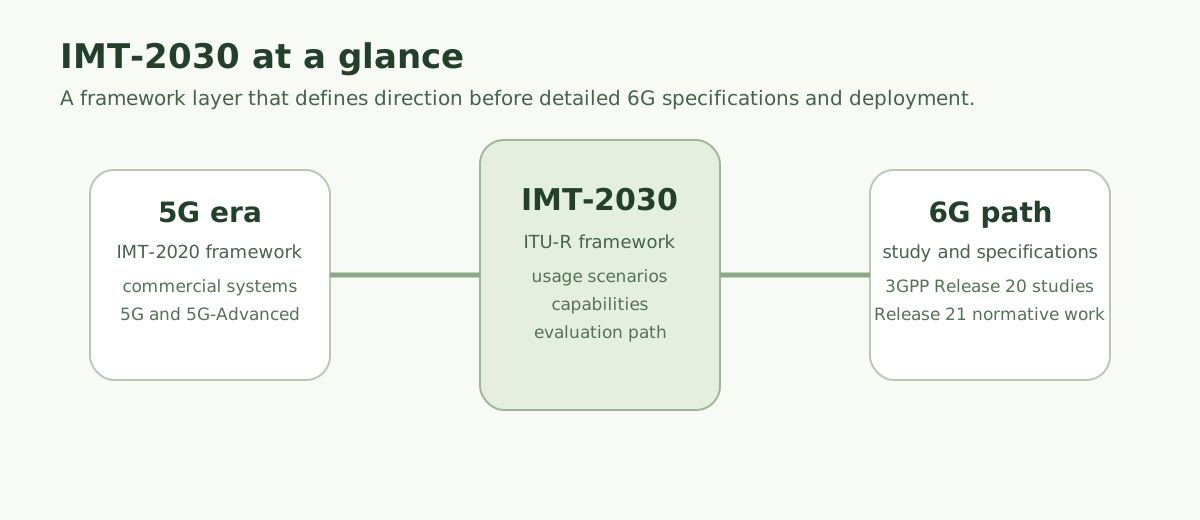
IMT-2030 is the global framework defined by ITU-R for the future development of mobile telecommunications around 2030 and beyond. It is the framework stage of what many people call 6G, but it is not a finished telecom standard or a final commercial network design. Instead, it defines the global direction: the usage scenarios future systems are expected to support, the capabilities they are expected to improve, and the broader design principles that should guide development. This matters because it gives the industry a common language before detailed specifications are written. In simple terms, IMT-2030 tells the world what future mobile networks should aim to do before bodies such as 3GPP decide how to specify them.
If IMT-2020 framed the 5G era, IMT-2030 frames the next one. It helps align researchers, vendors, operators, governments, and standards bodies around common targets. It also keeps 6G discussion grounded: the framework talks about use cases, capabilities, timelines, and evaluation, not imagined message flows or finished protocol stacks. For the broader 6G picture, start with What is 6G?. For the current deployed baseline, use the 5G hub.
Quick facts
| What it is | The ITU-R framework for IMT towards 2030 and beyond |
|---|---|
| What it is not | Not a final end-to-end telecom standard or protocol specification |
| Main framework text | Recommendation ITU-R M.2160 |
| Earlier comparison point | IMT-2020 in Recommendation ITU-R M.2083 |
| Key usage scenarios | IC, HRLLC, MC, UC, AIAC, and ISAC |
| Current maturity | Framework complete, requirements and evaluation work continuing, no finalized 6G deployment standard yet |
Contents
IMT-2030 in simple terms
- IMT-2030 is the global framework for the next phase of mobile networks after the 5G era.
- It is created by ITU-R, which sets the high-level direction before detailed standards are written.
- It is not a finished telecom standard, product, or protocol stack.
- It describes what future networks should be able to support, not exactly how every network must be built.
- It expands the discussion beyond speed into sensing, intelligence, resilience, sustainability, and broader connectivity.
- It helps guide later work from standards bodies such as 3GPP.
The easiest way to think about IMT-2030 is to compare it with an architecture brief before construction drawings exist. It tells the industry what problems future systems are expected to solve and what kinds of services they should support. It does not yet tell an equipment vendor exactly which signaling message, information element, or implementation method must be used.
That is why IMT-2030 matters even to people outside standards meetings. Journalists use it to understand what 6G claims are grounded in real framework work. Students use it to understand where the next generation begins. Operators and vendors use it to align long-term research with the expected international process.
Evolution from IMT-2020 to IMT-2030
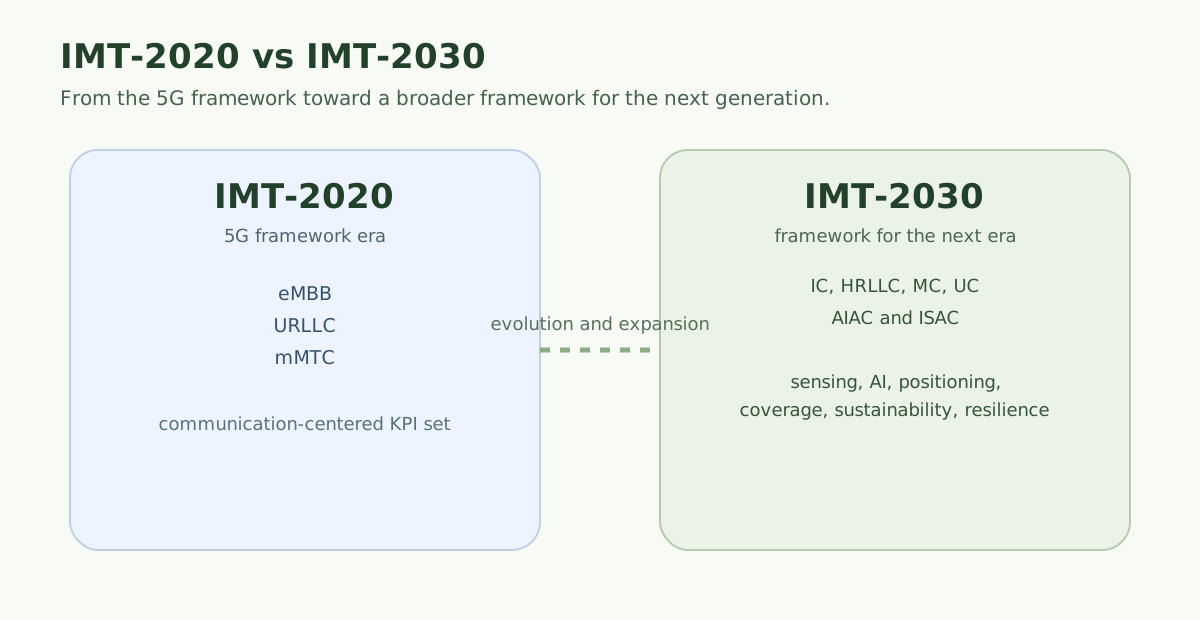
IMT-2020 was the framework stage for 5G. It captured the broad 5G vision around enhanced mobile broadband, ultra-reliable low-latency communication, and massive machine-type communication. That framework helped anchor a generation focused on more flexible radio access, lower latency, broader service differentiation, and expansion beyond traditional smartphone traffic.
IMT-2030 starts from the idea that those gains are important, but not enough by themselves. Mobile systems are now expected to support richer digital-physical interaction, broader coverage demands, stronger automation, better energy performance, more context awareness, and tighter links between communication and sensing. In other words, the next framework is not only about doing 5G faster. It is about extending what mobile systems are for.
A practical way to read the transition is this: IMT-2020 framed a network that could connect people and machines more effectively; IMT-2030 frames a network that is also expected to understand more about context, support more autonomous operation, and work across a broader mix of environments and service types.
| Area | IMT-2020 | IMT-2030 |
|---|---|---|
| Era | Framework stage for the 5G era | Framework stage for the next generation beyond 5G |
| Main service focus | Broadband, low latency, and massive connectivity | Those areas plus sensing, AI-related communication, broader coverage, and richer context awareness |
| Design emphasis | Flexible mobile broadband and multi-service support | Ubiquitous intelligence, resilience, sustainability, sensing integration, and broader connectivity |
| Capability scope | Strong communication KPIs | Communication KPIs plus new capability areas such as positioning, sensing, AI integration, and improved coverage |
| Current maturity | Already translated into deployed 5G systems | Still at framework, requirements, and study stage |
IMT-2030 objectives
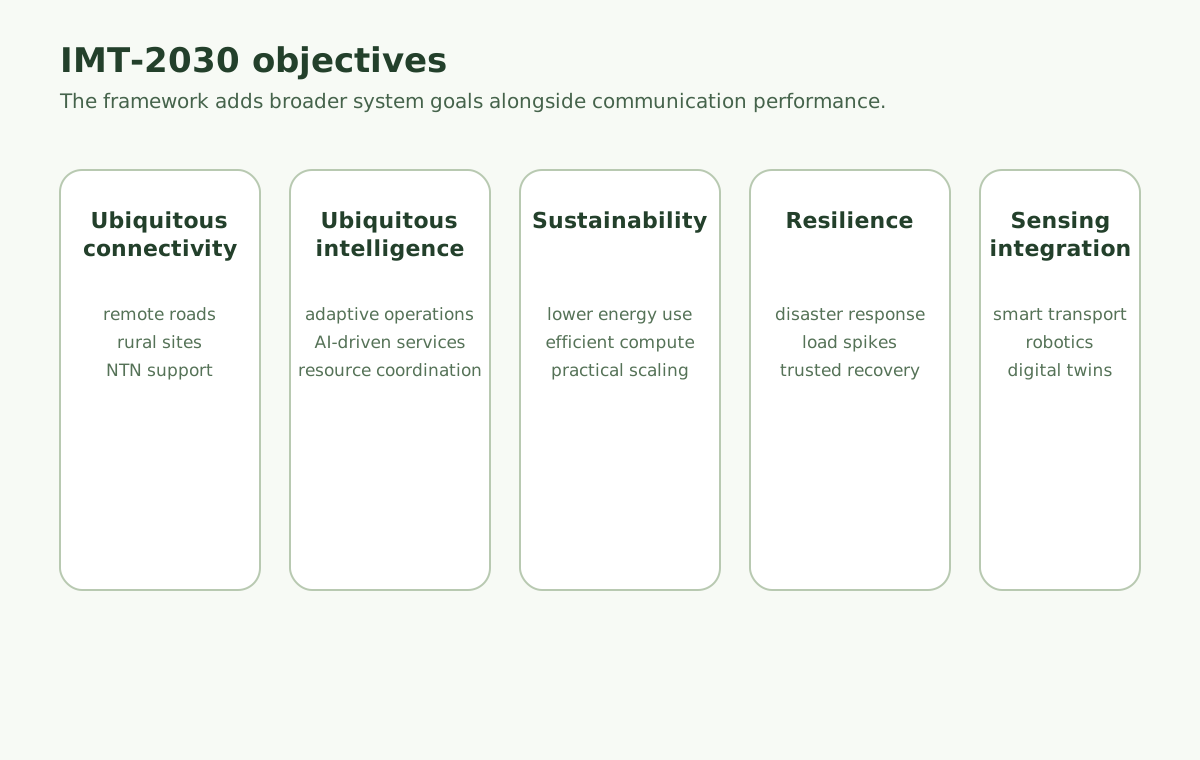
IMT-2030 is shaped by a set of high-level objectives and design principles rather than a fixed protocol blueprint. These objectives matter because they explain what future mobile networks are expected to be good at and what problems the framework is trying to solve in the real world.
Ubiquitous connectivity
This means future systems are expected to serve more places, more environments, and more device types with fewer gaps in service continuity. In real terms, that could mean better support for transport corridors, rural coverage, industrial campuses, offshore zones, and remote regions where purely terrestrial coverage may be weak or inconsistent.
What matters here is not just coverage area on a marketing map. It is whether usable service can be sustained across different conditions, device densities, and mobility situations. That is why the framework keeps pointing toward better coverage, NTN integration, and stronger service continuity thinking.
Ubiquitous intelligence
This objective reflects the idea that future networks are expected to use intelligence more deeply across operation, optimization, and service support. The point is not simply adding AI as a feature label. The point is to make networks better at adapting to conditions, coordinating resources, and assisting applications that depend on real-time decision-making.
A real-world example is a factory or transport system where communication performance, scheduling, sensing, and local compute decisions need to work together. The framework treats intelligence as something that may be built into the overall system direction, not as an isolated software add-on.
Sustainability
Sustainability in IMT-2030 is broader than saving battery life. It includes more efficient use of energy, spectrum, infrastructure, and compute resources, while also considering environmental and economic impact. This matters because a future network that offers better performance but consumes much more power may not be viable at scale.
In practice, this objective touches radio efficiency, hardware design, AI workload efficiency, and deployment strategy. A sustainable framework is one that can grow without making network operation disproportionately more expensive or energy-intensive.
Resilience
Resilience means future networks are expected to stay useful under disruption, overload, unexpected events, and security pressure. That includes both technical robustness and operational robustness. A resilient mobile system should degrade gracefully, recover reliably, and remain trustworthy when conditions are poor.
A practical example is disaster response or dense public events where communication demand spikes while parts of the infrastructure may be stressed. The framework highlights resilience because real networks must work outside ideal lab conditions.
Sensing integration
Sensing integration reflects one of the clearest IMT-2030 shifts beyond the earlier framework. Future systems are expected not only to transport data, but also to support awareness of movement, position, objects, or the surrounding environment. This matters in areas such as smart transport, industrial automation, robotics, and digital twins.
The technical meaning is important: sensing has to coexist with communication rather than simply sit beside it. That creates real tradeoffs in signal design, radio-resource use, estimation quality, and implementation complexity.
IMT-2030 use cases
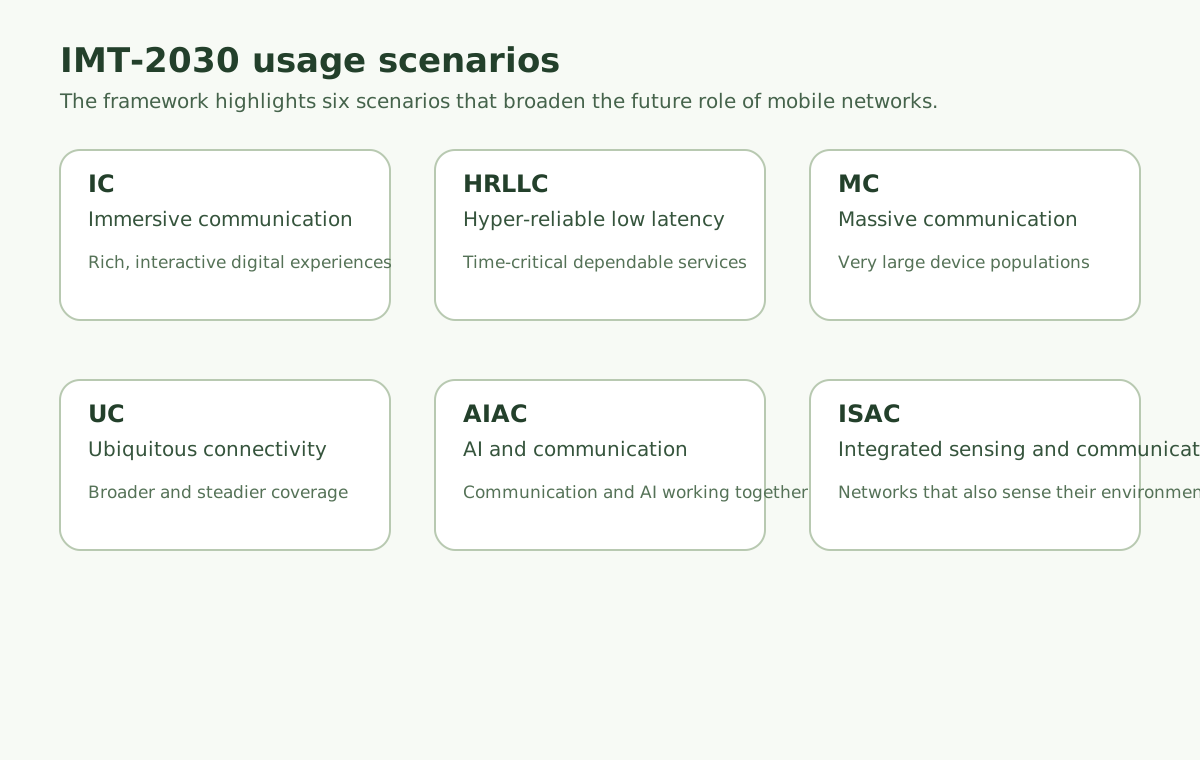
IMT-2030 highlights six usage scenarios: immersive communication (IC), hyper-reliable and low-latency communication (HRLLC), massive communication (MC), ubiquitous connectivity (UC), AI and communication (AIAC), and integrated sensing and communication (ISAC). These scenarios matter because they connect the framework to real service needs instead of leaving it as an abstract standards document.
Immersive communication
This covers richer interactive experiences such as advanced XR, shared remote environments, and highly responsive collaboration tools.
Real-world scenario: Remote design review where participants interact with the same 3D model in real time.
What it requires: High data rates, strong uplink, low and stable latency, synchronization, and often nearby compute support.
Hyper-reliable and low-latency communication
This is the continuation and expansion of time-critical communication for applications that need very fast and highly dependable behavior.
Real-world scenario: Motion control in automated production or safety-related transport coordination.
What it requires: Tight latency control, very high reliability, predictable scheduling, and strong resilience under load.
Massive communication
This covers extremely large numbers of connected devices, especially where many devices send small amounts of data or operate intermittently.
Real-world scenario: Dense utility meters, environmental sensors, and city-scale monitoring devices.
What it requires: High connection density, efficient signaling, low device power use, and scalable access behavior.
Ubiquitous connectivity
This focuses on making useful connectivity available across more environments and with better continuity across terrestrial and non-terrestrial layers.
Real-world scenario: Consistent service across remote roads, sea routes, or rural regions.
What it requires: Better coverage, stronger link budgets, NTN integration, mobility support, and service continuity planning.
AI and communication
This reflects the growing link between communication systems and AI-driven services, data handling, and model support across the network.
Real-world scenario: Distributed AI services that depend on communication quality and network-assisted model delivery.
What it requires: Efficient data movement, timing, compute coordination, and the ability to support AI inference and learning workflows.
Integrated sensing and communication
This scenario combines connectivity with sensing functions such as detection, localization, mapping, or environmental awareness.
Real-world scenario: Transport infrastructure that communicates with devices while also helping detect movement and position.
What it requires: Strong positioning, sensing accuracy, waveform and resource tradeoffs, and careful system integration.
Capability framework
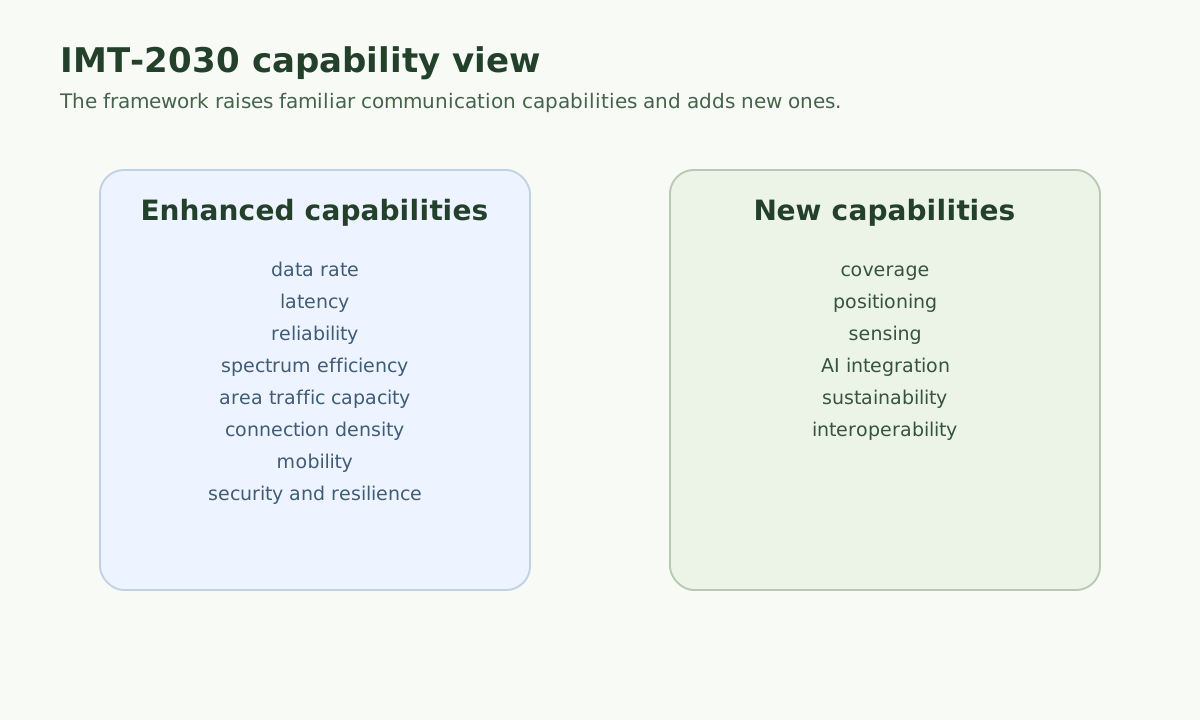
In standards work, a KPI is a key performance indicator. In this context, that means a way of describing what future radio technologies are expected to deliver. IMT-2030 matters because it expands the capability discussion beyond the familiar 5G communication KPIs into new areas such as positioning, sensing, AI integration, sustainability, and improved coverage.
ITU-R describes IMT-2030 as providing both enhanced capabilities beyond IMT-2020 and new capabilities to support expanded usage scenarios. That framing is important: the next framework is not only trying to raise old KPI numbers. It is also broadening what counts as a core system capability.
Data rate
Data rate still matters because richer applications need higher throughput, especially in immersive and high-bandwidth scenarios. But higher headline speed alone is not enough. What matters in real networks is where that performance is achievable and how consistently it can be delivered.
The challenge is that extremely high data rates often depend on spectrum, hardware, propagation conditions, and deployment density that are difficult to scale widely.
Latency
Lower latency matters for interactive systems, automation, robotics, and remote coordination. IMT-2030 keeps latency as a central capability because many emerging use cases depend on response time, not just throughput.
The challenge is that low latency depends on the whole system, including radio design, transport, compute placement, and scheduling.
Reliability
Reliability means the system can deliver data successfully and predictably when the service really matters. This is essential for industrial systems, safety-related communication, and critical control loops.
The challenge is that reliability often conflicts with efficiency, complexity, or cost, especially when mobility and dense environments are involved.
Energy efficiency and sustainability
Future networks need to do more without scaling energy use at the same rate. That applies to devices, base stations, cloud processing, and AI workloads. In practical terms, sustainability becomes part of the technical discussion because energy use can limit what is deployable.
The challenge is that many advanced features also increase processing and hardware demands.
Sensing capability
Sensing is one of the clearest new IMT-2030 capability areas. It means the framework is no longer describing a network only as a pipe for data, but also as a system that may help understand position, movement, or nearby objects.
The challenge is balancing sensing performance with communication performance while keeping implementations realistic.
AI capability
AI capability in IMT-2030 refers to the system’s ability to support AI-enabled functions such as distributed learning, data processing, and model inference. This matters because future services may depend on tighter communication-compute coordination.
The challenge is trust, data quality, model governance, and the extra overhead introduced by AI workloads.
| Capability | Why it matters | Main challenge |
|---|---|---|
| Data rate | Supports richer interactive and bandwidth-heavy services | Propagation, spectrum, and deployment practicality |
| Latency | Enables fast response for interactive and automated systems | Depends on the whole system, not just radio |
| Reliability | Supports critical or time-sensitive services | Often increases complexity and cost |
| Energy efficiency | Improves deployability and long-term sustainability | Advanced features can drive power upward |
| Sensing | Adds environmental awareness and positioning value | Communication-sensing tradeoffs |
| AI capability | Supports AI-enabled services and system adaptation | Trust, governance, and compute overhead |
Key technology directions
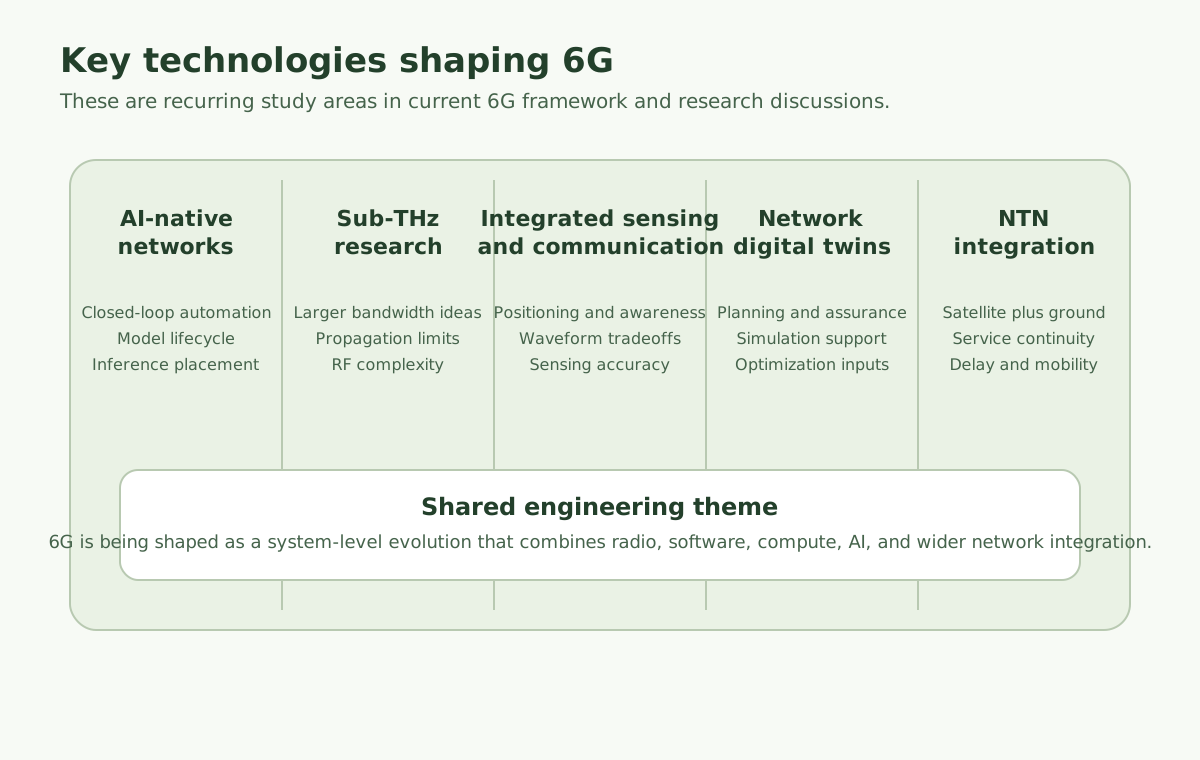
IMT-2030 is not a technology list by itself, but it points toward a set of directions that appear repeatedly in research, framework discussions, and early standards studies. These directions matter because they help explain how the framework might eventually be realized in real systems.
AI-native networks
AI-native networks are expected to use intelligence more deeply across optimization, control, and service support. The simple idea is that the network should adapt more effectively. The deeper technical question is how to manage data, model quality, inference placement, and trustworthy automation across a live telecom system.
Sub-THz spectrum
Higher-frequency research matters because it may provide access to larger bandwidths for selected use cases. But it also brings harder propagation conditions, blockage sensitivity, beamforming complexity, and difficult RF implementation constraints. This is why ITU-R has separately studied feasibility above 100 GHz.
Sensing integration
Sensing integration is important because the framework explicitly includes integrated sensing and communication as a usage scenario. That pushes the system discussion toward shared waveforms, positioning, detection, and environmental awareness rather than communication-only design.
Digital twins
Digital twins matter because more complex networks are harder to plan and optimize using static methods alone. A digital twin may help model network behavior, train AI systems, and test strategies before changes are pushed into real deployment.
NTN integration
Non-terrestrial networks are important because IMT-2030 puts strong emphasis on broader and more continuous connectivity. Satellite-terrestrial integration is one of the clearest ways to expand useful coverage, but it also introduces delay, mobility, timing, and service-continuity challenges.
Architecture vision
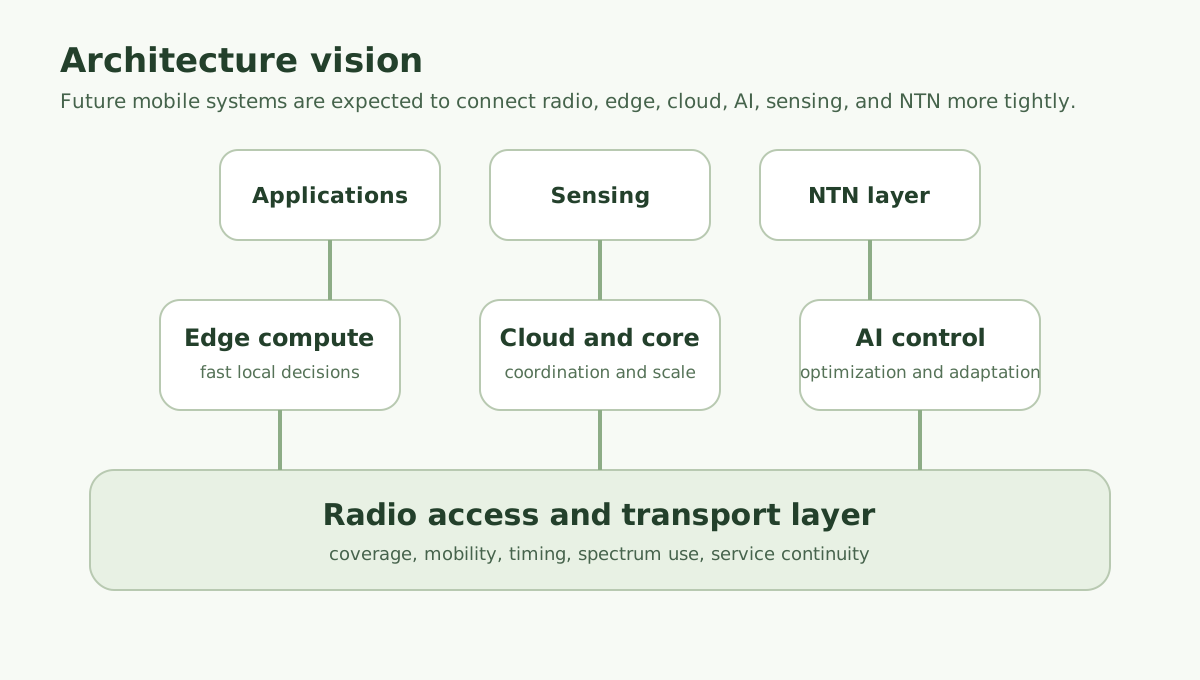
IMT-2030 does not define a frozen architecture diagram in the way a mature standards body eventually does. But the framework strongly implies a future system that is more distributed, more software-driven, more tightly linked with cloud and edge resources, and more capable of using intelligence throughout operation.
For general readers, the practical meaning is simple: future networks may work less like isolated mobile access islands and more like coordinated digital platforms that connect radio, compute, data, automation, and service control. For those working closer to networks, that implies stronger interaction between access, transport, edge compute, AI functions, orchestration, sensing support, and NTN layers.
This architecture direction matters because many future services depend on where decisions are made and where data is processed. A low-latency industrial control loop may require edge-local decisions. A city-scale digital twin may require broader data aggregation and model coordination. A resilient system may require control paths that can shift when part of the infrastructure is stressed.
Standardization ecosystem
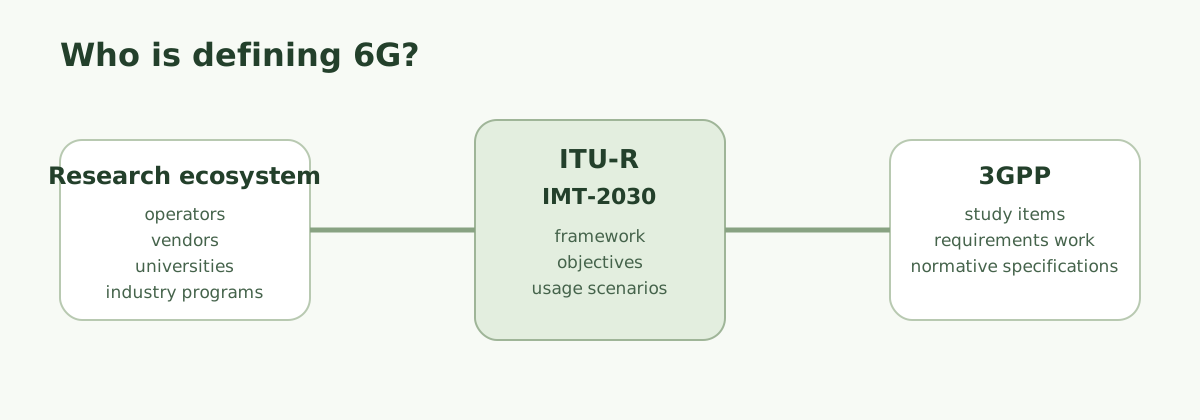
The role split is straightforward but important. ITU-R defines the framework, the high-level objectives, the usage scenarios, the capability direction, the evaluation process, and the broader IMT timeline. 3GPP is expected to translate that direction into detailed telecom specifications for candidate technologies as the work matures.
This interaction is how earlier generations were also handled. ITU-R provides the international IMT process and evaluation structure; standards organizations develop the detailed technical candidates that can fit into that process. That is why IMT-2030 and 3GPP Release work should not be treated as competing tracks. They are linked stages in a larger path.
As of April 8, 2026, 3GPP Release 20 is focused on 5G-Advanced and early 6G studies, while Release 21 is the official start of normative 6G work. That timing matters because it shows that the world is still moving from framework and study into the first serious specification phase, not skipping straight to deployment.
Timeline
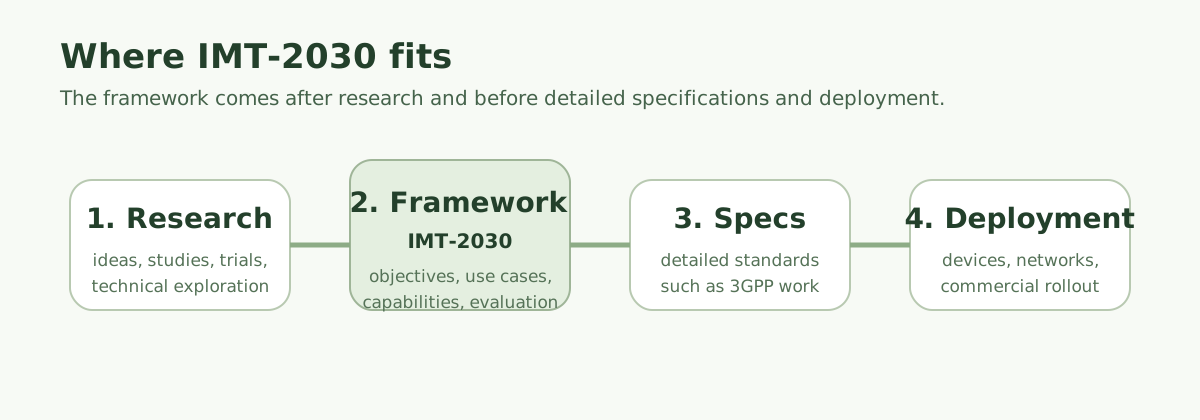
The IMT-2030 timeline is best understood as a staged process, not as a single launch date. The major phases are research, framework development, technical requirements and evaluation work, candidate technology submissions, detailed standards development, and then deployment.
A practical reading of the current timeline is this:
- 2022 to 2023: Future technology trends work and the IMT-2030 framework are established within ITU-R.
- 2024 to 2027: Technical performance requirements, evaluation guidance, and candidate process preparation continue.
- 2027 to 2029: ITU-R invites candidate radio interface technology submissions for the terrestrial IMT-2030 component.
- Late 2020s: 3GPP moves from Release 20 studies into Release 21 normative 6G work.
- Around 2030 and beyond: commercial deployment becomes possible if standards, spectrum, devices, and business conditions align.
This staged view is more useful than asking for a single 6G start date. A framework can be complete years before interoperable systems arrive, and candidate technologies can exist long before operators are ready to build business cases around them.
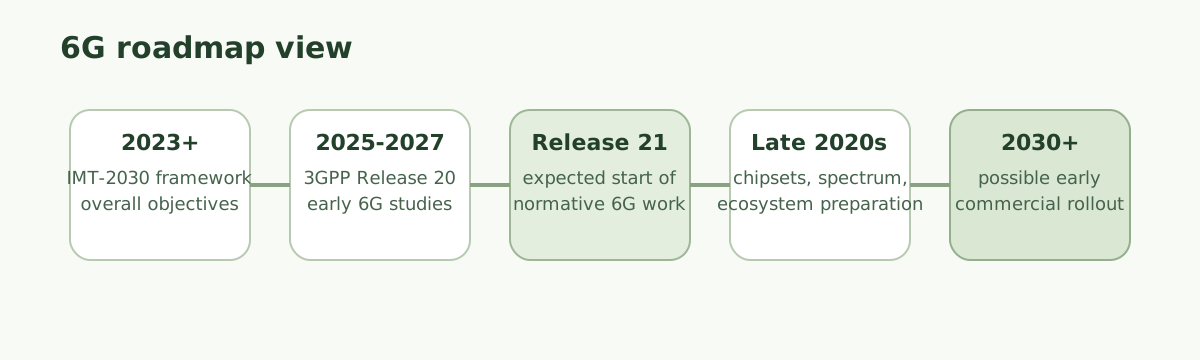
Suggested visual: A timeline from research to framework to requirements to standardization to deployment.
Challenges
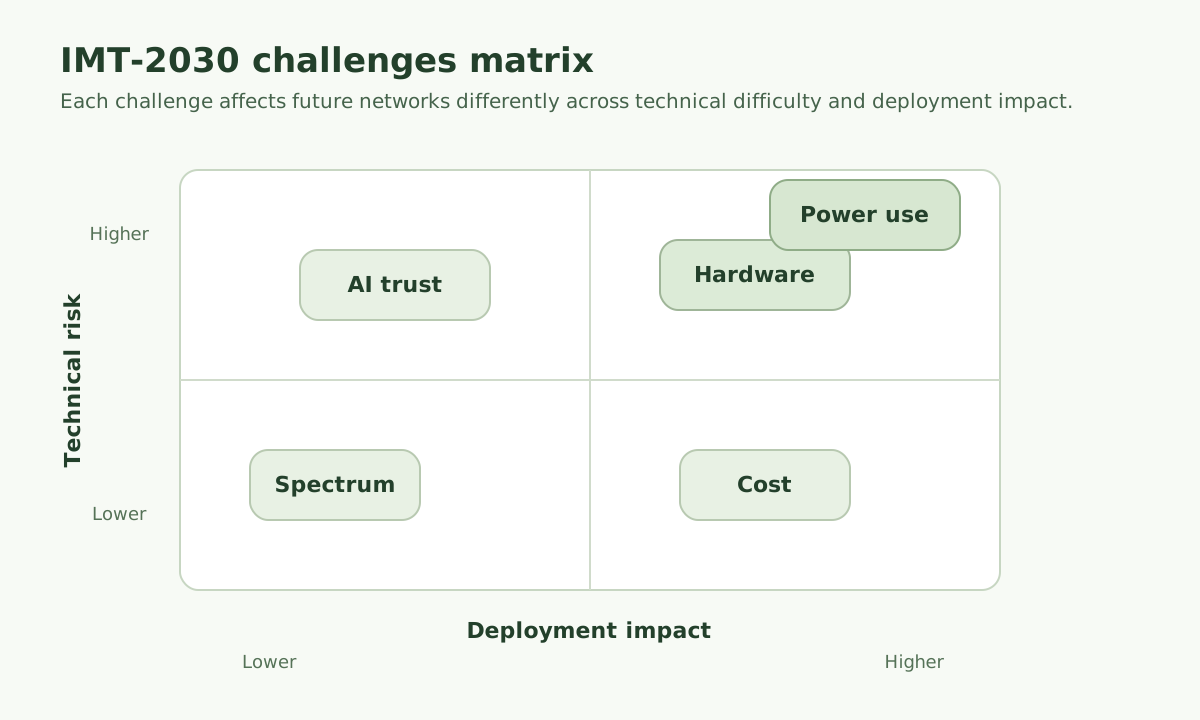
The value of IMT-2030 is that it sets direction, but direction alone does not guarantee deployable systems. Several practical challenges shape whether the framework can be translated into real networks at scale.
Power consumption
Many future capabilities depend on more complex radios, denser compute, and larger AI workloads. That can make energy efficiency harder, not easier, unless gains are designed into the system from the start.
Hardware complexity
Higher frequencies, tighter integration, and advanced antenna techniques push hardware design further. That affects cost, size, thermal behavior, and deployment practicality.
AI trust
AI can help automate operations, but it also raises questions about explainability, control, data quality, and what happens when automated decisions are wrong in a live network.
Cost
Even if a capability is technically attractive, operators still need a business case. A framework that points toward richer services must still be backed by economically realistic deployment models.
Spectrum
Many 6G discussions rely on future spectrum decisions that are not yet settled globally. Harmonization, coexistence, and practical deployment feasibility all affect whether ambitious targets can be realized.
| Challenge | Practical example |
|---|---|
| Power consumption | High-bandwidth radios and AI processing can raise site energy use if efficiency does not improve fast enough. |
| Hardware | Sub-THz research may look attractive on paper but remain difficult to scale across commercial hardware. |
| AI trust | Closed-loop optimization is useful only if operators can trust its decisions and recover from errors. |
| Cost | Operators may delay rollout if benefits do not justify infrastructure and device investment. |
| Spectrum | Without aligned spectrum policy, global interoperability and ecosystem scale become harder. |
What to watch next
Watchlist
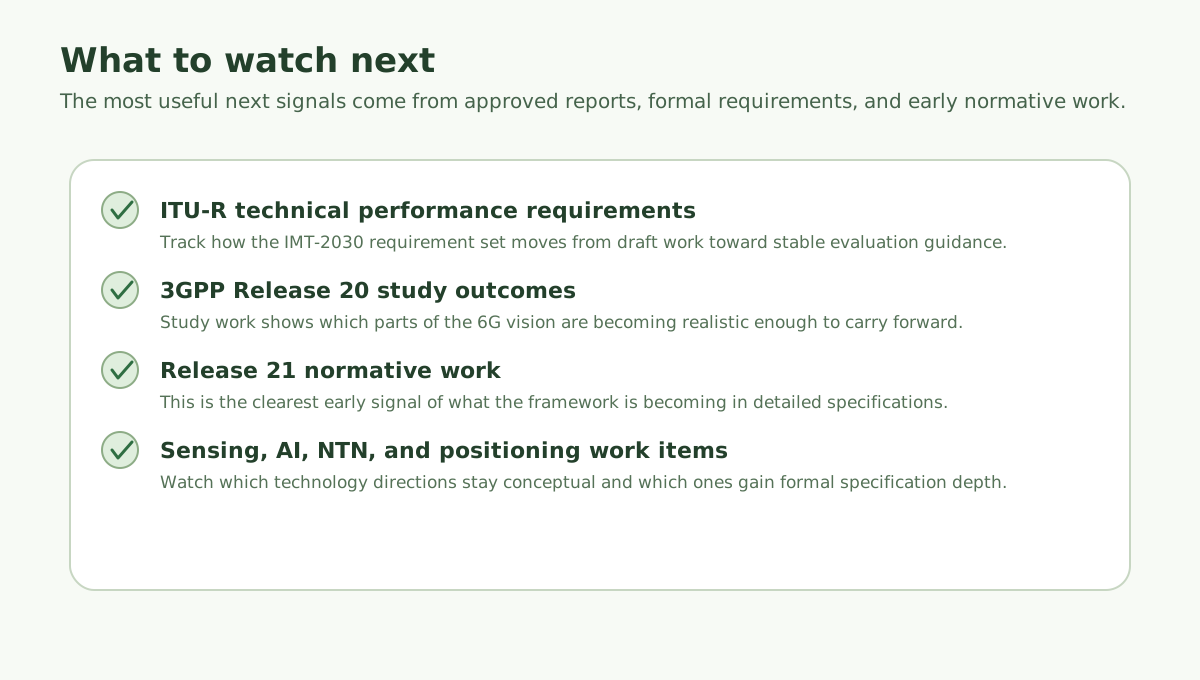
- Progress on the ITU-R IMT-2030 evaluation and submission reports.
- The status of the draft IMT-2030 technical performance requirements completed by WP 5D in February 2026.
- How 3GPP Release 20 studies narrow the design space for future 6G work.
- How Release 21 turns framework ideas into normative specification work.
- Whether sensing, positioning, AI integration, and NTN ideas remain framework concepts or become concrete work items.
- How sustainability and resilience targets are reflected in real technology choices rather than only in high-level messaging.
The most useful signals tend to be the conservative ones: new framework texts, approved reports, formal requirement updates, and the first detailed work items that show which parts of the vision are becoming standardizable.
Key takeaways
- IMT-2030 is the ITU-R framework for the next generation of mobile systems beyond the 5G era.
- It is a framework, not a final telecom standard or protocol definition.
- It expands the discussion beyond classic communication KPIs into sensing, AI integration, positioning, sustainability, and broader coverage.
- The six IMT-2030 usage scenarios connect the framework to practical future service needs.
- ITU-R defines the framework and evaluation path, while 3GPP is expected to develop detailed specifications later.
- Release 20 is focused on early 6G studies, and Release 21 is the official start of normative 6G work.
- The 2030 timeframe is best understood as a process window, not as a guaranteed single launch date.
FAQ
What is IMT-2030?
IMT-2030 is the global framework defined by ITU-R for mobile telecommunications around 2030 and beyond. It is widely treated as the framework stage for 6G.
Is IMT-2030 a standard?
It is a framework, not a complete end-to-end implementation standard. It defines direction, capabilities, usage scenarios, and evaluation structure rather than final protocol details.
How is IMT-2030 different from 5G?
IMT-2030 extends beyond the IMT-2020 framework used for 5G by adding new usage scenarios and capability areas such as sensing, AI integration, improved positioning, stronger coverage thinking, sustainability, and resilience.
When will 6G be available?
Many roadmaps align 6G with the 2030 timeframe, but exact timing depends on formal requirements, standards work, spectrum decisions, devices, and operator rollout economics.
Who defines IMT-2030?
ITU-R defines the IMT-2030 framework and evaluation path. Detailed future telecom specifications are expected to come from standards bodies such as 3GPP.
References
- ITU-R IMT-2030 overview page
- Recommendation ITU-R M.2160: Framework and overall objectives of the future development of IMT for 2030 and beyond
- ITU press release on IMT-2030 framework approval
- Recommendation ITU-R M.2083: IMT vision for 2020 and beyond
- 3GPP Release 20
- 3GPP Rel-20 planning and progress in TSG SA
- 3GPP release portal