6G vs 5G
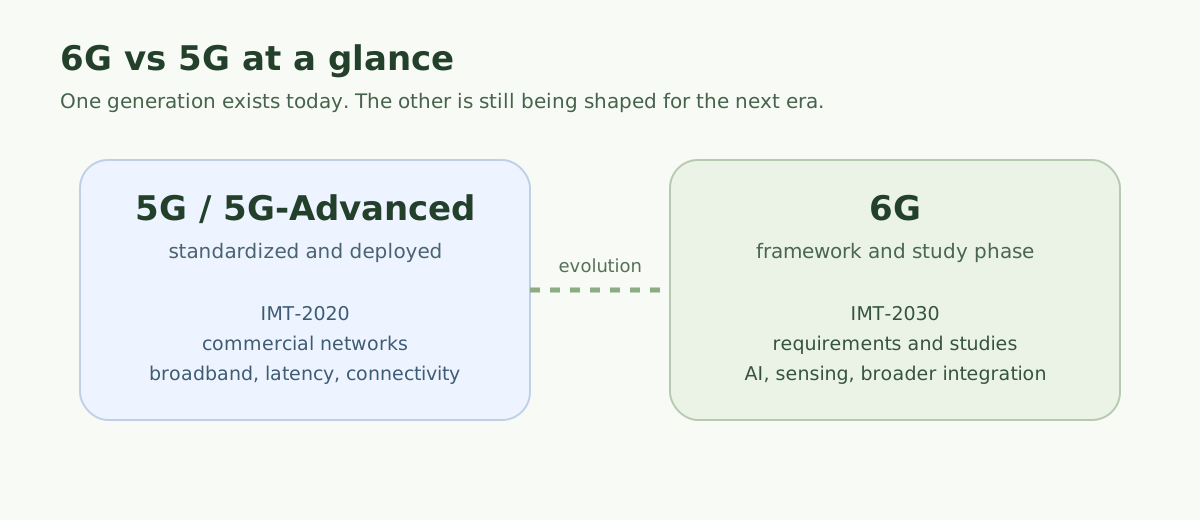
5G is the current deployed generation of mobile networks. It is standardized, commercial, and already used worldwide for broadband, low-latency services, private networks, and many industrial and consumer applications.
6G, by contrast, is still being shaped through the IMT-2030 framework, research programs, technical requirements work, and early standards studies. So this is not a comparison between two fully deployed systems. It is a comparison between one generation that exists today and one that is expected to build on it in the next decade.
This matters because many public discussions oversimplify the difference. 6G is not just “faster 5G,” and 5G is not standing still. The more accurate picture is that 5G, especially 5G-Advanced, is still evolving, while 6G is being framed around broader goals such as AI-native operation, sensing, sustainability, resilience, and wider connectivity. For the wider context, start with What is 6G?. For the formal framework behind future 6G work, use IMT-2030 Explained.
Quick facts
| 5G status | Standardized and commercially deployed under the IMT-2020 framework |
|---|---|
| 6G status | Still in framework, requirements, and early study phase under IMT-2030 |
| Bridge period | 5G-Advanced is the practical bridge between today’s 5G deployments and future 6G work |
| Big picture | 5G is a real network generation; 6G is a developing direction that is expected to build on it |
| Core difference | 6G discussions place more emphasis on AI, sensing, broader coverage, and deeper system integration |
Contents
6G vs 5G in simple terms
- 5G is real, standardized, and deployed now; 6G is still being developed.
- 5G focuses on broadband, low latency, and large-scale connectivity; 6G is expected to add stronger AI, sensing, and broader system integration.
- 5G mainly uses sub-6 GHz and mmWave; 6G research also studies higher frequencies such as sub-THz bands.
- In 5G, AI is mostly used to optimize the network; in 6G, AI is expected to be built more deeply into the system design.
- 5G is already supporting commercial services; 6G is still at the framework, requirement, and study stage.
- 6G is expected to build on 5G and coexist with it, not appear as an instant replacement.
Evolution from 5G to 6G
6G is best understood as an extension of the mobile path that 5G started. 5G introduced a more flexible radio system, lower latency compared with LTE, broader support for industrial and machine communication, and a stronger shift toward cloud-native networking in the core. It also widened the role of mobile networks beyond human-centric broadband.
Even so, 5G still has practical limits. Coverage quality can vary heavily by market and spectrum layer. mmWave offers impressive performance but is difficult to scale widely. AI is increasingly used, but mostly as an optimization tool rather than as a native system function. Sensing is not a core mainstream capability of deployed 5G systems. These gaps help explain why a new framework is being discussed.
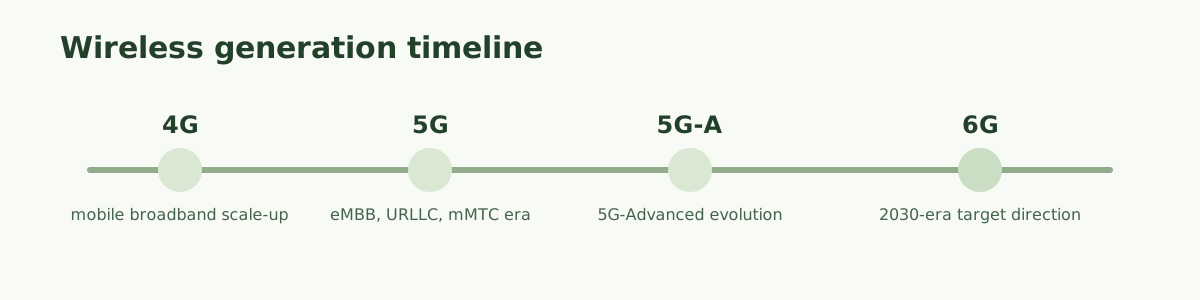
5G-Advanced is the bridge between the two. It extends 5G with stronger automation, better positioning support, more mature cloud-native behavior, and a clearer path toward AI assistance, NTN support, and richer service coordination. That is why it makes more sense to think in terms of 5G -> 5G-Advanced -> 6G than to imagine a hard cutover.
Key differences
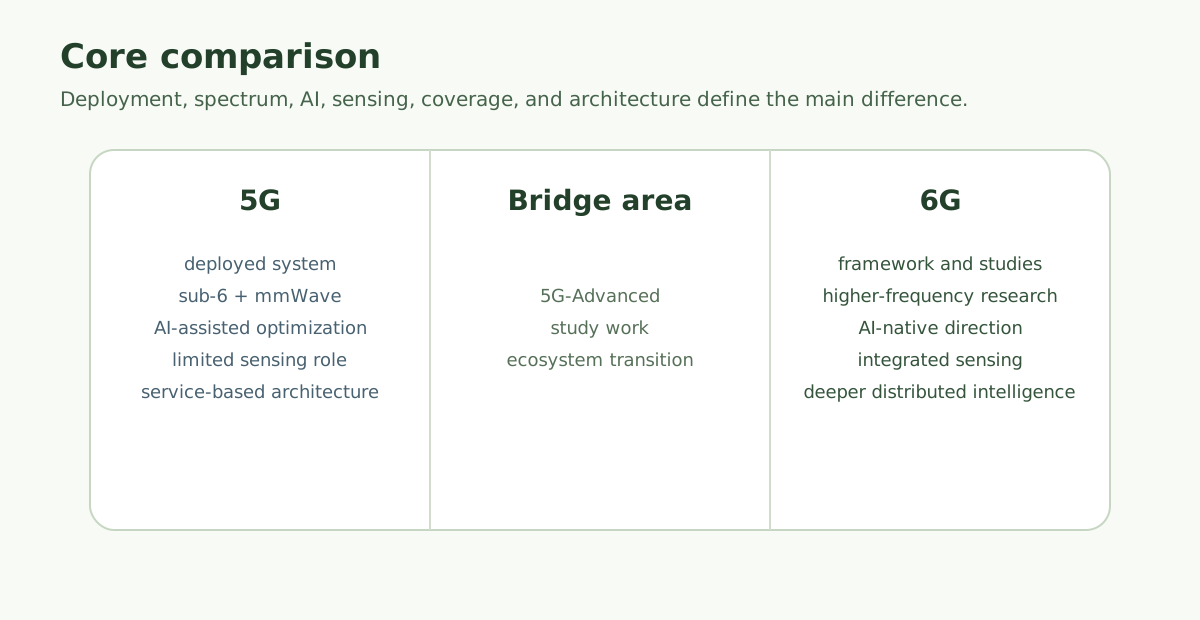
The table below is the most practical way to compare 6G and 5G. Some rows compare mature 5G capabilities with future 6G expectations, so the right-hand side should be read as a framework direction or study direction, not as a finished product specification.
| Area | 5G / 5G-Advanced | 6G direction |
|---|---|---|
| Framework | IMT-2020 | IMT-2030 |
| Deployment status | Standardized and commercially deployed since 2019 | Still in framework, requirements, and early study phase |
| Data rates | Peak data rate up to 20 Gbit/s in the IMT-2020 framework | Expected to exceed IMT-2020, with research visions sometimes discussing much higher rates in selected scenarios |
| Latency | Supports low-latency services, especially in advanced deployment cases | Expected to push lower and more deterministic behavior for richer interactive and control scenarios |
| Reliability | Strong reliability support, especially for URLLC-style services | Expected to extend toward more demanding hyper-reliable low-latency use cases |
| Spectrum | Sub-6 GHz and mmWave are the main practical layers | Research includes those layers plus sub-THz and above-100 GHz study work |
| AI integration | AI is mostly used as an optimization and operations aid | AI-native design is being studied as a deeper architectural principle |
| Sensing | Limited and not central to mainstream deployments | Integrated sensing and communication is a named IMT-2030 usage scenario |
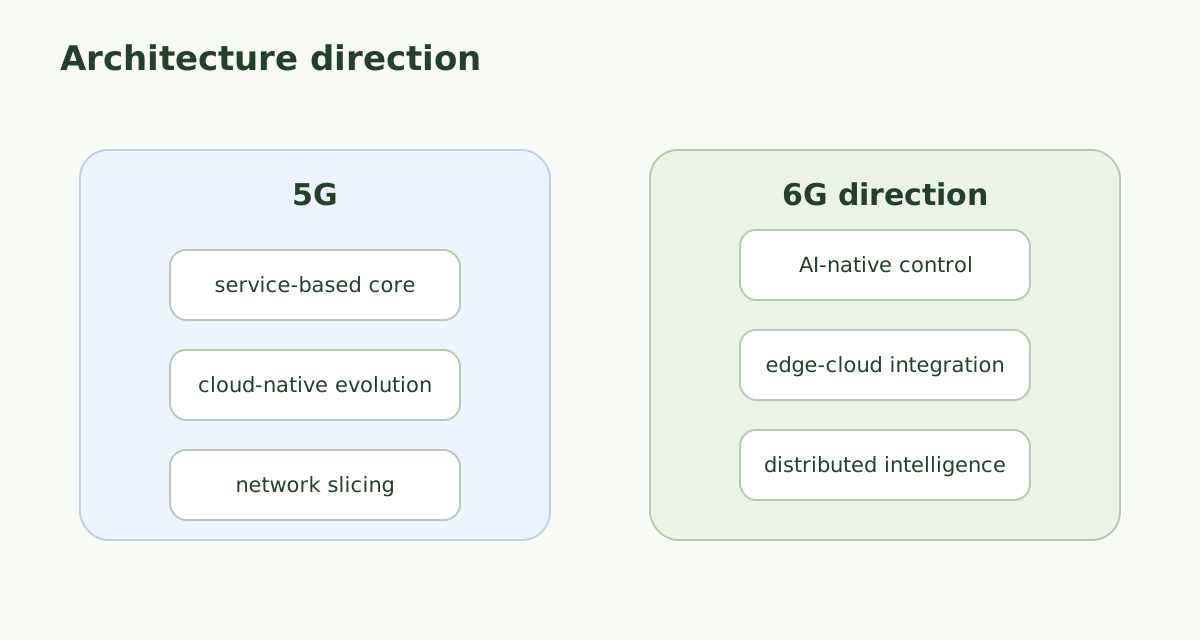
| Architecture | Cloud-native evolution, service-based core, slicing, distributed RAN | Expected to add stronger AI-native control, deeper edge-cloud coordination, and broader distributed intelligence |
| Coverage model | Mainly terrestrial, with NTN support growing | Broader terrestrial and non-terrestrial integration is a more central objective |
| Energy efficiency | Important but often deployment-specific in practice | Sustainability is elevated as a more explicit framework objective |
Architecture differences
5G already moved mobile systems toward a more software-driven model. The 5G Core introduced a service-based architecture, which means core functions interact through standardized service interfaces instead of older tightly coupled node models. 5G also expanded cloud-native thinking and made network slicing a core architectural idea for separating different service needs over a common infrastructure.
6G is expected to build on that foundation rather than discard it. The difference is in emphasis. The current 6G vision includes more distributed intelligence, tighter cloud-edge coordination, stronger intent-driven automation, and system behavior that may depend more deeply on AI, data, context, and sensing support. In simple terms, 5G modernized mobile architecture; 6G is expected to push it toward a more adaptive and aware system.
AI: 5G vs 6G
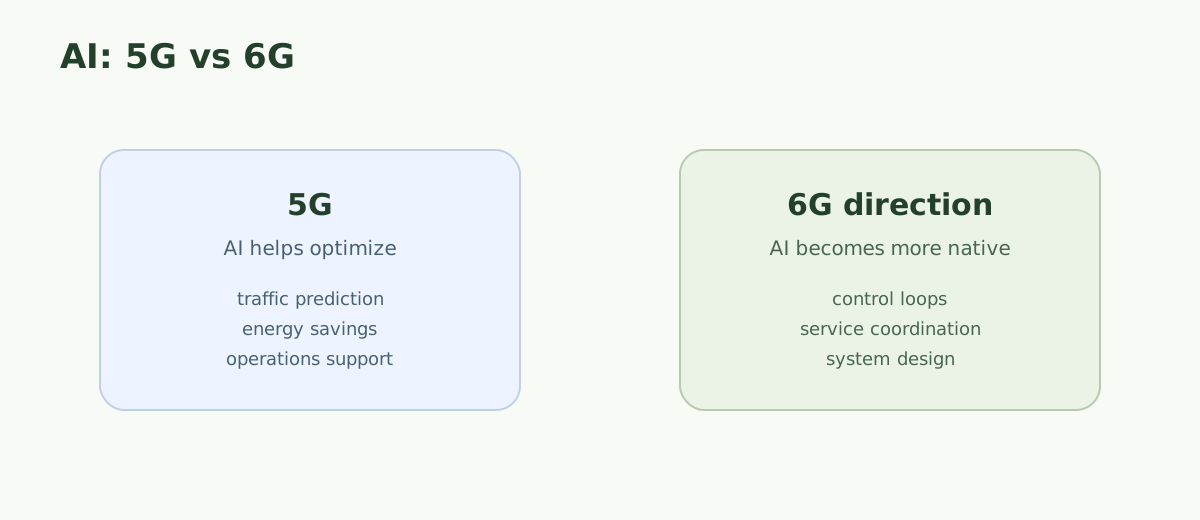
In 5G, AI is mainly used to optimize the network. It can help with traffic prediction, energy savings, radio optimization, alarm handling, and operations support. That is useful, but it usually means AI is added to the system as an improvement layer.
In 6G, the vision goes further. AI is expected to be part of the system design itself. That is why people use the term AI-native networks. The idea is not simply that AI tools are used more often, but that network behavior, control loops, optimization, and service support may be designed from the beginning with AI in mind.
This matters because it changes how the network may be built and operated. It affects data collection, trust, model lifecycle management, inference placement, and the boundary between communication and compute.
Spectrum and PHY differences
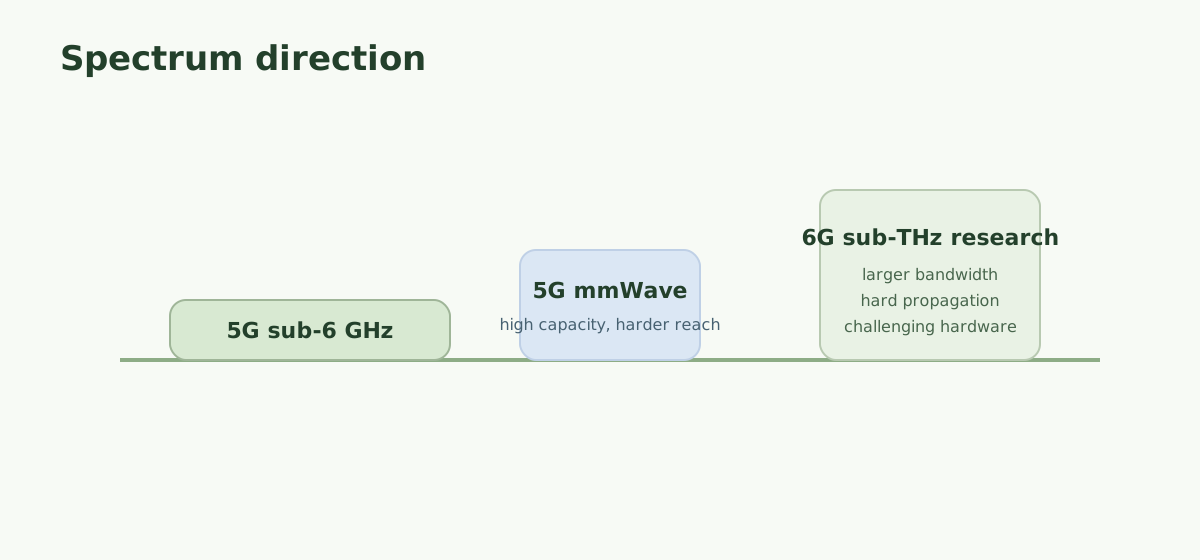
5G is built mainly around two spectrum directions: sub-6 GHz for wider practical coverage and mmWave for very high capacity in selected dense deployments. These layers already involve major tradeoffs between coverage, capacity, device cost, propagation, and site density.
6G is expected to keep learning from those layers, but research also expands into higher-frequency territory, especially sub-THz and above-100 GHz study work. That matters because larger bandwidths may become available, but propagation gets harder, blockage becomes more severe, hardware complexity rises, and practical deployment becomes more demanding.
This is why spectrum comparisons between 5G and 6G should never be reduced to “higher frequency equals better.” The real question is where higher frequencies are usable, affordable, and energy-efficient enough to support actual services.
Use case differences
The most useful way to compare 6G and 5G is by asking what each generation is expected to support in the real world. 5G already enables many important services. 6G may extend those services into richer, more integrated, and more autonomous forms rather than replacing them with completely unrelated ones.
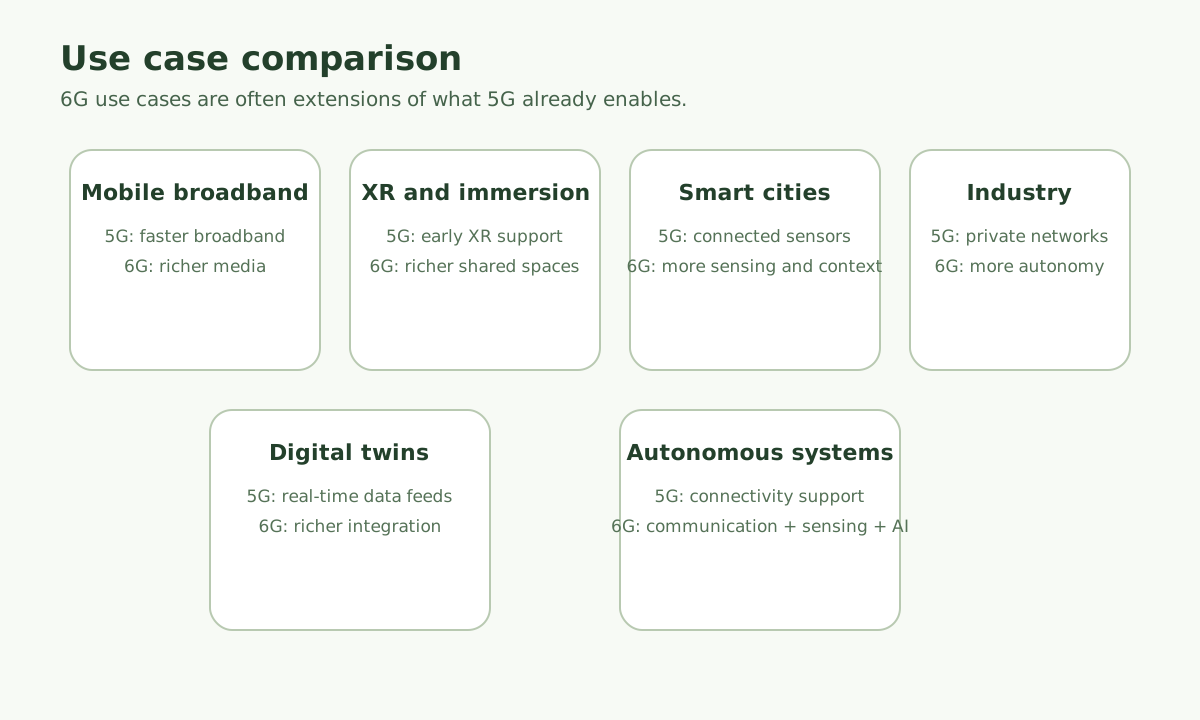
Mobile broadband
5G: Delivers higher mobile broadband capacity, better video performance, and improved fixed wireless access.
6G may add: Higher and more stable throughput for richer interactive media and more compute-linked applications.
XR and immersive communication
5G: Supports many early XR and cloud-assisted experiences, though quality can depend heavily on coverage, uplink, and edge support.
6G may add: Richer shared environments, stronger uplink support, lower latency variation, and more natural immersive collaboration.
Smart cities
5G: Supports connected sensors, smart lighting, surveillance, and traffic data collection.
6G may add: More tightly coordinated infrastructure with stronger positioning, sensing, and real-time system awareness.
Industrial automation
5G: Enables private networks, factory connectivity, and low-latency control in selected environments.
6G may add: More adaptive and autonomous industrial coordination with stronger sensing, tighter timing, and deeper local intelligence.
Digital twins
5G: Supports telemetry collection and real-time updates for digital models.
6G may add: Richer twin behavior through better sensing integration, positioning, AI support, and large-scale coordination.
Autonomous systems
5G: Supports connected vehicles, robotics, and remote monitoring where communication quality is strong enough.
6G may add: Broader support for context-aware and cooperative systems that depend on communication plus sensing plus intelligence together.
Performance expectations
Performance comparisons are often where the most hype appears, so this section needs careful wording. In the IMT-2020 framework, 5G peak data rate is specified at 20 Gbit/s in ideal conditions. That number is real in standards terms, but it is not the same thing as everyday user speed on a live network.
In the 6G discussion, research literature and future-technology reports often talk about much higher rates, and Tbps-level ideas are sometimes mentioned in selected scenarios. The important point is that these are research visions or forward-looking targets, not finalized commercial guarantees. Real-world performance will still be shaped by spectrum, propagation, deployment density, device capability, scheduling, load, and service design.
So the most honest summary is this: 5G already has defined theoretical targets and real deployment experience. 6G is expected to exceed 5G in several performance areas, but its most extreme figures still belong to the study and vision space rather than everyday network reality.
Standardization differences
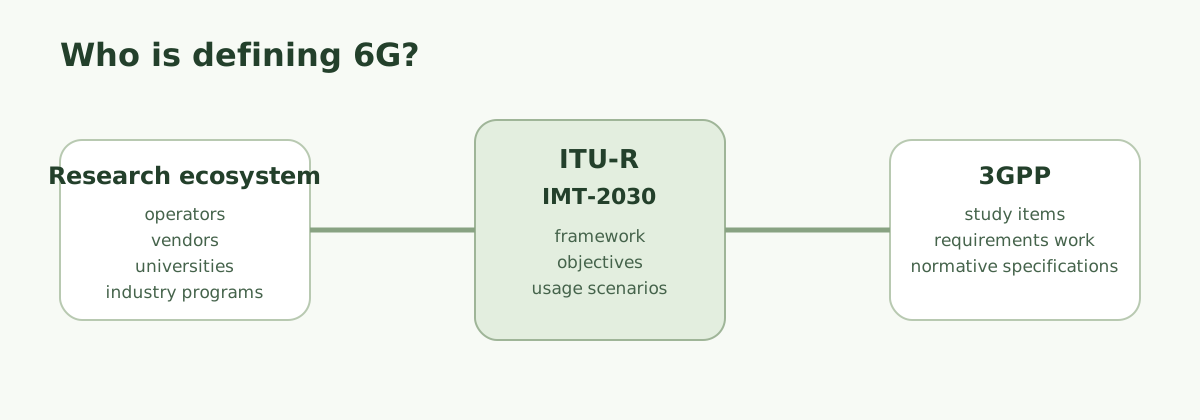
5G is anchored by IMT-2020 at the ITU-R level and by 3GPP Releases 15 through 18 for the main wave of specifications and evolution. Release 18 is the formal start of 5G-Advanced, and Release 19 continues that evolution.
6G is anchored by IMT-2030 at the framework level. That framework defines usage scenarios, capabilities, and the broader vision, but it is not yet the same thing as a deployable specification set. On the 3GPP side, Release 20 includes early 6G studies, while Release 21 is the official start of normative 6G work. That is the clearest current difference: 5G is mature enough to deploy globally; 6G is still progressing from framework into detailed specification work.
Timeline
5G commercial deployment began in 2019 and has continued expanding since then. 5G-Advanced became the formal evolution stage around Release 18, placing much of the 2024 to 2026 period in a practical transition era for networks, devices, and platform capabilities. 6G is widely aligned with the 2030 timeframe, but that should be understood as a process window rather than a guaranteed switch-on date.
In practical terms:
- 2019 onward: 5G commercial deployment begins and expands globally.
- 2024 to 2026: 5G-Advanced grows as the bridge period.
- 2025 to 2027: early 6G studies mature alongside IMT-2030 requirement work.
- Late 2020s: Release 21 normative work and ecosystem preparation become central.
- Around 2030 and beyond: early 6G deployment becomes possible if standards, hardware, and spectrum align.
Challenges
5G and 6G both face difficult tradeoffs, but the nature of those tradeoffs is different because one generation is already deployed and the other is still being defined.
| Generation | Main challenge | Why it matters |
|---|---|---|
| 5G | Deployment cost | Dense radio layers, transport, and modernization costs can slow rollout and create uneven user experience between markets. |
| 5G | Deployment complexity | Standalone migration, slicing, private networks, and cloud-native transformation all add operational complexity. |
| 6G | Energy consumption | Higher-frequency radios, AI workloads, and broader coordination can push power demand upward if efficiency does not improve enough. |
| 6G | Hardware difficulty | Sub-THz and advanced integrated systems are much harder to build, scale, and cool. |
| 6G | AI trust | AI-native networks require trustworthy automation, good data, explainable behavior, and clear control boundaries. |
| 6G | Spectrum and policy | Future deployment depends on globally practical spectrum decisions, not just technical ambition. |
Should you care?
For most users today, 5G is the important generation because it affects current coverage, speed, device support, and service quality. 6G matters more as a direction of travel. It tells industries, governments, vendors, and researchers where wireless systems may head next.
If you are a journalist, the main reason to care is accuracy: not every 6G claim describes a real product. If you are a student, this comparison shows how generations evolve through frameworks and studies before they become everyday networks. If you work in telecom or connected industries, this comparison helps separate what is deployable now from what is still being studied for the next era.
What to watch next
Watchlist
- How far 5G-Advanced extends today’s 5G architecture before 6G work takes over.
- How IMT-2030 requirements evolve and which capability areas gain the most weight.
- Which Release 20 studies become Release 21 normative items.
- Whether sensing, AI-native control, NTN integration, and high-frequency work become concrete implementation paths.
- How power efficiency, hardware realism, and business case discussions shape the final 6G pace.
Key takeaways
- 5G is a deployed generation under IMT-2020; 6G is a developing framework and study path under IMT-2030.
- 6G is expected to build on 5G and coexist with it rather than appear as an instant replacement.
- The biggest differences are not only in speed, but also in AI integration, sensing, wider connectivity, and system architecture.
- 5G mainly uses sub-6 GHz and mmWave, while 6G research also studies sub-THz and above-100 GHz feasibility.
- 5G uses AI mostly as an optimization tool; 6G is expected to push toward AI-native system behavior.
- 5G already has defined theoretical targets and commercial deployment experience; 6G still has many evolving targets and open questions.
- The most realistic timeline places 6G around 2030 and beyond, subject to standards, spectrum, and ecosystem readiness.
FAQ
What is the difference between 5G and 6G?
5G is a deployed and standardized mobile system. 6G is still under development and is expected to extend 5G with stronger AI integration, sensing, broader coverage thinking, and deeper system coordination.
Is 6G available now?
No. 6G is not available as a finalized commercial mobile standard today. Current work is focused on framework definition, requirements, and early standards studies.
Will 6G replace 5G?
6G is expected to build on 5G and coexist with it for years. In practice, mobile generations overlap rather than changing all at once.
How fast will 6G be?
Research visions often discuss much higher rates than 5G and sometimes mention Tbps-level ideas in selected scenarios, but those figures are not finalized commercial guarantees.
When will 6G launch?
Many roadmaps align 6G with the 2030 timeframe, but rollout depends on standards maturity, spectrum, hardware, devices, and operator investment decisions.
References
- Recommendation ITU-R M.2083: IMT vision for 2020 and beyond
- Recommendation ITU-R M.2160: Framework and overall objectives of the future development of IMT for 2030 and beyond
- ITU-R IMT-2030 overview and updates
- ITU-R M.2516: Future technology trends of terrestrial IMT systems towards 2030 and beyond
- 3GPP Release 20
- 3GPP releases portal