Telecom engineering reference for protocols, messages, call flows, troubleshooting, releases, and tools.
Menu
LTE RRCLTEUE -> eNodeB3GPP TS 36.331
LTE - SecurityModeFailure
Uplink LTE RRC message sent by the UE when it cannot continue with the received SecurityModeCommand.
Message Fact Sheet
Protocol
lte-rrc
Network
lte
Spec
3GPP TS 36.331
Spec Section
5.3.10, 6.2.2
Direction
UE -> eNodeB
Message Type
Security Control
Full message name
LTE - SecurityModeFailure
Protocol
LTE-RRC
Technology
LTE
Direction
UE -> eNodeB
Interface
Uu
Signaling bearer / channel
SRB1 / UL-DCCH
Typical trigger
The UE receives SecurityModeCommand but cannot continue with the selected security configuration or related context.
Main purpose
Reports that LTE AS security activation could not be completed successfully, so the security step and later dedicated signaling cannot continue normally.
Main specification
3GPP TS 36.331, 5.3.10, 6.2.2
Release added
Release 8
Procedures where used
RRC Connection Establishment, AS Security Activation Failure
Related timers
Correlate with the surrounding access and security sequence rather than a message-specific timer
Related cause values
The message itself indicates failure of the security activation step
What is SecurityModeFailure in simple terms?
Uplink LTE RRC message sent by the UE when it cannot continue with the received SecurityModeCommand.
Reports that LTE AS security activation could not be completed successfully, so the security step and later dedicated signaling cannot continue normally.
Why this message matters
SecurityModeFailure is the UE telling the eNodeB that LTE radio-layer security could not be activated successfully.
Where this message appears in the call flow
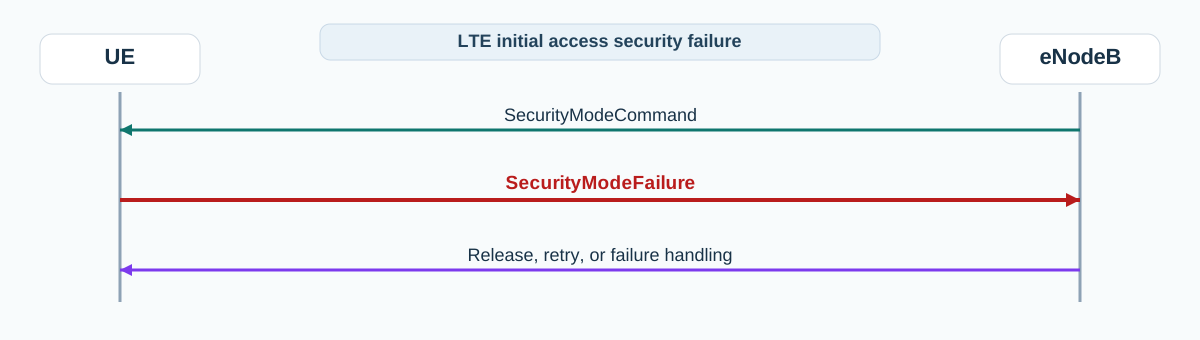
LTE initial access
In the initial access path, SecurityModeFailure shows that the AS security step broke before protected dedicated signaling could continue.
Call flow position: Failure branch of the early AS security activation stage.
Typical state: UE is connected on SRB1 but cannot continue from the received SecurityModeCommand into protected dedicated signaling.
Preconditions:
SecurityModeCommand has been received.
The UE cannot complete the selected security activation step.
Next likely message: Release, retry, or failure handling
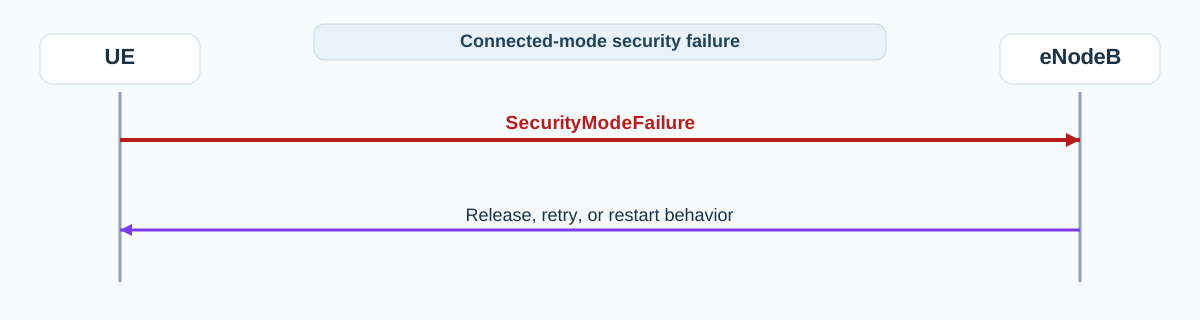
Connected-mode continuation
In connected-mode continuation, SecurityModeFailure marks the break point that prevents normal protected LTE RRC signaling.
Call flow position: Failure branch that prevents later protected LTE RRC signaling from continuing normally.
Typical state: UE is in connected mode but the security-control step cannot complete.
Preconditions:
SRB1 is active.
The received security configuration or context cannot be accepted.
Next likely message: Failure handling rather than normal protected continuation
Next message(s): Release, retry, or failure handling outside the normal success path
Message direction and transport
Sender and receiver: UE -> eNodeB
Interface: Uu
Domain: Access-side radio control
Signaling bearer: SRB1
Logical channel: UL-DCCH
Transport / encapsulation: RRC over DCCH on SRB1 as the failure branch of the LTE AS security activation step
Security context: This message appears when the intended security activation step cannot complete, so it marks a break in the expected protected-signaling path.
Message Structure Overview
SecurityModeFailure is the explicit failure branch for the LTE AS security activation procedure.
The practical value of the message is mostly in its timing and its correlation with the preceding SecurityModeCommand.
When this message appears, later protected LTE RRC signaling should not be assumed to continue normally.
The transaction identifier should match the SecurityModeCommand that triggered the failure.
The main practical meaning is that LTE AS security activation did not complete.
Move immediately into the preceding command and the following release or retry behavior.
Important Information Elements
IE
Required
Description
rrc-TransactionIdentifier
Yes
Transaction identifier matching the preceding SecurityModeCommand.
criticalExtensions
Yes
Versioned wrapper carrying the SecurityModeFailure payload.
nonCriticalExtension
Optional
Release-extension branch used for later additions.
Detailed field explanation
rrc-TransactionIdentifier
Transaction identifier matching the preceding SecurityModeCommand.
Presence: Required
In practice: In practice, compare this field with the original request and with any later release-dependent optional fields so you can see whether the network accepted the same service model the UE asked for.
criticalExtensions
Versioned wrapper carrying the SecurityModeFailure payload.
Presence: Required
In practice: In practice, compare this field with the original request and with any later release-dependent optional fields so you can see whether the network accepted the same service model the UE asked for.
nonCriticalExtension
Release-extension branch used for later additions.
Presence: Optional
In practice: In practice, compare this field with the original request and with any later release-dependent optional fields so you can see whether the network accepted the same service model the UE asked for.
What to check in logs and traces
Confirm the message follows SecurityModeCommand.
Verify the transaction identifier matches the command.
Check whether SecurityModeComplete is absent and whether failure handling follows.
Correlate the failure with UE capability, algorithm choice, and earlier security preparation.
Common Issues and Troubleshooting
SecurityModeFailure appears during access.
Likely cause: The UE could not continue with the selected security configuration or related context.
What to inspect: Check SecurityModeCommand, selected algorithms, UE security capabilities, and the earlier security preparation path.
Next step: Compare against a successful access trace and identify what differs before the failure.
The connection is released after security activation starts.
Likely cause: SecurityModeFailure may be the real turning point even if earlier setup looked normal.
What to inspect: Correlate the failure with the following release, retry, or restart behavior.
Next step: Treat this message as the main boundary between a healthy and failed control path.
Later dedicated signaling never becomes protected.
Likely cause: The security path failed before protected signaling could begin.
What to inspect: Check whether SecurityModeFailure replaced SecurityModeComplete in the sequence.
Next step: Validate the whole security branch before debugging later signaling assumptions.
LTE / 5G / Variant Comparison
Compared with SecurityModeComplete
SecurityModeComplete confirms successful AS security activation. SecurityModeFailure is the branch used when the UE cannot continue with the security step.
Compared with SecurityModeCommand
SecurityModeCommand starts the LTE AS security activation step. SecurityModeFailure reports that the UE could not finish it.
FAQ
What is SecurityModeFailure in LTE?
It is the uplink LTE RRC message the UE sends when it cannot continue with SecurityModeCommand.
What does SecurityModeFailure mean in a trace?
It means the LTE AS security activation step failed, so later protected dedicated signaling cannot continue normally.
What should I inspect first when SecurityModeFailure appears?
Start with the preceding SecurityModeCommand, the selected algorithms, UE capability support, and the following failure handling.
What comes after SecurityModeFailure?
Usually release, retry, or other failure-handling behavior rather than normal protected continuation.
Decode this message with the 3GPP Decoder, inspect the related message database, or open the matching call flow to see where this signaling step fits in the full procedure.