What does Authentication Request do in 5G?
It challenges the UE so the network can verify subscriber identity before allowing registration to continue.
| Protocol | nas | Network | 5g |
|---|---|---|---|
| Spec | 3GPP TS 24.501 | Spec Section | 8.2.1 |
| Direction | AMF to UE | Message Type | 5GMM signaling |
| Full message name | 5G NAS - Authentication Request |
|---|---|
| Protocol | NAS |
| Technology | 5G |
| Direction | AMF to UE |
| Interface | N1 |
| Signaling bearer / channel | NAS signaling / Dedicated NAS message, commonly transported via DL Information Transfer |
| Typical trigger | Sent after Registration Request or another 5GMM procedure when the network needs to authenticate the UE. |
| Main purpose | Carries the network authentication challenge and related security context so the UE can prove subscriber legitimacy. |
| Main specification | 3GPP TS 24.501, 8.2.1 |
| Release added | Release 15 |
| Procedures where used | 5G Initial Registration, Mobility Registration Update, 5G Authentication Procedure |
| Related timers | T3560 |
Authentication Request is the NAS message the AMF uses to challenge the UE and start the 5G primary authentication procedure.
Carries the network authentication challenge and related security context so the UE can prove subscriber legitimacy.
Authentication Request is the network challenging the UE to prove that it is a valid subscriber.
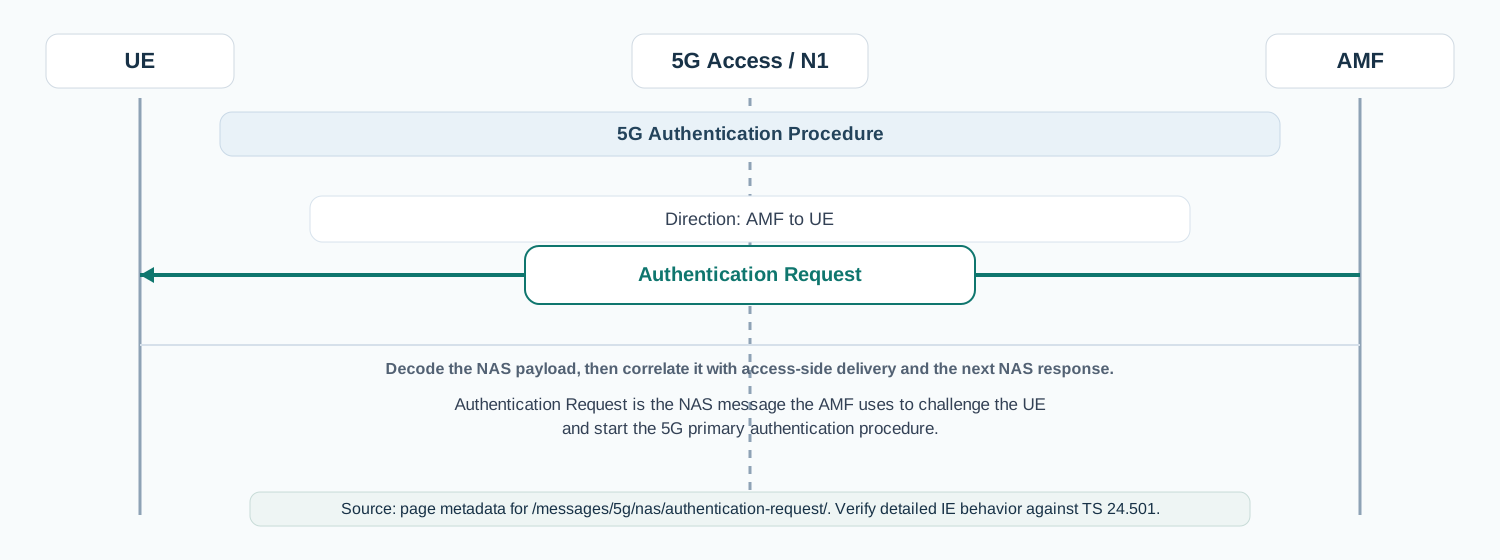
Call flow position: Network challenge message that starts the UE side of 5G primary authentication.
Typical state: UE is attempting to register or refresh 5GMM context and has not yet completed authentication.
Preconditions:
Next likely message: Authentication Response or Authentication Failure
Previous message(s): Registration Request, Identity Response
Next message(s): Authentication Response, Authentication Failure
Security context: Often sent before full NAS security is active, so the exact protection state depends on the authentication stage and available context.
This message is not typically analyzed as ASN.1 on the wire. It is usually read as a NAS or protocol field structure instead.
Authentication Request follows the NAS 24.501 IE structure and is not an ASN.1 message.
Authentication Request
  Extended Protocol Discriminator: 5G Mobility Management
  Security Header Type: Plain NAS
  Message Type: Authentication Request
  ngKSI: 3
  ABBA: 0x0000
  RAND: 9f76b5c4a102f6d1557a4f2cb9d0e841
  AUTN: 8d34fe2210ca7f118e4c22aa119b55f0
| IE | Presence | Description |
|---|---|---|
ngKSI | Mandatory | Identifies the NAS key set context associated with the authentication procedure. |
ABBA | Mandatory | Anti-bidding down between architectures parameter used in 5G authentication handling. |
Authentication parameter RAND | Mandatory | Random challenge value the UE uses to compute the authentication response. |
Authentication parameter AUTN | Mandatory | Authentication token that lets the UE verify the network and derive response values. |
EAP message | Optional | Present when the network is using EAP-based primary authentication rather than pure 5G AKA challenge handling. |
ngKSIIdentifies the NAS key set context associated with the authentication procedure.
Presence: Mandatory
In practice: In practice, compare this field with the original request and with any later release-dependent optional fields so you can see whether the network accepted the same service model the UE asked for.
ABBAAnti-bidding down between architectures parameter used in 5G authentication handling.
Presence: Mandatory
In practice: In practice, compare this field with the original request and with any later release-dependent optional fields so you can see whether the network accepted the same service model the UE asked for.
Authentication parameter RANDRandom challenge value the UE uses to compute the authentication response.
Presence: Mandatory
In practice: In practice, compare this field with the original request and with any later release-dependent optional fields so you can see whether the network accepted the same service model the UE asked for.
Authentication parameter AUTNAuthentication token that lets the UE verify the network and derive response values.
Presence: Mandatory
In practice: In practice, compare this field with the original request and with any later release-dependent optional fields so you can see whether the network accepted the same service model the UE asked for.
EAP messagePresent when the network is using EAP-based primary authentication rather than pure 5G AKA challenge handling.
Presence: Optional
In practice: If present, it reflects the external DN authentication result. It is worth checking when the session succeeds on NAS but service access still depends on an external authentication flow.
Likely cause: The UE may reject the challenge, fail lower-layer delivery, or be unable to verify AUTN.
What to inspect: Check RAND/AUTN values, UE logs, and whether any Authentication Failure follows.
Next step: Compare against a known-good authentication trace and verify subscriber credentials and time synchronization context.
It challenges the UE so the network can verify subscriber identity before allowing registration to continue.
Decode this message with the 3GPP Decoder, inspect the related message database, or open the matching call flow to see where this signaling step fits in the full procedure.