Who sends Deregistration Request (UE Originating)?
The UE sends it when it wants to deregister from the 5GS.
| Protocol | nas | Network | 5g |
|---|---|---|---|
| Spec | 3GPP TS 24.501 | Spec Section | 8.2.11 |
| Direction | UE to AMF | Message Type | 5GMM signaling |
| Full message name | 5G NAS - Deregistration Request (UE Originating) |
|---|---|
| Protocol | NAS |
| Technology | 5G |
| Direction | UE to AMF |
| Interface | N1 |
| Signaling bearer / channel | NAS signaling / Dedicated NAS message, often transported through UL Information Transfer |
| Typical trigger | UE power off handling, SIM change, user action, or explicit service logic requiring deregistration. |
| Main purpose | Lets the UE explicitly request deregistration so the network can release mobility-management reachability and related context. |
| Main specification | 3GPP TS 24.501, 8.2.11 |
| Release added | Release 15 |
| Procedures where used | UE-Originated Deregistration |
Deregistration Request (UE Originating) is the NAS message the UE sends when it wants to deregister from the 5GS.
Lets the UE explicitly request deregistration so the network can release mobility-management reachability and related context.
This is the UE asking to leave the 5G registered state.
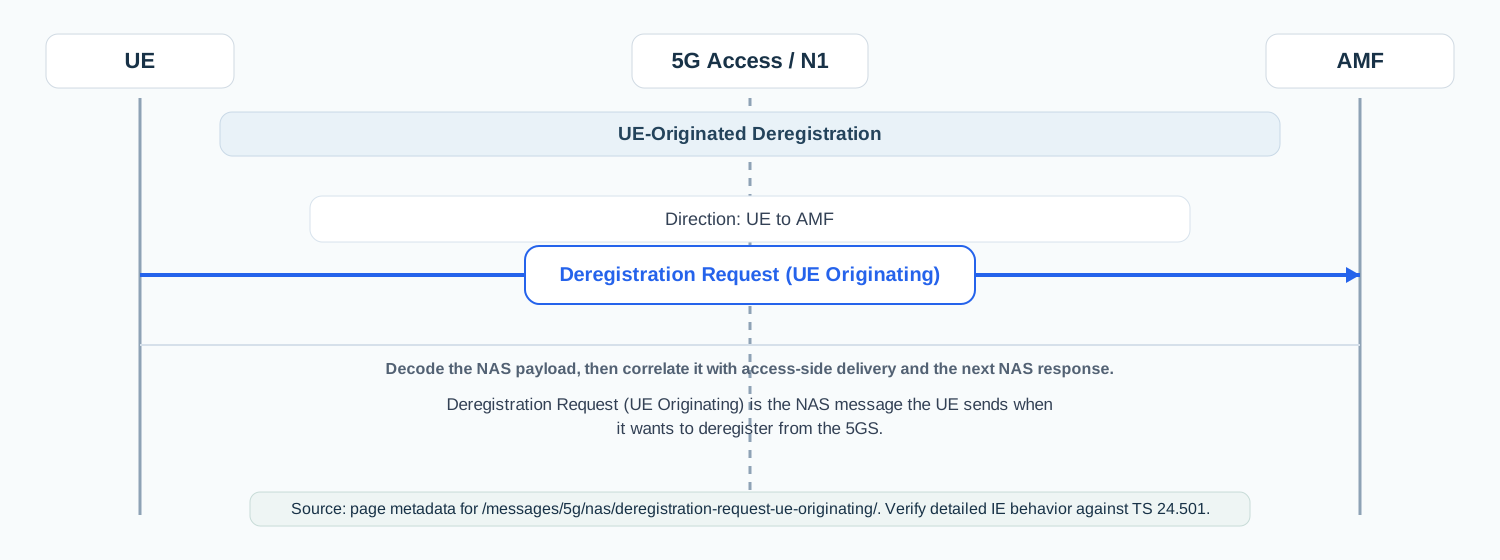
Call flow position: Opening NAS message when the UE chooses to leave registered 5GS state.
Typical state: UE is registered before the request and moves toward deregistered state.
Preconditions:
Next likely message: Deregistration Accept (UE Originating)
Previous message(s): Registered-state NAS signaling
Next message(s): Deregistration Accept (UE Originating), Deregistered state
Security context: Normally sent with valid NAS security because deregistration usually happens while the UE still has active registered context.
This message is not typically analyzed as ASN.1 on the wire. It is usually read as a NAS or protocol field structure instead.
Deregistration Request is a NAS 24.501 message, not an ASN.1-defined message.
Deregistration Request (UE Originating)
  Extended Protocol Discriminator: 5G Mobility Management
  Security Header Type: Integrity protected and ciphered
  Message Type: Deregistration Request (UE Originating)
  Deregistration Type: Switch off, 3GPP access
| IE | Presence | Description |
|---|---|---|
Deregistration type | Mandatory | Explains what kind of deregistration is being requested and what access context it applies to. |
5GMM cause | Optional | Optional cause context used in some scenarios. |
Deregistration typeExplains what kind of deregistration is being requested and what access context it applies to.
Presence: Mandatory
In practice: In practice, compare this field with the original request and with any later release-dependent optional fields so you can see whether the network accepted the same service model the UE asked for.
5GMM causeOptional cause context used in some scenarios.
Presence: Optional
In practice: In practice, compare this field with the original request and with any later release-dependent optional fields so you can see whether the network accepted the same service model the UE asked for.
Likely cause: The network may not have received or fully processed the request.
What to inspect: Check uplink transport, NAS integrity, and whether a deregistration accept followed.
Next step: Correlate later paging with AMF state and confirm whether deregistration really completed.
The UE sends it when it wants to deregister from the 5GS.
Decode this message with the 3GPP Decoder, inspect the related message database, or open the matching call flow to see where this signaling step fits in the full procedure.