5G Slice Authentication Procedure
5G Slice Authentication is the authorization side of slice handling, where the network decides whether a subscriber is really allowed to use a requested slice.
It is usually visible not as one isolated message, but as the combination of Requested NSSAI, subscription checks, and the final Allowed NSSAI outcome.
Introduction
This procedure is most useful when the UE requests a valid-looking slice but the network still does not return the expected result, or when registration seems fine but later service fails on slice-specific grounds.
The key challenge is separating true authorization failure from later service mismatch, because both can look like “slice not working” from the outside.
What Is Slice Authentication in Simple Terms?
- What starts the procedure: The UE requests a slice and the network must validate entitlement and policy.
- What the UE and network want to achieve: Return a slice result that matches both subscriber entitlement and serving-network constraints.
- What success looks like: The slice is authorized and later service can use it cleanly.
- What failure means: The slice is denied, remapped unexpectedly, or later service shows the authorization was not enough.
Why this procedure matters
Without clean slice authorization, the rest of the slice-aware service chain becomes noisy and hard to diagnose because registration and service failures blur together.
Quick Fact Sheet
| Procedure name | 5G Slice Authentication |
|---|---|
| Domain | Slice authorization and entitlement checks in 5G registration and service handling |
| Main trigger | The network must validate whether a subscriber is allowed to use a requested slice |
| Start state | UE has requested slice access and the network must evaluate entitlement and policy |
| End state | The requested slice is allowed, remapped, or effectively denied for the current context |
| Main nodes | UE, AMF, UDM / UDR, NSSF, SMF |
| Main protocols | NAS registration signaling, subscription retrieval, slice-selection support |
| Main success outcome | The subscriber is authorized for the intended slice and later service can continue cleanly |
| Main failure outcome | The slice is not authorized or later service reveals that entitlement and service intent do not align |
| Most important messages | Registration Request, Registration Accept, Requested NSSAI, Allowed NSSAI |
| Main specs | TS 23.501, TS 23.502, TS 24.501, TS 29.531 |
Preconditions
- The UE has requested one or more slices during registration or update handling.
- The network can retrieve subscriber entitlement and serving policy information.
- Slice-selection assistance and subscription data are available where the architecture uses them.
- Later service procedures can verify whether the slice was practically usable.
Nodes and Interfaces
Nodes involved
| Node | Role in this procedure |
|---|---|
| UE | Requests slice access and later attempts to use the resulting allowed slice context. |
| AMF | Coordinates registration and evaluates slice entitlement against serving-network policy and subscription data. |
| UDM / UDR | Provide the subscriber data that constrains which slices are permitted. |
| NSSF | Supports slice-selection assistance and AMF suitability decisions when used. |
| SMF | Later proves whether the authorized slice is compatible with the intended DNN and session behavior. |
Interfaces used
| Interface | Path | Role |
|---|---|---|
| N1 | UE <-> AMF | Carries the Requested NSSAI and final allowed slice outcome. |
| Subscription path | AMF <-> UDM / UDR | Provides entitlement data used for slice authorization. |
| N22 | AMF <-> NSSF | Supports slice-selection decisions when the deployment uses NSSF. |
| N11 | AMF <-> SMF | Later shows whether the selected slice can support requested session behavior. |
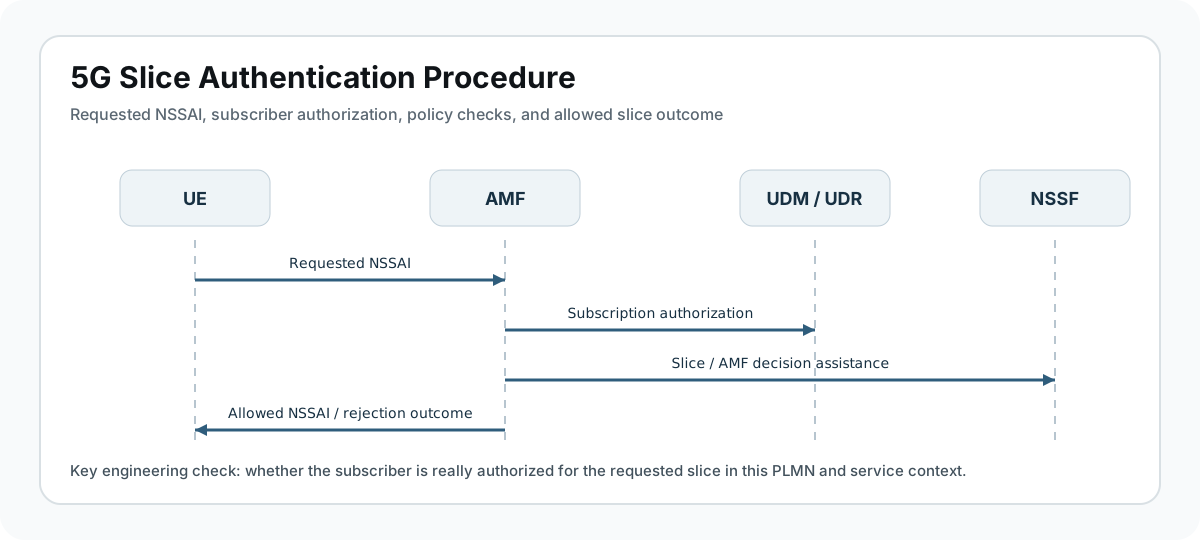
End-to-End Call Flow
UE                AMF              UDM / NSSF
|-- Registration Request (Requested NSSAI) ------->|
|                              |-- authz checks -->|
|                              |<-- authz result --|
|<-- Registration Accept (Allowed NSSAI) ---------|
|==== later service validates slice usability =====>|
Major Phases
| Phase | What happens |
|---|---|
| 1. Requested slice arrives | The UE asks to use one or more slices during registration or update handling. |
| 2. Authorization evaluation | The network checks subscription, roaming constraints, and serving policy. |
| 3. Allowed slice outcome | The network returns a slice result that reflects what is really permitted. |
| 4. Service confirmation | Later session procedures prove whether the authorized slice supports the intended service. |
Step-by-Step Breakdown
UE requests access to a slice
Sender -> receiver: UE -> AMF
Message(s): Registration Request with Requested NSSAI
Purpose: Start the slice-authorization decision using the UE’s requested service intent.
State or context change: The network now has to decide whether the subscriber can use the requested slice.
Note: Engineers often call this slice authentication even though the visible evidence is spread across registration and later service use.
The network validates subscription and policy
Sender -> receiver: AMF <-> UDM / UDR / NSSF
Message(s): Subscription retrieval, policy checks, and slice-selection assistance
Purpose: Confirm whether the requested slice is allowed in the current serving and subscriber context.
State or context change: The subscriber’s requested slice intent is reduced to a policy-approved result.
Note: This is where home entitlement, roaming restrictions, and local serving policy can diverge from what the UE expected.
Allowed slice information is returned
Sender -> receiver: AMF -> UE
Message(s): Registration Accept with Allowed NSSAI
Purpose: Provide the slice result the UE can actually use from this registration context onward.
State or context change: The UE now has the network-approved slice set for the current environment.
Note: Missing slices in Allowed NSSAI are often the clearest practical sign of failed authorization.
Later service requests confirm the practical result
Sender -> receiver: UE -> AMF / SMF
Message(s): PDU Session Establishment Request and later session handling
Purpose: Show whether the authorized slice can really support the intended service and DNN.
State or context change: The authorization decision turns into a real service outcome rather than only a registration result.
Note: If the slice looks valid in registration but service later fails, the issue may be entitlement-to-service mismatch rather than total authorization failure.
Important Messages in This Flow
| Message | Protocol | Direction | Purpose in this procedure | What to inspect briefly |
|---|---|---|---|---|
| Registration Request | NAS | UE -> AMF | Carries Requested NSSAI and starts slice-authorization handling. | Inspect the requested slice list and the broader registration context. |
| Registration Accept | NAS | AMF -> UE | Returns Allowed NSSAI and the effective authorization result. | Check which requested slices survived and which did not. |
| PDU Session Establishment Request | NAS | UE -> core | Later proves whether the authorized slice really supports the intended service. | Correlate the requested S-NSSAI here with the earlier Allowed NSSAI. |
Important Parameters to Inspect
| Parameter | What it is | Where it appears | Why it matters | Common issues |
|---|---|---|---|---|
| Requested S-NSSAI | The slice the UE wants to use. | Registration Request | This is the starting authorization input. | If it is wrong or stale, the network may appear to reject a slice the UE never requested properly. |
| Subscription entitlement | Whether the subscriber is allowed to use the slice at all. | Subscription retrieval path | This is the core authorization question. | Subscriber provisioning mismatches are a common cause of missing slice access. |
| Serving-network policy | Local restrictions on slice use by PLMN, TAC, or roaming condition. | Authorization evaluation | Explains why a valid subscriber may still not get the requested slice in a specific context. | Local policy causes “works here, fails there” behavior. |
| Allowed NSSAI | The final allowed slice set returned to the UE. | Registration Accept | This is the visible network decision the UE can act on. | Unexpected differences here are the fastest way to detect an authorization mismatch. |
| Later DNN / session compatibility | Whether the allowed slice supports the intended service path. | PDU session setup | Shows whether authorization and service behavior are aligned. | A subscriber can be authorized for a slice but still fail later because the service intent is wrong. |
Success Criteria
- Requested slice intent is received correctly.
- The network applies subscriber and serving-context authorization consistently.
- Allowed NSSAI reflects the real authorization outcome.
- Later service succeeds on the authorized slice without mismatch.
Common Failures and Troubleshooting
| Symptom | Likely cause | Where to inspect | Relevant message(s) | Relevant interface(s) | Likely next step |
|---|---|---|---|---|---|
| The slice is requested but never allowed | The requested slice failed entitlement or serving-policy checks. | Requested S-NSSAI, Allowed NSSAI, and subscription result. | Registration Request, Registration Accept | N1, subscription path | This is the cleanest slice-authorization failure signature. |
| The slice is allowed but service still fails | Authorization succeeded, but the service request does not align with DNN or session policy. | Allowed NSSAI and later session request. | Registration Accept, PDU Session Establishment Request | N1, N11 | Do not over-label this as total authentication failure. |
| Roaming changes the slice result | Mapped or visited-network slice policy changed the outcome. | Requested, mapped, and allowed slice context. | Registration Request, Registration Accept | Roaming authorization path | Roaming cases need special care because the home intent can still be correct. |
| Authorization differs by area or AMF | Serving context or policy domain changed the authorization outcome. | Mobility update result and Allowed NSSAI changes. | Registration Accept after movement | Mobility + policy | This is a strong clue that the issue is environmental rather than subscriber-global. |
What to Check in Logs and Traces
- Compare the requested slice to the allowed slice first.
- Check whether the issue is really authorization or a later service mismatch.
- Use roaming and serving-area context to explain unexpected authorization changes.
- Correlate the slice result with later PDU session behavior before drawing conclusions.
Related Pages
Related sub-procedures
- 5G Network Slice Selection
- 5G Slice-Aware Registration Rejection / Retry
- 5G Slice-Aware PDU Session Establishment
- 5G Mobility Registration Update
Related message reference pages
Related troubleshooting pages
FAQ
What is Slice Authentication?
It is the practical authorization path where the network decides whether a subscriber may use a requested slice in the current context.
Is there a single slice-authentication message?
No. The outcome is usually visible across registration, subscription checks, and later service use rather than in one standalone message.
What should I inspect first?
Start with Requested S-NSSAI, Allowed NSSAI, and the subscriber entitlement behind them.
Why can authorization look successful but service still fail?
Because later DNN, SMF, or session-policy behavior may still not match the allowed slice result.
How is this different from Network Slice Selection?
Slice selection is the broader mechanism. Slice authentication focuses on the entitlement and authorization side of that mechanism.