Telecom engineering reference for protocols, messages, call flows, troubleshooting, releases, and tools.
Menu
LTE RRCLTEeNodeB -> UE3GPP TS 36.331
LTE - RRCConnectionReconfiguration
Downlink LTE RRC message used to modify radio configuration, measurements, mobility behavior, bearer settings, and connected-mode control after setup.
Message Fact Sheet
Protocol
lte-rrc
Network
lte
Spec
3GPP TS 36.331
Spec Section
5.3.5, 6.2.2
Direction
eNodeB -> UE
Message Type
Connected-mode Control
Full message name
LTE - RRCConnectionReconfiguration
Protocol
LTE-RRC
Technology
LTE
Direction
eNodeB -> UE
Interface
Uu
Signaling bearer / channel
SRB1 / DL-DCCH
Typical trigger
The network needs to change connected-mode radio behavior such as bearer setup, measurement control, handover preparation, mobility execution, or other dedicated configuration.
Main purpose
Updates the UE with new connected-mode LTE RRC configuration such as bearers, measurements, mobility settings, security-related changes, and feature-specific radio control.
Mobility, bearer, and measurement-related configuration blocks are the main practical reading points
What is RRCConnectionReconfiguration in simple terms?
Downlink LTE RRC message used to modify radio configuration, measurements, mobility behavior, bearer settings, and connected-mode control after setup.
Updates the UE with new connected-mode LTE RRC configuration such as bearers, measurements, mobility settings, security-related changes, and feature-specific radio control.
Why this message matters
RRCConnectionReconfiguration is the main LTE message the network uses to change UE radio behavior after the connection is already up.
Where this message appears in the call flow
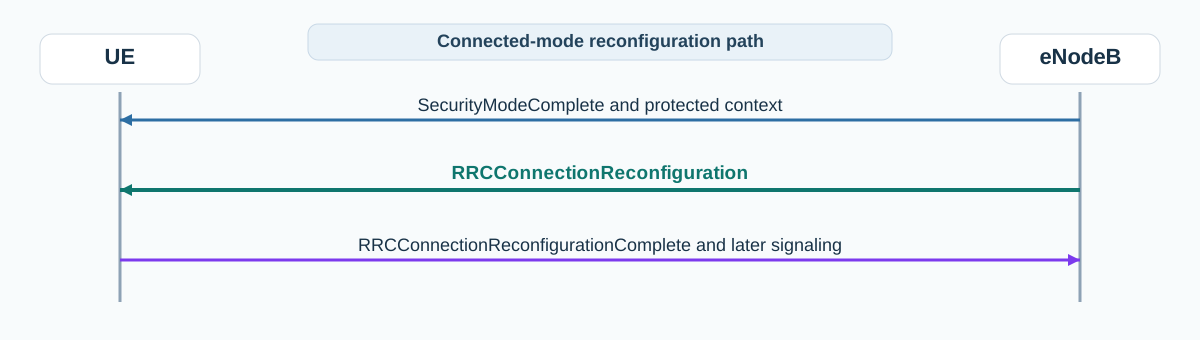
Connected-mode continuation
In connected-mode continuation, RRCConnectionReconfiguration is the main downlink update step before the UE confirms completion.
Call flow position: Main connected-mode update message used after setup and security activation.
Typical state: UE is in RRC_CONNECTED and later radio behavior is being changed without releasing the connection.
Preconditions:
SRB1 is active.
The network has decided to modify the dedicated radio configuration.
Next likely message: RRCConnectionReconfigurationComplete
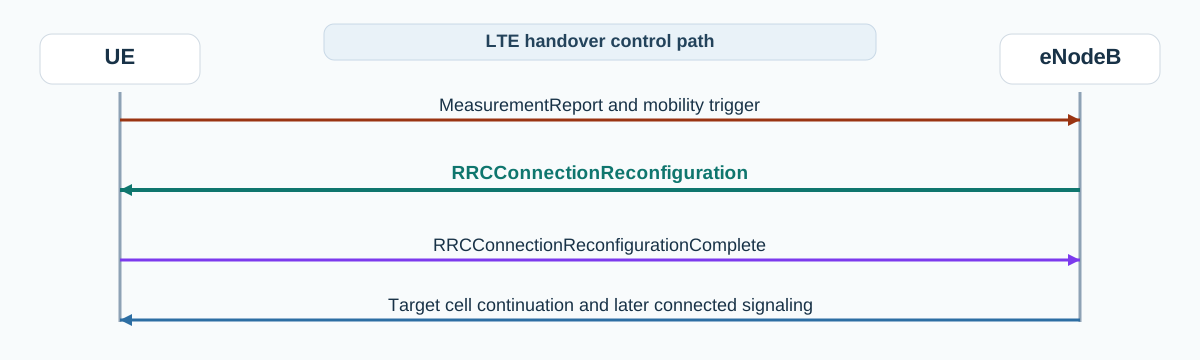
LTE handover
In LTE handover, RRCConnectionReconfiguration carries the mobility-control update that prepares or executes the handover path.
Call flow position: Mobility-control message used to prepare or execute connected handover behavior.
Typical state: UE is in connected mode and measurement or mobility logic has already led to a handover-related update.
Preconditions:
Measurement and mobility conditions support the reconfiguration.
Target-side mobility handling is available where required.
Next likely message: RRCConnectionReconfigurationComplete
Start by identifying which optional top-level blocks are present.
measConfig often points to reporting or mobility preparation.
mobilityControlInfo shifts the reading toward handover execution.
radioResourceConfigDedicated is important for bearer and dedicated radio changes.
Important Information Elements
IE
Required
Description
rrc-TransactionIdentifier
Yes
Transaction identifier used to correlate the reconfiguration procedure.
measConfig
Optional
Measurement objects, reporting rules, gaps, and measurement-related control.
mobilityControlInfo
Optional
Mobility-related configuration used in handover execution paths.
radioResourceConfigDedicated
Optional
Dedicated radio configuration changes for bearers and connected-mode behavior.
securityConfigHO
Optional
Security configuration used in handover-related cases.
nonCriticalExtension
Optional
Release-extension branch for later additions.
Detailed field explanation
rrc-TransactionIdentifier
Transaction identifier used to correlate the reconfiguration procedure.
Presence: Required
In practice: In practice, compare this field with the original request and with any later release-dependent optional fields so you can see whether the network accepted the same service model the UE asked for.
measConfig
Measurement objects, reporting rules, gaps, and measurement-related control.
Presence: Optional
In practice: In practice, compare this field with the original request and with any later release-dependent optional fields so you can see whether the network accepted the same service model the UE asked for.
mobilityControlInfo
Mobility-related configuration used in handover execution paths.
Presence: Optional
In practice: In practice, compare this field with the original request and with any later release-dependent optional fields so you can see whether the network accepted the same service model the UE asked for.
radioResourceConfigDedicated
Dedicated radio configuration changes for bearers and connected-mode behavior.
Presence: Optional
In practice: In practice, compare this field with the original request and with any later release-dependent optional fields so you can see whether the network accepted the same service model the UE asked for.
securityConfigHO
Security configuration used in handover-related cases.
Presence: Optional
In practice: In practice, compare this field with the original request and with any later release-dependent optional fields so you can see whether the network accepted the same service model the UE asked for.
nonCriticalExtension
Release-extension branch for later additions.
Presence: Optional
In practice: In practice, compare this field with the original request and with any later release-dependent optional fields so you can see whether the network accepted the same service model the UE asked for.
What to check in logs and traces
Check the transaction identifier and correlate it with the completion message.
Identify the populated top-level configuration blocks.
Inspect measConfig, mobilityControlInfo, and radioResourceConfigDedicated according to the active procedure.
In handover cases, compare the message with measurement history and target-cell assumptions.
Confirm the next UE action is RRCConnectionReconfigurationComplete.
Common Issues and Troubleshooting
The UE receives reconfiguration but does not complete the procedure.
Likely cause: One or more populated configuration blocks may be unsupported, inconsistent, or procedure-misaligned.
What to inspect: Check the top-level blocks, UE capability alignment, and whether the configuration matches the intended scenario.
Next step: Compare against a known-good reconfiguration for the same use case.
Handover fails after reconfiguration delivery.
Likely cause: The mobility-related configuration may not match the target-cell preparation or measurement basis.
What to inspect: Check mobilityControlInfo, securityConfigHO, measurement context, and target assumptions.
Next step: Validate the mobility preparation rather than only the downlink reconfiguration decode.
Measurements or bearers behave differently after the update.
Likely cause: The change is likely inside measConfig or radioResourceConfigDedicated.
What to inspect: Compare the before and after connected-mode configuration.
Next step: Read the reconfiguration as a delta against the earlier connected state.
LTE / 5G / Variant Comparison
Compared with RRCConnectionSetup
RRCConnectionSetup creates the first dedicated connected context. RRCConnectionReconfiguration changes that context later in connected mode.
Compared with NR RRCReconfiguration
LTE and NR both use reconfiguration as the main connected-mode update message, but the exact field structure and feature scope differ between TS 36.331 and TS 38.331.
FAQ
What is RRCConnectionReconfiguration in LTE?
It is the main downlink LTE RRC message used to change connected-mode radio behavior after setup.
What comes after RRCConnectionReconfiguration?
The UE normally responds with RRCConnectionReconfigurationComplete.
Why is RRCConnectionReconfiguration important?
It is the main connected-mode update message for measurements, mobility, bearers, and other dedicated LTE control.
What should I inspect first in RRCConnectionReconfiguration?
Start by identifying which top-level optional blocks are populated, especially measConfig, mobilityControlInfo, and radioResourceConfigDedicated.
Decode this message with the 3GPP Decoder, inspect the related message database, or open the matching call flow to see where this signaling step fits in the full procedure.