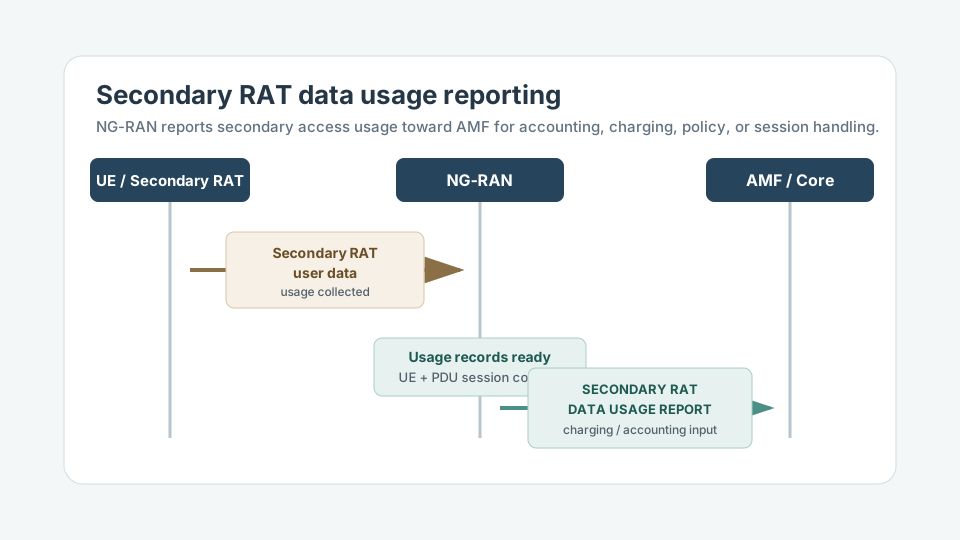
Secondary RAT Data Usage Report is the NGAP message sent by the NG-RAN node to the AMF to report data usage over a secondary RAT for charging, accounting, mobility, or policy-related handling.
NG-RAN has collected usage information for user data carried over a secondary RAT and needs to report that usage toward the AMF and core-network functions.
Main purpose
Reports secondary RAT data usage, supports charging and accounting visibility, supports policy and session-related usage handling, helps track usage in dual connectivity or multi-RAT operation, and separates usage reporting from normal PDU session setup, modify, or release signalling.
Main specification
3GPP TS 38.413, Secondary RAT Data Usage Report message
Release added
Release 15
Procedures where used
Secondary RAT Data Usage Reporting, Dual connectivity usage tracking, Multi-RAT mobility support, PDU session usage accounting, Charging and policy-related usage reporting
What is Secondary RAT Data Usage Report in simple terms?
Secondary RAT Data Usage Report is the NGAP message sent by the NG-RAN node to the AMF to report data usage over a secondary RAT for charging, accounting, mobility, or policy-related handling.
Reports secondary RAT data usage, supports charging and accounting visibility, supports policy and session-related usage handling, helps track usage in dual connectivity or multi-RAT operation, and separates usage reporting from normal PDU session setup, modify, or release signalling.
Why this message matters
Secondary RAT Data Usage Report is the NG-RAN telling the AMF how much data was carried over a secondary radio access for a specific UE context.
Where this message appears in the call flow
Secondary RAT Data Usage Reporting
NG-RAN reports secondary RAT usage toward AMF so core functions can use it for charging, accounting, policy, or session handling.
Call flow position: NG-RAN sends this UE-associated initiatingMessage when secondary RAT usage information must be reported toward the AMF.
Typical state: A UE context exists and NG-RAN has one or more secondary RAT usage records to report.
Preconditions:
AMF UE NGAP ID and RAN UE NGAP ID identify the UE-associated NGAP context.
Secondary RAT usage has been collected by NG-RAN.
Usage records can be correlated with the relevant PDU session or resource context where applicable.
Next likely message: AMF and core-side charging, accounting, policy, or session handling
PDU session usage correlation
The report list is interpreted per PDU session or resource context where those identifiers are present.
Call flow position: The usage report should be read together with PDU session resources and any related session modification, notify, or release procedures.
Typical state: Core functions can correlate reported usage with the appropriate PDU session or resource context.
Preconditions:
PDU Session ID or related resource context is available in the usage records when applicable.
The reported usage period matches observed secondary RAT activity.
Next likely message: Core-side usage accounting or session-state update
Mobility and dual connectivity support
Call flow position: The message helps preserve usage visibility when user traffic has used secondary access during multi-RAT or dual connectivity operation.
Typical state: Trace analysis correlates the usage report with mobility, handover, path switch, and secondary-RAT activity.
Preconditions:
Secondary RAT activity occurred for the UE.
The usage report timing can be compared with mobility and user-plane events.
Next likely message: Charging, accounting, or policy handling based on secondary RAT usage
Transport / encapsulation: NGAP over SCTP/IP between NG-RAN and AMF
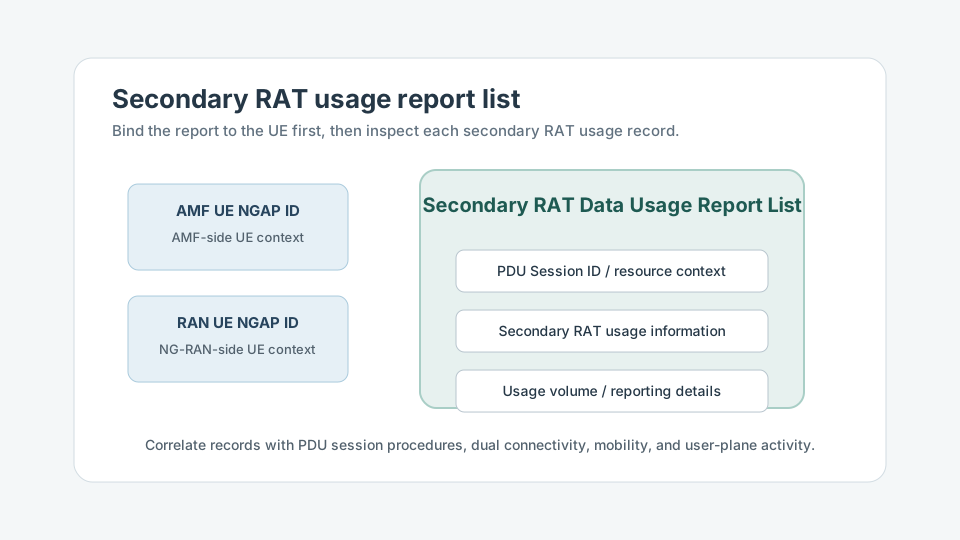
Security context: Secondary RAT Data Usage Report is UE-associated. The AMF UE NGAP ID and RAN UE NGAP ID must bind the report to the correct UE context before any charging, accounting, or session-related interpretation is trusted.
Message Structure Overview
Secondary RAT Data Usage Report is an NG-RAN-to-AMF UE-associated initiatingMessage.
AMF UE NGAP ID and RAN UE NGAP ID anchor the report to the correct UE context.
Secondary RAT Data Usage Report List is the key mandatory payload.
Usage records should be correlated with PDU Session ID or the relevant resource context where present.
The report is used for usage visibility and should be read alongside dual-connectivity, mobility, and PDU session procedures.
ASN.1 for Secondary RAT Data Usage Report
SecondaryRATDataUsageReport ::= SEQUENCE {
  protocolIEs ProtocolIE-Container { {SecondaryRATDataUsageReport-IEs} },
  ...
}

SecondaryRATDataUsageReport-IEs NGAP-PROTOCOL-IES ::= {
  { ID id-AMF-UE-NGAP-ID                         CRITICALITY reject TYPE AMF-UE-NGAP-ID                         PRESENCE mandatory } |
  { ID id-RAN-UE-NGAP-ID                         CRITICALITY reject TYPE RAN-UE-NGAP-ID                         PRESENCE mandatory } |
  { ID id-SecondaryRATDataUsageReportList        CRITICALITY ignore TYPE SecondaryRATDataUsageReportList        PRESENCE mandatory },
  ...
}
How to read this ASN.1
Decode the UE identity pair first, then inspect each item in Secondary RAT Data Usage Report List. The top-level message identifies the UE-associated report; the operational detail is in the usage records.
Treat this as a teaching example based on the expected message structure, not as a captured network trace.
The usage list is the main payload to inspect.
Correlate any PDU Session ID or resource context with PDU session procedures and user-plane activity.
Important Information Elements
IE
Presence
Description
Message Type
Mandatory
Identifies the NGAP PDU as SECONDARY RAT DATA USAGE REPORT.
AMF UE NGAP ID
Mandatory
Mandatory AMF-side UE identifier used to correlate the report with the correct UE context.
RAN UE NGAP ID
Mandatory
Mandatory NG-RAN-side UE identifier used to bind the report to the correct radio-side UE context.
Secondary RAT Data Usage Report List
Mandatory
Mandatory list carrying per-session or per-resource secondary RAT usage reporting information.
Detailed field explanation
Message Type
Identifies the NGAP PDU as SECONDARY RAT DATA USAGE REPORT.
Presence: Mandatory
In practice: In practice, compare this field with the original request and with any later release-dependent optional fields so you can see whether the network accepted the same service model the UE asked for.
AMF UE NGAP ID
Mandatory AMF-side UE identifier used to correlate the report with the correct UE context.
Presence: Mandatory
In practice: In practice, compare this field with the original request and with any later release-dependent optional fields so you can see whether the network accepted the same service model the UE asked for.
RAN UE NGAP ID
Mandatory NG-RAN-side UE identifier used to bind the report to the correct radio-side UE context.
Presence: Mandatory
In practice: In practice, compare this field with the original request and with any later release-dependent optional fields so you can see whether the network accepted the same service model the UE asked for.
Secondary RAT Data Usage Report List
Mandatory list carrying per-session or per-resource secondary RAT usage reporting information.
Presence: Mandatory
In practice: In practice, compare this field with the original request and with any later release-dependent optional fields so you can see whether the network accepted the same service model the UE asked for.
What to check in logs and traces
Confirm the message direction is NG-RAN to AMF.
Verify AMF UE NGAP ID and RAN UE NGAP ID match the UE context.
Check that Secondary RAT Data Usage Report List is present.
Correlate usage records with expected PDU session or resource context.
Confirm report timing matches the secondary RAT usage period.
Check whether AMF and core charging or accounting behavior follows expected logic.
Confirm the message is not being confused with PDU Session Resource Notify.
Common Issues and Troubleshooting
Usage is reported against the wrong UE.
Likely cause: AMF UE NGAP ID or RAN UE NGAP ID correlation may be wrong.
What to inspect: Compare both UE identifiers with the active UE context across preceding and following NGAP messages.
Next step: Fix UE-context correlation before analyzing charging, accounting, or PDU session behavior.
Secondary RAT usage is expected but the report is missing.
Likely cause: NG-RAN may not have generated usage records, the trigger condition may not have occurred, or the report may have been filtered or lost.
What to inspect: Compare secondary RAT activity, dual-connectivity periods, and NGAP reporting timestamps.
Next step: Verify NG-RAN usage reporting configuration and check whether another procedure carried related usage data.
The report is present but not tied to the expected PDU session.
Likely cause: Usage records may be missing PDU session correlation or the wrong session context may be used.
What to inspect: Compare PDU Session ID or resource context in the report with PDU Session Resource Modify, Notify, Release, and user-plane activity.
Next step: Correct session correlation before diagnosing charging or policy behavior.
Charging or accounting does not reflect secondary RAT traffic.
Likely cause: Usage report timing, volume, or routing toward core functions may be inconsistent with the actual secondary RAT activity.
What to inspect: Check usage values, reporting period, AMF handling, and downstream charging or accounting logs.
Next step: Separate NG-RAN measurement/report generation from core-side accounting consumption.
The message is analyzed as PDU Session Resource Notify.
Likely cause: Both are NG-RAN-to-AMF UE-associated reports, but they carry different payloads.
What to inspect: Check whether the key IE is Secondary RAT Data Usage Report List or PDU Session Resource Notify List/Released List.
Next step: Use usage-report analysis for secondary RAT volume records; use Notify analysis for PDU session resource status.
LTE / 5G / Variant Comparison
Compared with PDU Session Resource Notify
PDU Session Resource Notify reports PDU session resource status or release information. Secondary RAT Data Usage Report reports secondary RAT data usage information.
Compared with PDU Session Resource Modify Indication
Modify Indication requests modification of PDU session resources. Secondary RAT Data Usage Report reports already measured secondary RAT usage.
Compared with Path Switch Request
Path Switch Request asks the core to move the downlink path after handover. Secondary RAT Data Usage Report provides usage data that may need to be correlated with mobility and path-switch activity.
FAQ
What is Secondary RAT Data Usage Report in NGAP?
It is the NG-RAN-to-AMF NGAP message used to report data usage over a secondary RAT for a UE context.
Who sends Secondary RAT Data Usage Report?
The NG-RAN node sends Secondary RAT Data Usage Report to the AMF.
Is this message UE-associated?
Yes. It includes AMF UE NGAP ID and RAN UE NGAP ID to bind the report to the correct UE-associated NGAP context.
What does Secondary RAT Data Usage Report List contain?
It contains one or more usage records for secondary RAT usage, typically correlated with PDU session or resource context when available.
Why is secondary RAT usage reported?
It gives the core network visibility of secondary RAT traffic for charging, accounting, policy, mobility, or session-related handling.
How is this related to PDU sessions?
Secondary RAT usage is often associated with PDU session resources, so engineers should correlate usage records with PDU Session ID, session procedures, and user-plane activity.
How is it different from PDU Session Resource Notify?
PDU Session Resource Notify reports PDU session resource status or release information. Secondary RAT Data Usage Report reports secondary RAT data usage information.
How do you troubleshoot missing secondary RAT usage reports?
Confirm secondary RAT activity occurred, verify reporting triggers and NG-RAN configuration, check UE and PDU session correlation, and compare report timing with user-plane and mobility events.
Decode this message with the 3GPP Decoder, inspect the related message database, or open the matching call flow to see where this signaling step fits in the full procedure.