What does Configuration Update Command do in 5G?
It lets the network update UE registration-related context such as identity, tracking-area, slice, and timer information.
| Protocol | nas | Network | 5g |
|---|---|---|---|
| Spec | 3GPP TS 24.501 | Spec Section | 8.2.18 |
| Direction | AMF to UE | Message Type | 5GMM signaling |
| Full message name | 5G NAS - Configuration Update Command |
|---|---|
| Protocol | NAS |
| Technology | 5G |
| Direction | AMF to UE |
| Interface | N1 |
| Signaling bearer / channel | NAS signaling / Dedicated NAS message, commonly via DL Information Transfer |
| Typical trigger | Sent when the network must update registration-related context such as 5G-GUTI, TAI list, allowed NSSAI, NITZ, or registration-request indications. |
| Main purpose | Lets the AMF push refreshed identity, tracking area, slice, timer, and related mobility-management context to the UE. |
| Main specification | 3GPP TS 24.501, 8.2.18 |
| Release added | Release 15 |
| Procedures where used | Generic UE Configuration Update, Registered-state mobility-management update |
| Related timers | T3555 |
Configuration Update Command is the network-initiated NAS message used to update UE 5GMM context after registration.
Lets the AMF push refreshed identity, tracking area, slice, timer, and related mobility-management context to the UE.
Configuration Update Command is the network updating the UE's registered 5G context after registration is already active.
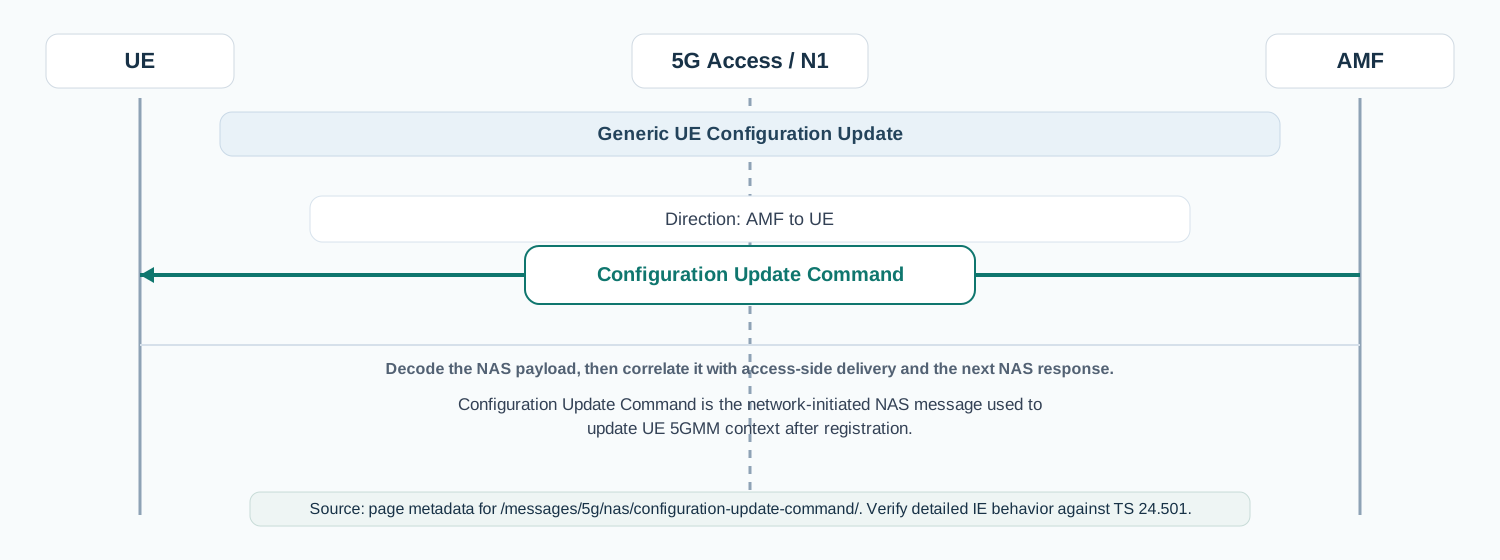
Call flow position: Network-initiated update of UE mobility-management context after registration.
Typical state: UE is already registered.
Preconditions:
Next likely message: Configuration Update Complete or a later registration trigger
Previous message(s): Registration Accept, Normal registered operation
Next message(s): Configuration Update Complete, Registration procedure if requested
Security context: Normally sent within an established NAS security context.
This message is not typically analyzed as ASN.1 on the wire. It is usually read as a NAS or protocol field structure instead.
Configuration Update Command is defined by NAS 24.501 rather than ASN.1.
Configuration Update Command
  Extended Protocol Discriminator: 5G Mobility Management
  Security Header Type: Integrity protected and ciphered
  Message Type: Configuration Update Command
  5G-GUTI: 02 F1 10 00 01 AB CD EF 56 78
  TAI List:
    PLMN: 001-01
    TAC: 0x2001
  Allowed NSSAI:
    S-NSSAI: SST 1, SD 0x112233
  Configuration Update Indication: Acknowledgement requested
| IE | Presence | Description |
|---|---|---|
5G-GUTI | Optional | Updated temporary identity that the UE should use after the command. |
TAI list | Optional | Updated tracking-area scope that affects reachability and later mobility behavior. |
Allowed NSSAI | Optional | Updated allowed slice context provided by the network. |
Configuration update indication | Optional | Tells the UE whether acknowledgement or a later registration procedure is requested. |
NITZ information | Optional | Optional network-provided time-zone and time information. |
5G-GUTIUpdated temporary identity that the UE should use after the command.
Presence: Optional
In practice: In practice, compare this field with the original request and with any later release-dependent optional fields so you can see whether the network accepted the same service model the UE asked for.
TAI listUpdated tracking-area scope that affects reachability and later mobility behavior.
Presence: Optional
In practice: In practice, compare this field with the original request and with any later release-dependent optional fields so you can see whether the network accepted the same service model the UE asked for.
Allowed NSSAIUpdated allowed slice context provided by the network.
Presence: Optional
In practice: In practice, compare this field with the original request and with any later release-dependent optional fields so you can see whether the network accepted the same service model the UE asked for.
Configuration update indicationTells the UE whether acknowledgement or a later registration procedure is requested.
Presence: Optional
In practice: In practice, compare this field with the original request and with any later release-dependent optional fields so you can see whether the network accepted the same service model the UE asked for.
NITZ informationOptional network-provided time-zone and time information.
Presence: Optional
In practice: In practice, compare this field with the original request and with any later release-dependent optional fields so you can see whether the network accepted the same service model the UE asked for.
Likely cause: The UE may not have applied the updated identity, TAI list, or slice context correctly.
What to inspect: Check the exact IE set in Configuration Update Command and whether Configuration Update Complete followed.
Next step: Correlate the updated fields with later paging, mobility, and slice behavior.
It lets the network update UE registration-related context such as identity, tracking-area, slice, and timer information.
Decode this message with the 3GPP Decoder, inspect the related message database, or open the matching call flow to see where this signaling step fits in the full procedure.