LTE Interfaces Explained
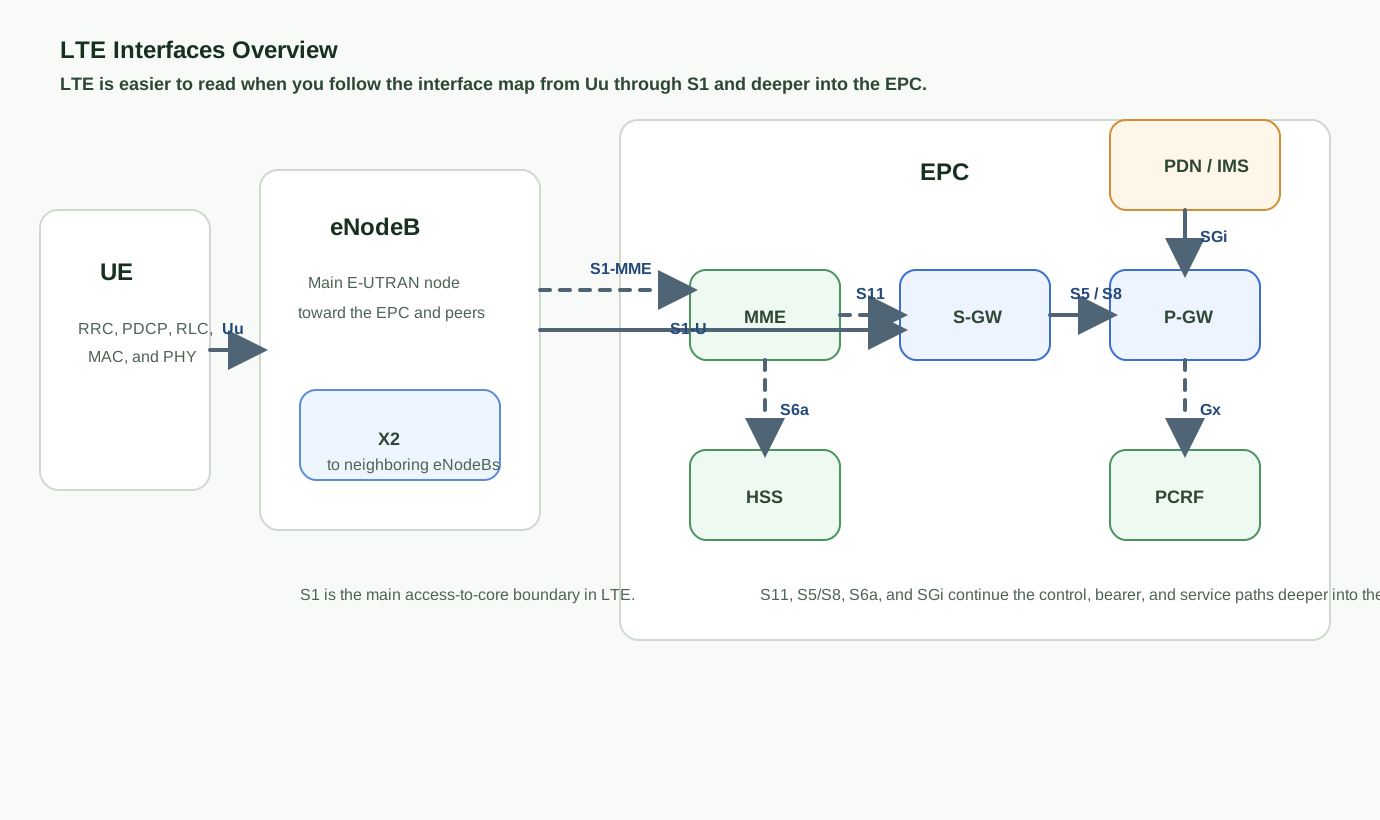
LTE architecture is built around a defined interface set that connects the E-UTRAN to the EPC and separates control-plane signaling from user-plane traffic. On the access side, the main interfaces are Uu, S1, and X2. On the core side, key interfaces include S11, S5/S8, S6a, and SGi.
This interface model is one of the reasons LTE is easier to reason about than older systems. Each interface has a clear role, a clear set of endpoints, and usually a clear control-plane or user-plane purpose. That makes the interface view one of the best entry points for understanding LTE signaling, bearer setup, paging, handover, and data transport.
Quick facts
| Best use | Interface-first architecture study, call-flow reading, and fault isolation. |
|---|---|
| Access-side interfaces | Uu, S1-MME, S1-U, and X2. |
| Core-side interfaces | S11, S5/S8, S6a, and SGi. |
| Control-plane examples | S1-MME, X2 control coordination, S11, and S6a. |
| User-plane examples | Uu, S1-U, S5/S8 user path, and SGi. |
| Why it matters | The interface map is often the fastest way to place attach, paging, bearer setup, handover, and data-path failures. |
LTE interfaces in the architecture
Why LTE interfaces matter
The LTE interface model explains where signaling travels, where user traffic travels, how the eNB reaches the EPC, how neighboring eNBs coordinate handovers, how the MME reaches the HSS, how the S-GW reaches the P-GW, and how the core reaches external networks and operator services such as IMS.
This is why interface-level analysis is so useful in troubleshooting. If attach is failing, the issue may be on S1-MME, S11, or S6a. If data is missing after successful attach, the issue may be on S1-U, S5/S8, or SGi. If handover is failing, the issue may be on X2 or on an S1-based mobility path.
Overview of main LTE interfaces
| Interface | Connects | Plane | Main role |
|---|---|---|---|
| Uu | UE and eNB | Radio | LTE air interface. |
| S1-MME | eNB and MME | Control plane | Access signaling and NAS transport. |
| S1-U | eNB and S-GW | User plane | User-data transport. |
| X2 | eNB and eNB | Control plus user support | Inter-eNB mobility and coordination. |
| S11 | MME and S-GW | Control plane | Session and bearer-control signaling. |
| S5/S8 | S-GW and P-GW | User plus control support | Core bearer path between gateway roles. |
| S6a | MME and HSS | Control plane | Subscription and authentication support. |
| SGi | P-GW and external packet networks | User plane / service side | External connectivity to PDNs and IMS. |
Uu interface
The Uu interface is the LTE radio interface between the UE and the eNB. It is where RRC runs on the control side and PDCP, RLC, MAC, and PHY run on the user and lower-layer side.
Uu is what makes LTE a radio-access system in the first place, but it is only the beginning of the path. Once signaling or traffic leaves the radio side, it must cross S1 and the EPC-facing interfaces to become a working end-to-end service.
S1 interface
The S1 interface is the main boundary between the E-UTRAN and the EPC. It is split into S1-MME for the control plane and S1-U for the user plane.
| S1 side | Connects | Main purpose |
|---|---|---|
| S1-MME | eNB and MME | Control signaling such as NAS transport, initial UE access, context setup, paging, and S1-based mobility signaling. |
| S1-U | eNB and S-GW | User-plane traffic between the LTE access side and the EPC gateway path. |
S1 is the most important LTE access-to-core interface because it is where radio access becomes EPC signaling and where user traffic leaves the RAN and enters the core packet path.
Open the S1-MME deep dive for the control-plane view.
X2 interface
The X2 interface connects eNBs to each other inside the E-UTRAN. It is the main peer interface on the LTE access side and is especially important for inter-eNB mobility and coordination.
X2 is the RAN-side complement to S1. If S1 is the access-to-core bridge, X2 is the access-to-access bridge inside the E-UTRAN. That makes it one of the first interfaces to inspect during X2-based handover work.
S11 interface
The S11 interface connects the MME and the S-GW inside the EPC. It is part of the control-plane path used for bearer and session coordination between the main EPC control node and the main access-side user-plane gateway.
In practical terms, S11 is one of the key internal EPC interfaces behind attach completion, bearer creation, and user-connectivity setup. If that coordination fails, the access side may look healthy while the session side remains incomplete.
S5/S8 interface
The S5/S8 interface connects the S-GW and the P-GW. S5 is used in non-roaming or local cases, while S8 is used in roaming architecture between visited and home network gateway roles.
This is the interface that carries the packet path deeper into the EPC toward external services. It is also one of the most important interfaces when comparing non-roaming and roaming LTE architecture.
S6a interface
The S6a interface connects the MME and the HSS. It is used for subscription and authentication-related exchange between the EPC control-plane anchor and the subscriber database side.
Without S6a, the EPC control plane cannot fully apply subscriber-aware behavior to LTE access. That makes it a key interface behind successful attach and service authorization.
SGi interface
The SGi interface connects the P-GW to external packet data networks and operator IP services. This is the service-facing edge of LTE architecture where traffic leaves the EPC and reaches the Internet, enterprise networks, or IMS-based services.
Even if radio, signaling, and bearer setup are all successful, service connectivity can still fail beyond the EPC if the SGi-side path or the attached service network has problems.
Control plane and user plane across LTE interfaces
The LTE interface set becomes much easier to understand when grouped by plane.
| Plane | Main interfaces |
|---|---|
| Control plane | S1-MME, X2 coordination signaling, S11, and S6a. |
| User plane | Uu, S1-U, S5/S8 user path, SGi, and some X2-related forwarding support during mobility scenarios. |
LTE interfaces and major procedures
Major LTE procedures become easier to place when you track which interfaces they touch.
| Procedure | Common interface view |
|---|---|
| Attach | Usually spans Uu, S1-MME, S6a, S11, S1-U, and S5/S8. |
| Paging | Usually centers on S1-MME and Uu, with EPC-side context awareness around the MME path. |
| Handover | Usually centers on X2 for X2-based mobility or on S1-MME plus EPC coordination for S1-based mobility, with S1-U continuity behind it. |
Common troubleshooting angles across LTE interfaces
- S1-MME problems often show up as setup, context, paging, or NAS transport failures.
- S1-U problems often show up as missing traffic after otherwise healthy control-plane signaling.
- X2 problems often show up during inter-eNB handover and mobility coordination.
- S11 problems often show up as MME to S-GW coordination or bearer-control failures.
- S6a problems often show up as subscription or authentication reachability issues.
- S5/S8 and SGi problems often show up deeper in the data path after attach or bearer creation looks correct.
FAQ
What are the main interfaces in LTE?
The main LTE interfaces are Uu, S1-MME, S1-U, X2, S11, S5/S8, S6a, and SGi.
What is the difference between S1-MME and S1-U?
S1-MME is the control-plane side of S1 between the eNB and MME, while S1-U is the user-plane side between the eNB and Serving Gateway.
What does the X2 interface do in LTE?
X2 connects eNBs to each other and supports inter-eNB coordination, especially mobility and handover-related behavior.
What is S6a used for?
S6a is used between the MME and the HSS for subscription and authentication-related information exchange.
What is the purpose of SGi?
SGi is the service-facing interface between the P-GW and external packet data networks or operator IP services such as IMS.
Key takeaways
- LTE architecture depends on a defined interface set linking UE, E-UTRAN, EPC, and external networks.
- S1 is the main access-to-core interface, split into S1-MME and S1-U.
- X2 is the main inter-eNB interface inside the E-UTRAN.
- S11, S5/S8, S6a, and SGi cover the key EPC-side coordination, gateway, subscriber, and external-service paths.
- Understanding LTE interfaces is one of the fastest ways to read attach, paging, handover, bearer, and data-path behavior correctly.