LTE Core Network (EPC) Architecture Explained
The LTE core network is the Evolved Packet Core (EPC), the packet-switched core of the Evolved Packet System (EPS). In the 3GPP architecture, the EPC works with the E-UTRAN to provide mobility management, subscriber handling, security support, bearer control, packet-data connectivity, and policy enforcement. The main EPC entities shown in the EPS reference model are the MME, Serving Gateway (S-GW), PDN Gateway (P-GW), HSS, and PCRF, with operator IP services such as IMS connected on the packet-data-network side.
The EPC is what turns LTE from a radio access network into a complete mobile system. The E-UTRAN provides radio access and forwards signaling and traffic toward the core, but the EPC is where attach, authentication support, bearer creation, packet routing, policy control, and mobility anchoring come together. In the LTE system model, the eNB connects to the EPC over S1-MME and S1-U, which is why the EPC sits at the center of most end-to-end LTE procedures.
LTE EPC Architecture Diagram
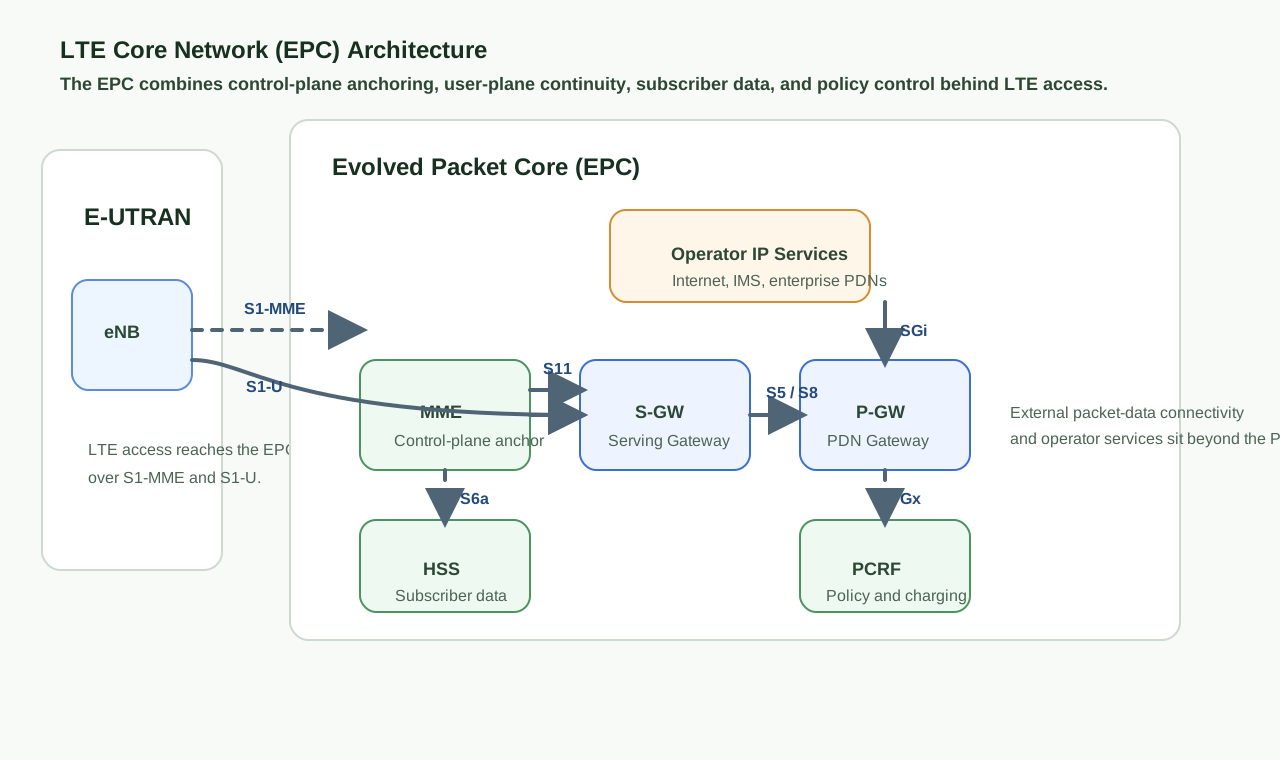
Quick facts
| Core domain | Evolved Packet Core (EPC) |
|---|---|
| Parent system | Evolved Packet System (EPS) |
| Control-plane anchor | MME |
| User-plane anchors | S-GW and P-GW |
| Subscriber and policy functions | HSS and PCRF |
| Key interfaces | S1-MME, S1-U, S11, S5/S8, S6a, SGi, Gx |
Contents
- LTE EPC Architecture Diagram
- What Is the EPC in LTE?
- Main LTE Core-Network Nodes
- MME in LTE Core Architecture
- Serving Gateway (S-GW)
- PDN Gateway (P-GW)
- HSS and PCRF
- Key EPC Interfaces
- Control Plane and User Plane in the EPC
- Bearer Architecture in the EPC
- EPC and LTE Attach
- EPC and Mobility
- Roaming, IMS, and Operator Services
- Common Troubleshooting Angles in the EPC
- Start Exploring LTE Core-Network Topics
- Key takeaways
- FAQ
What Is the EPC in LTE?
The Evolved Packet Core is the all-IP core network used with LTE access. In practical terms, the EPC is responsible for mobility-management control, packet-data connectivity, bearer establishment and maintenance, subscription and authentication support, policy and charging control, and access to operator and external IP services.
Unlike older mobile core architectures with separate circuit-switched and packet-switched domains, the EPC is built for packet services. That is one reason LTE is described as an all-IP system. The EPC also works closely with the bearer model, so QoS and service behavior are expressed through EPS bearers rather than through circuit-style service models.
Main LTE Core-Network Nodes
This is the core EPC node set shown in the EPS architecture and associated PCC architecture. Together, these nodes define how LTE access becomes a subscriber-aware, bearer-driven, packet-connectivity system rather than just a radio link.
| Node | Main architectural role |
|---|---|
| MME | Control-plane node for mobility management, NAS handling, and security-related control. |
| S-GW | User-plane anchor and mobility anchor for inter-eNB handover and some inter-system mobility cases. |
| P-GW | Connectivity to packet data networks and operator IP services. |
| HSS | Subscriber and authentication-related database and support function. |
| PCRF | Policy and charging control function. |
MME in LTE Core Architecture
The Mobility Management Entity (MME) is the main EPC control-plane node for LTE access. It hosts the NAS signaling context, NAS signaling security, AS security control, and key control functions such as idle-mode mobility handling and paging origination in ECM-IDLE. In the EPS architecture, the MME sits between the E-UTRAN and the wider core control architecture, with interfaces such as S1-MME, S11, and S6a.
From a system perspective, the MME is where many core control procedures converge: attach-related control, UE reachability and paging control, bearer-control coordination, NAS transport and state handling, and mobility-management control toward LTE access.
Serving Gateway (S-GW)
The Serving Gateway is a key user-plane node in the EPC. It acts as the local mobility anchor point for inter-eNB handover, provides mobility anchoring for inter-3GPP mobility, and supports downlink packet buffering for idle-mode UEs plus initiation of network-triggered service request behavior. Architecturally, the S-GW sits between E-UTRAN and P-GW, with S1-U on the access side and S5/S8 toward the P-GW.
That makes the S-GW the EPC node that stabilizes the user-plane path while the radio side moves. In practice, this is why handover analysis often depends on both RAN signaling and S-GW anchoring behavior.
PDN Gateway (P-GW)
The PDN Gateway is the EPC node that connects LTE users to packet data networks (PDNs) and operator IP services. In the EPS architecture model, the P-GW sits on the path toward SGi, which leads to external networks such as the Internet and operator services such as IMS. The P-GW is also central to how packet connectivity is tied to a PDN connection and its bearers.
Architecturally, the P-GW is where LTE access meets external service connectivity. That is why IMS, enterprise services, and general Internet access are all represented on the far side of the P-GW in the EPS reference model.
HSS and PCRF
The Home Subscriber Server (HSS) provides subscriber-related information and supports authentication and subscription handling in the EPC. The MME reaches the HSS over S6a, which is why the EPC can make access decisions that are subscriber-aware rather than purely radio-driven.
The PCRF is the Policy and Charging Rules Function. It gives LTE core behavior its policy-aware nature through charging and policy control, including QoS and gating behavior. In the EPS architecture, the PCRF connects toward the P-GW using Gx. The bearer model is not only about routing packets; it is also about applying the correct service treatment, charging rules, and QoS behavior across the packet path.
Key EPC Interfaces
| Interface | Connects | Main purpose |
|---|---|---|
| S1-MME | eNB and MME | Control-plane signaling. |
| S1-U | eNB and S-GW | User-plane transport. |
| S11 | MME and S-GW | Session and bearer-control signaling. |
| S5/S8 | S-GW and P-GW | Core user-plane path and related bearer transport. |
| S6a | MME and HSS | Authentication and subscription data exchange. |
| SGi | P-GW and external packet networks or operator services | External connectivity. |
| Gx | P-GW and PCRF | Policy and charging control. |
Control Plane and User Plane in the EPC
A core LTE architecture concept is the split between control plane and user plane. The EPC control plane is centered on the MME, supported by interfaces such as S1-MME toward the eNB, S11 toward the S-GW, and S6a toward the HSS.
The EPC user plane is centered on S1-U between eNB and S-GW, S5/S8 between S-GW and P-GW, and SGi between P-GW and external packet networks. This split is why some LTE issues are purely EPC signaling problems while others are user-plane forwarding or policy-enforcement problems.
Bearer Architecture in the EPC
The bearer model is central to EPC design. A radio bearer transports packets of an EPS bearer between UE and E-UTRAN. An S1 bearer transports packets of an EPS bearer between E-UTRAN and S-GW. An E-RAB is the concatenation of the radio bearer and the S1 bearer, and the bearer path continues in the core network through S5/S8 toward the P-GW.
A default bearer provides the UE with connectivity throughout the lifetime of the PDN connection and is Non-GBR, while dedicated bearers can be created for more specific service treatment. This is a key EPC idea: the core network does not just authenticate the UE and route traffic. It creates and maintains the service-bearing packet path that the LTE access network and external service network both rely on.
EPC and LTE Attach
A simplified EPC reading of LTE attach looks like this: the UE reaches LTE access through the eNB; the eNB forwards control-plane signaling to the MME over S1-MME; the MME interacts with the HSS over S6a; the MME coordinates with the S-GW over S11; the S-GW and P-GW establish the core user-plane path; and a default bearer provides ongoing PDN connectivity.
This is why attach is not only a NAS procedure. It is also an EPC architecture procedure that creates control-plane anchoring, user-plane connectivity, and bearer context.
EPC and Mobility
Mobility in LTE is not just a radio problem. The EPC plays a major role too. The S-GW acts as the local mobility anchor point for inter-eNB handover and as the mobility anchor for certain inter-3GPP movement cases. Meanwhile, the MME remains central to mobility control in the EPC signaling plane.
This is why handover behavior can involve both radio-side mobility execution in the E-UTRAN and core-side context and anchoring behavior in the EPC.
Roaming, IMS, and Operator Services
The EPC supports both non-roaming and roaming EPS reference models. In roaming architecture, the S8 interface extends the S-GW to P-GW path across visited and home network roles, allowing subscriber handling, policy control, and packet connectivity across operator boundaries.
The EPS non-roaming architecture also shows operator IP services such as IMS on the packet-data-network side of the P-GW. That means VoLTE and other IMS-based services are reached through the EPC packet-connectivity architecture rather than through a separate LTE voice core.
Common Troubleshooting Angles in the EPC
These are the fault domains engineers usually isolate once radio access looks healthy but service still fails. The EPC is where many apparently "network-side" LTE problems are actually rooted.
- MME-side attach or NAS-state issues.
- S11 bearer-control problems between MME and S-GW.
- S1-U or S5/S8 user-plane path issues.
- HSS reachability or subscriber-data issues on S6a.
- PCRF or policy-control issues affecting QoS or charging behavior.
- P-GW connectivity problems toward external networks on SGi.
Start Exploring LTE Core-Network Topics
Key takeaways
- The LTE core network is the EPC, the packet core of the EPS.
- Its main nodes are MME, S-GW, P-GW, HSS, and PCRF.
- The EPC combines mobility control, bearer control, subscriber handling, policy control, and packet-data connectivity.
- S1-MME, S1-U, S11, S5/S8, S6a, SGi, and Gx are the key EPC-facing interfaces.
- The bearer model is central: default bearer connectivity, E-RAB realization, and core packet paths are all EPC-driven concepts.
- The EPC is also the bridge from LTE access into IMS and other operator or external IP services.
FAQ
What is the LTE core network called?
The LTE core network is called the Evolved Packet Core (EPC), part of the Evolved Packet System (EPS).
What are the main nodes in the EPC?
The main EPC nodes are the MME, S-GW, P-GW, HSS, and PCRF.
Is the MME user plane or control plane?
The MME is a control-plane node. User-plane anchoring in the EPC is centered on the S-GW and P-GW path.
What is the difference between S-GW and P-GW?
The S-GW is the EPC-side anchor toward LTE access and mobility, while the P-GW connects the EPC to external packet data networks and operator IP services.
What does the PCRF do in LTE?
The PCRF provides policy and charging control, including flow-based charging and policy behavior such as QoS and gating control.
Does the EPC support roaming?
Yes. EPS architecture defines both non-roaming and roaming models, including S8 for roaming-related S-GW to P-GW connectivity.