VoNR Registration Procedure | Voice Over NR IMS Registration Tutorial
Introduction
VoNR Registration is the process through which a User Equipment (UE) registers with the IP Multimedia Subsystem (IMS) using the 5G NR radio access network.
Before a UE can initiate or receive voice calls using Voice over NR (VoNR), it must complete:
- 5G network registration
- IMS PDU session establishment
- IMS SIP registration
After successful registration, the UE becomes VoNR ready, meaning it can perform native voice calls over 5G Standalone networks.
The procedure is defined by the 3rd Generation Partnership Project in the following specifications:
- 3GPP TS 23.501
- 3GPP TS 23.502
- 3GPP TS 24.229
Network Elements Involved
The VoNR registration procedure involves several network components.
| Network Element | Function |
|---|---|
| UE | Initiates registration |
| gNB | Provides NR radio connectivity |
| AMF | Manages registration and mobility |
| SMF | Controls PDU session establishment |
| UPF | Handles user plane traffic |
| P-CSCF | First IMS signaling node |
| S-CSCF | Central IMS call control node |
VoNR Registration Call Flow
The registration sequence spans both 5G core signaling and IMS signaling.
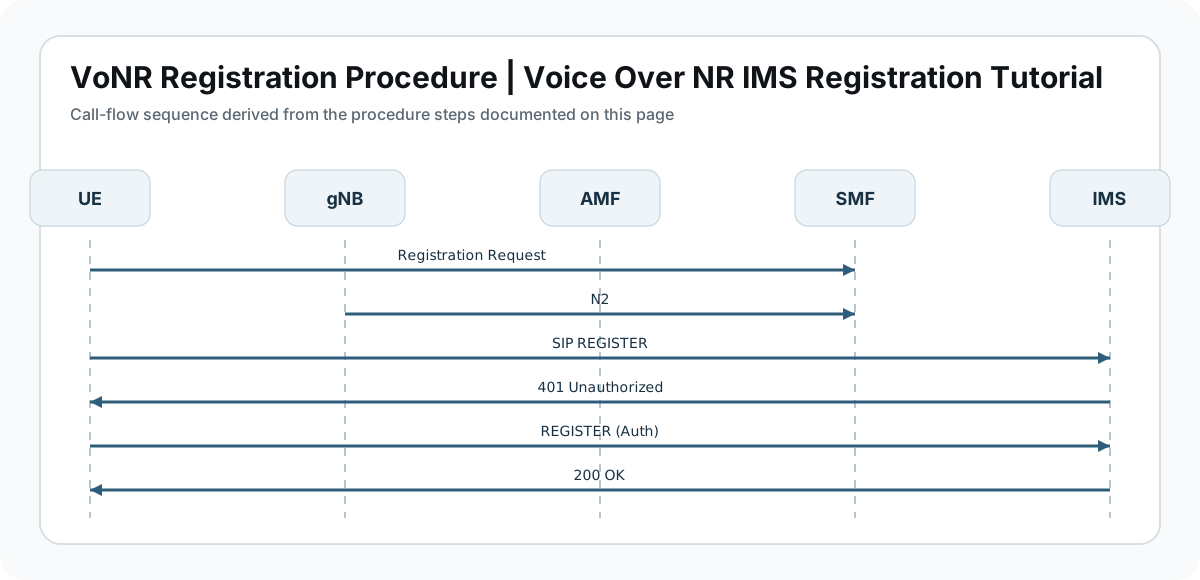
VoNR Registration Call Flow Diagram
UE        gNB        AMF        SMF        IMS
 |         |          |          |          |
 |--Registration Request------->|          |
 |         |----------N2-------->|          |
 |         |                     |          |
 |------PDU Session Establishment----------|
 |                                         |
 |-----------SIP REGISTER----------------->|
 |<----------401 Unauthorized--------------|
 |-----------REGISTER (Auth)-------------->|
|<----------200 OK------------------------|Step-by-Step VoNR Registration Procedure
Step 1: 5G Initial Registration
The UE first registers with the 5G Core Network.
This procedure establishes the basic connectivity between the UE and the network.
Important messages include:
| Message | Description |
|---|---|
| Registration Request | UE requests network access |
| Authentication Request | Network challenges UE |
| Authentication Response | UE sends authentication credentials |
| Security Mode Command | Security algorithms activated |
| Registration Accept | UE successfully registered |
After this step, the UE becomes registered in the 5G network.
Step 2: IMS PDU Session Establishment
To access IMS services, the UE establishes a PDU session dedicated for IMS signaling.
Typical configuration:
| Parameter | Value |
|---|---|
| DNN | ims |
| PDU Session Type | IPv4 / IPv6 |
| QoS Flow | SIP signaling profile |
The Session Management Function (SMF) creates the session, while the User Plane Function (UPF) handles traffic routing.
This step allows the UE to communicate with IMS servers.
Step 3: SIP REGISTER Procedure
Once the IMS PDU session is active, the UE registers with IMS using SIP signaling.
The SIP registration process follows these steps:
- UE sends SIP REGISTER to the P-CSCF
- IMS responds with 401 Unauthorized
- UE sends REGISTER with authentication credentials
- IMS validates credentials and responds 200 OK
After this step, the UE becomes IMS registered.
Example SIP REGISTER Message
REGISTER sip:ims.operator.com SIP/2.0
From: <sip:user@operator.com>
To: <sip:user@operator.com>
Contact: <sip:user@UE-IP>
Authorization: Digest credentials
This message allows IMS to authenticate the subscriber and create a registration binding.
VoNR QoS Configuration
VoNR services rely on QoS flows to ensure low latency voice traffic.
Typical QoS identifiers include:
| Service | 5QI | Description |
|---|---|---|
| SIP Signaling | 5QI = 5 | IMS signaling traffic |
| Voice Media | 5QI = 1 | Conversational voice |
These QoS flows guarantee low delay and high reliability for voice sessions.
Important Parameters to Check
For troubleshooting VoNR registration, engineers should verify:
| Parameter | Description |
|---|---|
| IMS DNN / APN | Must be configured as ims |
| SIP Server Address | P-CSCF configuration |
| QoS Flow | Correct 5QI values |
| UE IMS Capability | VoNR support |
Troubleshooting VoNR Registration Issues
IMS Registration Failure
Possible causes:
- incorrect IMS configuration
- unreachable P-CSCF
- subscriber profile mismatch
PDU Session Failure
Possible reasons:
- IMS DNN not allowed
- SMF configuration error
- incorrect UE subscription profile
SIP Authentication Failure
Possible causes:
- incorrect credentials
- authentication vector mismatch
- subscriber database error
Registration Timing
Typical VoNR registration times:
| Procedure | Time |
|---|---|
| 5G Registration | ~200-500 ms |
| PDU Session Setup | ~200-400 ms |
| IMS Registration | ~300-600 ms |
Total time for VoNR readiness is usually less than 1 second.
Summary
The VoNR Registration procedure prepares the UE for voice services in 5G networks.
The process includes:
- 5G network registration
- IMS PDU session establishment
- SIP registration with IMS
Once these steps are complete, the UE is VoNR capable and ready to initiate or receive voice calls over 5G NR.